U.S. Jazz Diplomacy—with James Ketterer: CR Amplified ep. 6
How did jazz evolve into an unlikely diplomatic force for the United States? Professor James Ketterer joins CR Amplified to revisit the history, tensions, and global impact of jazz diplomacy
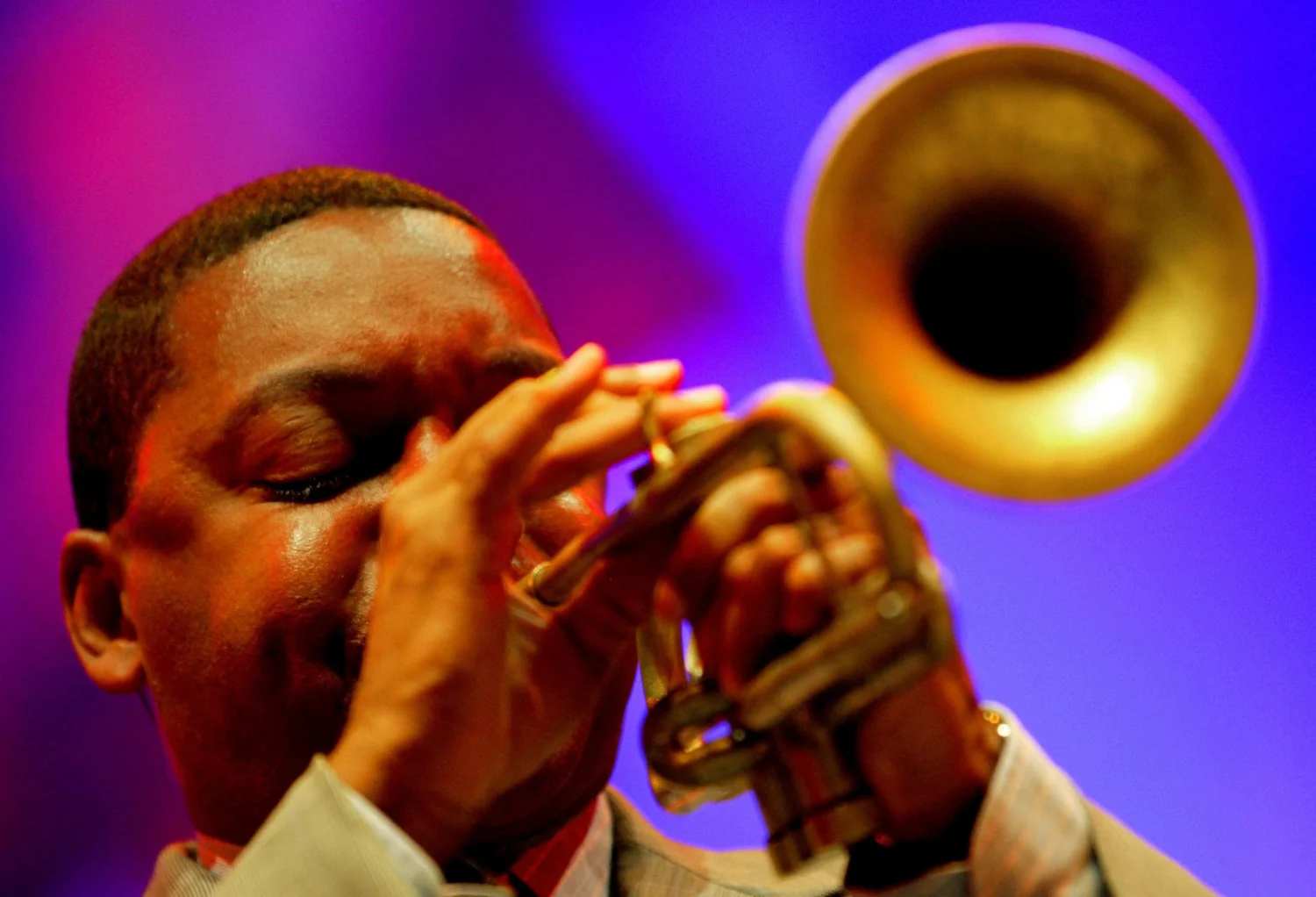
Jazz is often celebrated for its unique form of soulful expression, but it’s a little-known fact that the genre had a diplomatic dimension across borders. U.S. jazz has worked its way into the world’s diverse communities, evolving itself and reshaping musical genres along the way.
Judi Yassin (JY): Welcome to CR Amplified, the Cairo Review’s podcast, where we talk to experts and policy makers about relevant issues on the world stage. I’m Judi Yassin. Today, we’re going to be talking about U.S. jazz diplomacy with Professor James Ketterer.
Professor Ketterer is a senior fellow at the Bard Center for Civic Engagement. He’s worked in Egypt and the U.S. on government development and public diplomacy initiatives. And he’s also a jazz drummer with the Arch Stanton Quartet.
Hello, Professor Ketterer.
Professor James Ketterer (Ketterer): Hello, and good morning. It’s nice to be here.
JY: Thank you. It’s lovely to have you. So first, I wanted to begin by asking what were the origins of jazz diplomacy?
Ketterer: Yeah, let me just take a little step back and put it in the broader context of the use of culture as a diplomatic tool. So when people think about diplomacy, they think of the stereotypical diplomat, somebody who may be a group of men in gray suits who are at a conference room table in Geneva, Switzerland, or some such place, and they’re negotiating a treaty. And that, of course, is part of diplomacy, and that does happen. But that’s not really what happens day to day in diplomacy.
There are many other facets, many other things that go on and one of them is a component of diplomacy called public diplomacy. And this is not just the United States, these are many, many ministries of foreign affairs, the U.S. State Department. This is how countries kind of project their culture as a component of how they present themselves to the world and as their diplomatic initiatives.
So within that context, some people call it soft power, some people say public diplomacy, but it’s all the same thing. And so the use of jazz in particular really started as a diplomatic tool following World War II. And immediately following World War II, the U.S. entered into the Cold War, this competition, this ideological and geostrategic competition with the Soviet Union.
But it was also a competition about ideas and culture and influence. And so in the midst of those times, in the late 1940s into the 1950s, you also saw that many countries were becoming independent for the first time in a long time. They were throwing off the yoke of colonial oppression. They were becoming independent and then there was this Cold War competition between the Soviets and the Americans to influence them.
The Soviets would say to many of those countries, “You can’t listen to the Americans. You can’t trust the Americans because look at how they treat their own people. Look at how they treat African Americans. And, you know, you should come to the Soviet side and not the American side of this Cold War struggle.”
So there was a member of the U.S. Congress at the time. His name was Adam Clayton Powell, Jr. and he represented a neighborhood in New York City called Harlem, a very famous neighborhood and a center of African American culture. And Congressman Powell said, well, you know, they’re not wrong about some of those issues, but they’re not telling the whole story.
And the whole story is much more complex. It’s much more nuanced, and it’s a rich story to tell. And particularly, it was an outgrowth, this rich story to tell, of something called the Harlem Renaissance, which was books and music and dance and such a flowering of African American culture in the 20th century.
He said “Why don’t we use jazz as a cultural diplomatic tool to show more of this nuanced picture of the American experience and the African American experience around the world, not to deny that there were problems, but to just show the whole picture and the whole context.”
So it started in that way. And it was starting at the same time that the American civil rights movement was really getting going and African Americans were seeking their rights that had been denied to them for so very long.
So all of this was coming together at the same time, late 40s, early 50s, and then the program really got going into the mid 50s and beyond, the jazz diplomacy program.
JY: You mentioned that part of the Soviet criticism was that African Americans are not treated with equality in the US. Do you think jazz was chosen as a representation of American democratic ideals for the music itself or more for the people who actually played the music, the musicians?
Ketterer: That’s a great question, because I think the answer, I’ll give you one of those academic answers that is not very satisfying. And that’s kind of both and it depends.
The nature of the music itself really does embody a democratic ethos, a democratic spirit in many ways. And that’s because of the way the music is constructed. So European inspired classical music, orchestral music, musicians are reading the notes on the page and they’re performing a piece of music based upon exactly what is written on the page. Now they can interpret it in different ways and they can play it well, not well, somewhere in between. But the notes on the page is really the game.
In jazz, it’s something really quite different because the musicians have the structure of a song that they agree upon. They agree upon the speed of the song, the chord progressions of the song, all of the elements of the infrastructure of this song. But once they’ve agreed upon that, then when they’re playing the song, every musician in the group gets an opportunity to take a solo, to play music that’s not written on a page, that is improvised. So this idea of improvising something and speaking musically something that’s your voice is seen as really like a musical conversation.
So the idea that you’d have this conversation of musicians between the musicians, among the musicians, and then between the band and the audience was seen by many as something that really represented this idea of equality and having a voice amidst other voices.
Now to the second part of your question, not just the music, but the people who were playing the music. So the people who were chosen to be really the initial stars of this jazz diplomacy program truly were stars. People like Duke Ellington, who had a band before World War II and then after World War II, he really transformed into a very, very sophisticated and well-known composer of music and really one of the great composers, not just American composers and not just jazz, one of the great composers of the 20th century.
Other people like Dizzy Gillespie, a trumpet player, Dave Brubeck and his quartet, but the really big star of this was Louis Armstrong.And the choosing of these people also intersected with the Civil Rights Movement and this question of the status of African Americans.
And then the question that they had to answer for themselves, and I try to answer in my exploration of this topic, is how could some of these African American musicians who are the best musicians at this art form and are American, how could they represent the United States and the United States government around the world on these official tours, while at the same time, in many cases, they and other African Americans being treated as second-class citizens at home? So the tension between this kind of superstar, ambassador-level musician and second-class citizen at home is a massive tension point that I think people like Louis Armstrong answered it not by being a traditional diplomat, but he answered it as a musical diplomat.
JY: Do you think this tension that you mentioned weakened the message abroad and how people perceived it, or do you think it made it more genuine?
Ketterer: I think it made it more genuine, and that gets to the heart of one of the elements of jazz diplomacy. Just as a side note, in my own experience in working in international development and diplomacy, I worked for a very famous ambassador, and he was very famous in the field of public diplomacy and soft power. And he would say to us all the time, “We have to tell the whole story. We have to tell the authentic story,” and he would say, quoting the name of an old but very good movie, “We have to tell the good, the bad, and the ugly, because if we don’t say that, no one’s going to believe us because it’s just going to be propaganda. They’re going to know we’re not telling the whole story.”
And I think this is good diplomacy in general of any type, but it’s also exactly what someone like Louis Armstrong did, and when he would tour the world, he would present some music that would really, through the music and through the lyrics of what he was singing, would tell this story. There was one song in particular, a song that was written by Fats Waller and some others in the 1920s, and he would sing it in the 50s and the 60s, and this song is called, “What Did I Do to Be So Black and Blue?” And the lyrics are very poignant, very compelling, lyrics like, “I’m white inside, but that don’t help my case because I can’t hide what’s in my face, the sin is in my skin.”
And those kinds of lyrics are incredibly powerful, and then if you imagine he’s doing that as part of an official U.S. government tour, I think that combination, it answers your question that it makes it more powerful, it takes it on as authentic, and it shows the good, the bad, and the ugly.
JY: And do you think, from your personal perspective, these jazz diplomacy programs, do you think they were generally successful in what they aimed to achieve initially?
Ketterer: Well, yes, I do think they were successful. I think one of the challenges of the whole field of public diplomacy is how to define success and how to measure that success. So if one were to say, and some people do say this about public diplomacy, well, we need to see immediate quantitative measures of this success and the support of American interests or American policies. And by the way, any Ministry of Foreign Affairs who is doing this kind of thing, you could fill in the blanks, so not just the Americans, it could be the British or the Swedish or the Egyptians or whatever, any of these diplomatic initiatives. How do you measure success? How do you define it?
And I think if it’s defined too narrowly and with too immediate results that are expected, it’s not going to be seen as successful. I think you can’t expect that if jazz musicians would go around the world and they would suddenly convince somebody to policy X, Y, or Z. But I don’t think that was ever really the intention.
I think the intention with any of these public diplomacy programs is to just give people a deeper understanding of a culture, of a society, of a people, and to find some contact points and some entry points that are something different than things that are kind of seen as traditionally diplomatic, which can be, I think, very exclusive and off-putting. I can give you a specific story about just one, I would say, outcome. We can decide for ourselves if it’s a success or not.
But I was giving a talk about jazz diplomacy many years ago in California, and when we got to the question-and-answer period, there was an older man in the back who stood up, and he said, “Well, I don’t have a question, but I have a comment.” And I usually brace myself when someone says that because it could be that nothing good is going to come. But what he said was actually quite good.
He said that Duke Ellington, who we were talking about, came to his city when he was very young. And he said, you know, “I didn’t know who Duke Ellington was. I didn’t know what jazz was. I didn’t know what the United States was. I just knew that something exciting was happening in my city, and I wanted to go.” But his parents didn’t have the resources to buy a ticket, so he didn’t go. But he and his friends went down to the football stadium, and they looked through the fence, and he said, “This music that I heard was so different, was so otherworldly, was so kind of wild and free,” that it really captured his imagination.
And he went home and told his parents, and they said, “Well, you know, you could maybe go down to the American library.” And so he did, and they gave him some books, and they piqued his interest, And eventually he moved to the U.S. to go to get his Ph.D., and he got married in the U.S., and he has a family in the U.S. and a life in the U.S. So, you know, is that a success? Is it not a success?
I mean, I think it’s just an interesting connection, and it’s something that he felt, you know, Duke Ellington is not the one who ended up convincing him to get a Ph.D. in his field all those years later, but it just piqued his interest, and it made him think, “There’s something interesting here, and I should explore more.” And for me, that’s the definition of long-term but tangible success of a public diplomacy program. The city that he was in, he didn’t say, and I asked him, was Isfahan, Iran.
And so I just think that the whole thing really adds up to a really compelling story.
JY: I think it’s interesting that you framed it through one story, because it is a very human thing, music, and it is difficult to measure it on a diplomatic sort of scale.
Ketterer: Yes.
JY: But you are also a jazz drummer. So I wanted to ask, what drew you initially to jazz, and what sparked your interest in its diplomatic capacity?
Ketterer: So my parents are musicians. My father has passed away, but he was a drummer, and he played other instruments, and he was a music educator, and my mother is a singer. And so I grew up with lots of music around me, and I grew up in a world where people were playing music, and they had connections to lots of other people who were playing music, and there was always good music playing in the house. And so I was just kind of immersed in that kind of a situation, which was a good way to kind of just feel like I had access to lots of different musical ideas. Like nobody was saying you should only like this kind or this kind or this kind, or, you know, it was pretty wide open. So I think that was an initial spark to it.
And I, you know, like a lot of little kids in school, I started taking music lessons and progressed through the years and played in the school bands and then other bands, and then eventually when I was in high school, different kinds of bands that my friends and I put together. And then I had a big decision to make as I was finishing high school. Was I going to go to music conservatory, or was I going to go to quote-unquote normal university?
I chose the latter, but I never stopped playing music. I never stopped taking lessons. I never stopped, you know, thinking about ways to not just listen to music, which is very important for me, but also to be involved in music in a variety of different ways.
And so over the last few years, I’ve had the good fortune to be involved in a band that I started, but it’s truly a gathering of like minds. It’s not like it’s not my band, it’s a collective. It’s a quartet called the Arch Stanton Quartet, and we’ve been together since 2009. This is a band that, by the way, came to Egypt and played in the Cairo Jazz Festival.
I wasn’t playing drums at that time because I was already in Egypt. I was working for Amideast, which is an educational, cultural American NGO, and worked with the U.S. Embassy, and we brought them to the Cairo Jazz Festival. But since I’ve been back from Egypt, I’ve rejoined the band and done lots and lots of performances with them. And, you know, it’s really over the last year, we’ve gotten a new grant to do a new piece of music that is based on the writings and the music of the author and composer Paul Bowles, who lived in Morocco for many years and who I met briefly when I lived in Morocco.
So that’s been a nice kind of personal connection to, you know, the Middle East and North Africa and to jazz and to me and to my life.
In terms of the diplomacy part of it, you know, I’ve worked in that area myself, and I really just encountered it in a variety of ways. I knew vaguely that these kinds of jazz diplomacy tours had happened, because there’s lots of old albums called the Jazz Ambassadors and things like that. But I started to do more research and to really dig into it, like, well, how was this constructed? Why was it constructed? How did it work? All the kinds of questions that we’re talking about today, you know, did it really work? Was it really valuable?
And so I just did, you know, some kind of old-fashioned research on it to dig into the topic and learn more about it. And the more I dug into it, the more I found that there’s a lot of interesting stuff, because what I knew about was more what’s happening now. I mean, it still happens in a different way than it happened in the past, but it’s still happening.
But I didn’t know enough about the origins of this and the kind of really famous points of people like Armstrong and Ellington and others. So it was a combination of my own musical playing and then, you know, academic research and put them together. And I’ve given versions of jazz diplomacy talks in many different parts of the world, and I’ve really enjoyed the way that people engage on the topic. When they hear these two words together, I think they’re often baffled. What does this really mean, jazz and diplomacy? And so I’m happy to talk to them about what it really means and how it really worked.
JY: Do you think that your own connection and experience with jazz affects the way you reflect on this jazz diplomacy era?
Ketterer: I think so. I mean, I think maybe, you know, I have a bias toward it. It’s the kind of music that I like, but it’s also the kind of music that I know.
And so, you know, when I’m discussing certain musicians, certain eras of music or something, it’s something I feel quite comfortable with because I know it not just through study, but I know it through actual playing it and being a practitioner. So I think that combination can be a good combination in many cases. I also know it in terms of having done it.
I mean, when I was a dean here at AUC, we also brought two bands for the 2022 Cairo Jazz Festival. But we put them on the road, and we went to Alexandria, we played there, we did workshops, we did jam sessions, they did media appearances, all kinds of things. And they did some of those things here at AUC, and it was really a very powerful experience.
And I was able to kind of interact with the whole experience. You know, I was a dean at AUC, and we had this grant from the U.S. Embassy to do it. But at the same time, I’m a musician, and we’re working with these musicians, and, you know, we’re trying to make this tour work in a way that’s going to be good for them because they’re also going to go home and be ambassadors of the experience.
JY: Is this sort of global exchange that you mentioned now what you mean when you say that jazz diplomacy is a two-way street?
Ketterer: It is. It is. I mean, I think both kind of in the movement of ideas and musical ideas, it’s a two-way street. I mean, people like Duke Ellington and Dave Brubeck, who we’re mentioning, they were sending their music around the world as they toured, but they were bringing music home. The radio programs and other musicians listening to touring musicians and radio programs, absorbing it around the world. You know, maybe two-way street is too limited, maybe it’s a multi-way street.
And I think that that has had this cumulative effect over time, and it’s been really powerful. And so, you know, jazz can be defined, I think, in a very narrow way by some people who are, like, purists about the music. I tend to not do that and not want to do that. I think a broad definition of it is really ideal because it’s inclusive of all these other traditions, all these other kinds of things that are happening, and it allows for the evolution of the art form over time, which is what we have seen.
It’s also, though, in kind of, like, very pure technical aspects of diplomacy, it’s a two-way street. So if we just look at the U.S. government and their diplomatic initiatives, over time they weren’t just sending musicians around the world, but they were taking musicians from around the world and bringing them to the States.
JY: I wanted to ask, when these jazz musicians traveled abroad, how did the exposure to these cultures affect the music that they came back with to the U.S.?
Ketterer: Yeah, that I think is something that turned out to be a really interesting outcome of this jazz diplomacy program. I don’t think that the people who initially designed the program had this in mind as an additional benefit, but it certainly was one in a big way.
And so, you know, if you send great musicians of any type, but including great jazz musicians around the world, their ears are open. They’re listening to different sounds in different places and different harmonies and different rhythms and different traditions in music, and this would affect the music that they would compose and that they would play.
And, you know, these were the days before any Internet or anything like that, the days before Spotify or anything like that. So the way that music would be shared would be on the radio, and there was a very famous jazz radio program on Voice of America. But also just in putting together recorded music, in these cases on vinyl albums, and selling them. And those albums would come back to the American public, who otherwise would have no idea what music in Egypt sounds like or music in Turkey or music in South Africa or what have you.
And so someone like Duke Ellington, this great composer I was telling you about, he took a very famous tour in 1963 and then recorded a whole album based upon the sounds that he heard in that tour. It’s called The Far East Suite. It’s really based on most of their time they were in the Middle East. And there’s all kinds of rhythms and traditions and harmonies in that album that are definitely drawn from their time in the Middle East.
The tour was cut short in 1963 because President John Kennedy was assassinated. But up until that point, they had been on the road for many, many weeks, and when they weren’t performing on stage, they were jamming with other musicians, meeting other musicians, listening to albums in those places, and it was a really profound effect.
So it affected the music that the American musicians were making and what they were bringing home to an American audience. And somebody like the Dave Brubeck Quartet, they had songs that were very popular on the radio that had Turkish rhythms in them and South Pacific rhythms in them that Americans had just never heard.
JY: And do you think that it worked the other way round as well, as in, did the countries that these jazz diplomats go to, do you think they were affected by their exposure to U.S. jazz?
Ketterer: Yes, for sure. And you can still see evidence of that today around the world and certainly in Cairo. And so, as I said, there was this radio program, this very famous radio program, and the person who was the head of the program, the voice of the program, his name was Willis Conover, and Voice of America would beam their signal in a time when everybody, you know, it was either TV or radio, but a lot of people were listening to radio because television was still very expensive. There was no Internet, there was no anything else like that. And so this radio station was going around the world, and there were musicians around the world listening to it.
So, you know, they would see some of these groups come through on the tours, they would hear the radio, then they would start to buy some albums, and they would develop their own version of jazz.
So it wasn’t just saying, OK, let’s play American jazz and let’s have it be exactly the same way that the American musicians are playing it. What really happened, and what continues to happen, and I think makes it such a much more interesting and rich musical and cultural experience, is that it intertwined with the cultural traditions of that place.
And so, like, at this time of our conversation right now, for instance, the Cairo Jazz Festival is going on. It’s one of the great jazz festivals in the world, and one of the things that I love so much about the Cairo Jazz Festival is that it draws in musicians from around the world, but also musicians here in Egypt who have gone through exactly that process that we’re talking about.
So when you hear a band of Egyptian jazz musicians, what I think is so fantastic is they’re great musicians, they’re world-class musicians, they are deeply aware of the American tradition of jazz, but they have, over time, they and people around the world, have turned it into a truly global art form.
JY: Right. I mean, you had a hand in these initiatives in Cairo and the U.S., but, I mean, back then, these musicians or ambassadors had to actually travel to these countries to spread the values. But today, in the digital era, this isn’t really necessary. I mean, the Internet is a huge form of diplomacy in itself.
So what forms do you think jazz diplomacy, or actually any kind of cultural diplomacy, takes online today?
Ketterer: Yeah, so there you’ve touched on something that’s really a great area of debate and conversation behind closed doors and the people who plan diplomatic programs and cultural diplomacy programs. And to say like, well, you know, everything’s online, it costs a lot of money, takes a lot of time to put a band on an airplane and bring them to another country and put them on a physical tour around a place.
And so, you know, the online component is, of course, great. I mean, people can access all kinds of music on their phones. You know, you can look up anything and within five seconds you’ve got that piece of music. It can be brand new, it can be very old of any genre of music. So that’s, you know, that’s a great convenience.
But what I think has been comforting to me for somebody who’s been around for a while and has worried about how will technology affect these sorts of things, is that we can see that there is still a great interest in live performance. People want to see musicians, they want to be in the same space when musicians are performing their music.
And I think that’s especially powerful when the music is improvised. When you’re seeing something, when somebody’s improvising a piece of music and they’re playing what’s in their minds and in their hearts as a musical expression, you’re hearing something that hasn’t existed even the night before and won’t exist the night after. This is the one singular performance. The one you’re seeing is unique. And so there’s something really compelling to that experience.
And you can see it when the performances happen and that there are good crowds. Good in both size, but also quality; people are really interacting and they’re seeking that kind of connection of being in the same space at the same time.
Now you were also kind of asking about another thing too, and like, why jazz? Is jazz still the most relevant thing to do? And of course there’s so many other genres of music and ones that overlap with jazz and ones that are really quite different from jazz. And they also can have a real cultural diplomatic value.
What I think I’ve focused on in this particular one that tells an interesting story, I think, is that jazz started off as a kind of uniquely American art form. And it was presented to the world initially at a time when the U.S. was looking for something to present that was uniquely American and that reflected something positive about the American spirit and experience. Even though it was the good, the bad, and the ugly, there was good in there to present.
And so that’s why I’m focused on jazz, but now there’s many different kinds of music that are used as diplomatic tools, and appropriately so.
JY: Right, I think jazz is a very unique genre of music in general.
Ketterer: Yeah, I would also say that when you say to people the word jazz, different people have different conceptions of what that might be.
In many cases they might say, I just have no idea what that is. In other cases what they think it is is a very kind of narrow definition of it that is probably not reflective of a much broader kind of music.
And so one of the things that I always like to do as, you know, putting together these kinds of programs, but also as a musician as well, is to present the music to people who don’t really know or they know just a little piece and they maybe know something that’s not quite accurate, and to open their eyes and open their ears to something that’s brand new. And hopefully they will say, “Oh, I didn’t know that’s what it was. I like that. I want to hear more of that. I want to hear something more that’s like that, and other bands that do that.” And to me that’s an enormous success and an enormous victory.
JY: What side of jazz do you think people overlook that you try to exhibit?
Ketterer: That it draws in so many different traditions and cultures and different kinds of sounds. I think, in some cases, younger people, what they might think about in jazz is maybe like an old movie clip that they saw from, you know, way back when, decades old, or maybe some albums or some music that their parents or grandparents had. And they haven’t encountered the things that are happening right now. Musicians their age, who are encountering this music and making it their own and presenting it to people their age.
And that, you know, sometimes you have to take an extra step to find that. It’s not as kind of obvious in popular culture as some other kinds of music. But when you do, I think more times than not, people are really engaged by the music. They really like it and they’re really intrigued.
JY: I think that’s a lovely note to end on. That concludes the episode of CR Amplified on U.S. Jazz Diplomacy. I’d like to thank Professor Ketterer for his thoughtful insights and for taking the time to speak to me. Thank you so much.
Ketterer: Thank you for having me.
JY: That’s it. Thanks for tuning in.