
Faith That Peace Will One Day Come
Former United States president and architect of the Camp David Accords Jimmy Carter discusses the 1978 conference that changed the Middle East and the prospects for peace today.
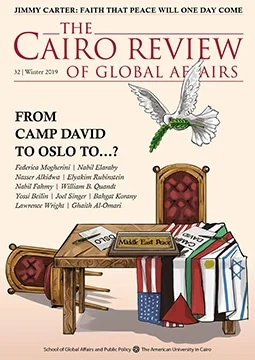
Former United States president and architect of the Camp David Accords Jimmy Carter discusses the 1978 conference that changed the Middle East and the prospects for peace today.
How Cairo views efforts at reforming United Nations’ peacekeeping, especially in the Middle East and Africa.
Activist and former advisor to the PLO negotiating team Diana Buttu discusses what she calls the death of Oslo and her hopes for a radical new future
Hassan Asfour, senior Oslo-era negotiator for the Palestine Liberation Organization, discusses why the Oslo Accords were doomed and the next step: declaring an independent Palestinian nation
He crafted the post-Oslo consensus, overhauled the economy, and mastered the Knesset. Now the kingdom he built wants its keys back
The European Union’s High Representative for Foreign Affairs and Security Policy Federica Mogherini asserts that the Oslo and Camp David Accords must be complemented by the realization of a two-state solution for the Palestinian–Israeli conflict in order to secure a lasting peace for the Middle East.
Peace did not prevail because certain ambiguous provisions contained in the Camp David Accords enabled Israel to deliberately evade its obligations and frustrate the entire peace process
An insider Israeli view on the personalities and ideas that drove the history-making Camp David Accords
How the Camp David Accords became a limited Egyptian–Israeli peace effort that ultimately transformed Arab–Israeli relations across the Middle East
Parsing the successes of the Israeli–Egyptian peace treaty against the failure of Camp David’s other framework agreement sheds light on the pillars of a successful security relationship, and the unique sticking points of the Palestinian–Israeli conflict
After forty years, the Camp David summit continues to be the seminal shaper of the modern Middle East. However, it was an effort fraught with challenges for the peacemakers that could have resulted in its collapse
On the atmosphere, negotiating style, and mistakes made at Camp David
For twenty-five years since the Oslo Agreement, Palestinian–Israeli negotiations have been characterized by a starkly uneven power dynamic. To reach a final solution, today’s negotiators must commit to leveling the playing field
Former Palestinian foreign minister Nasser Alkidwa takes a closer look at the strengths and weaknesses of the Oslo Accords, the lessons learned, and the way forward
What we have learned from the Oslo Accords needs to influence a future agreement so that a lasting Camp David-like peace can be reached between Israelis and Palestinians
How the Camp David Accords, as well as a little-known series of negotiations called the “Autonomy Talks,” came to serve as the basis for Palestinian self-rule during the Oslo negotiations
With the two-state solution on life support, it’s time to revisit solutions once discarded as radical—namely, the one-state option
After the PLO suffered a legitimacy crisis in the early 1990s, the organization was forced to survive by entering the Oslo talks. Despite initial success, it has since endured failures
Former United States president and architect of the Camp David Accords Jimmy Carter discusses the 1978 conference that changed the Middle East and the prospects for peace today.
How did the insiders and diplomats who witnessed the Camp David proceedings experience those events?
In a speech which may have policy implications for the Trump Administration’s Middle East policy, the United States Secretary of State Mike Pompeo lays out plans for the region at the American University in Cairo.
Fauda, Netflix’s hit TV series on Israeli undercover operatives in Palestine, presents Palestinian and Israeli characters that have nuanced emotions and desires; yet the show still otherizes Arabs and justifies Israel’s actions in the West Bank and Gaza.