Of Bombs and Regime Change: Experts Weigh the Israel-U.S. Strategy on Iran
Both the Americans and Israelis have for decades sought to topple the Islamic Republic. With Khamenei assassinated by Israeli bombing, is the end game near?
The United States and Israel bombed Iran on February 28 following another round of talks on Iran’s nuclear program, which Omani mediators said was close to an agreement.
In the opening salvo, U.S. President Donald Trump announced that Iran had walked away from a deal and that his country and Israel were coordinating attacks to prevent Iran from rebuilding its nuclear program.
“For these reasons, the United States military is undertaking a massive and ongoing operation to prevent this very wicked, radical dictatorship from threatening America and our core national security interests. We’re going to destroy their missiles and raze their missile industry to the ground. It will be totally again obliterated. We’re going to annihilate their navy[…] They will never have a nuclear weapon.”
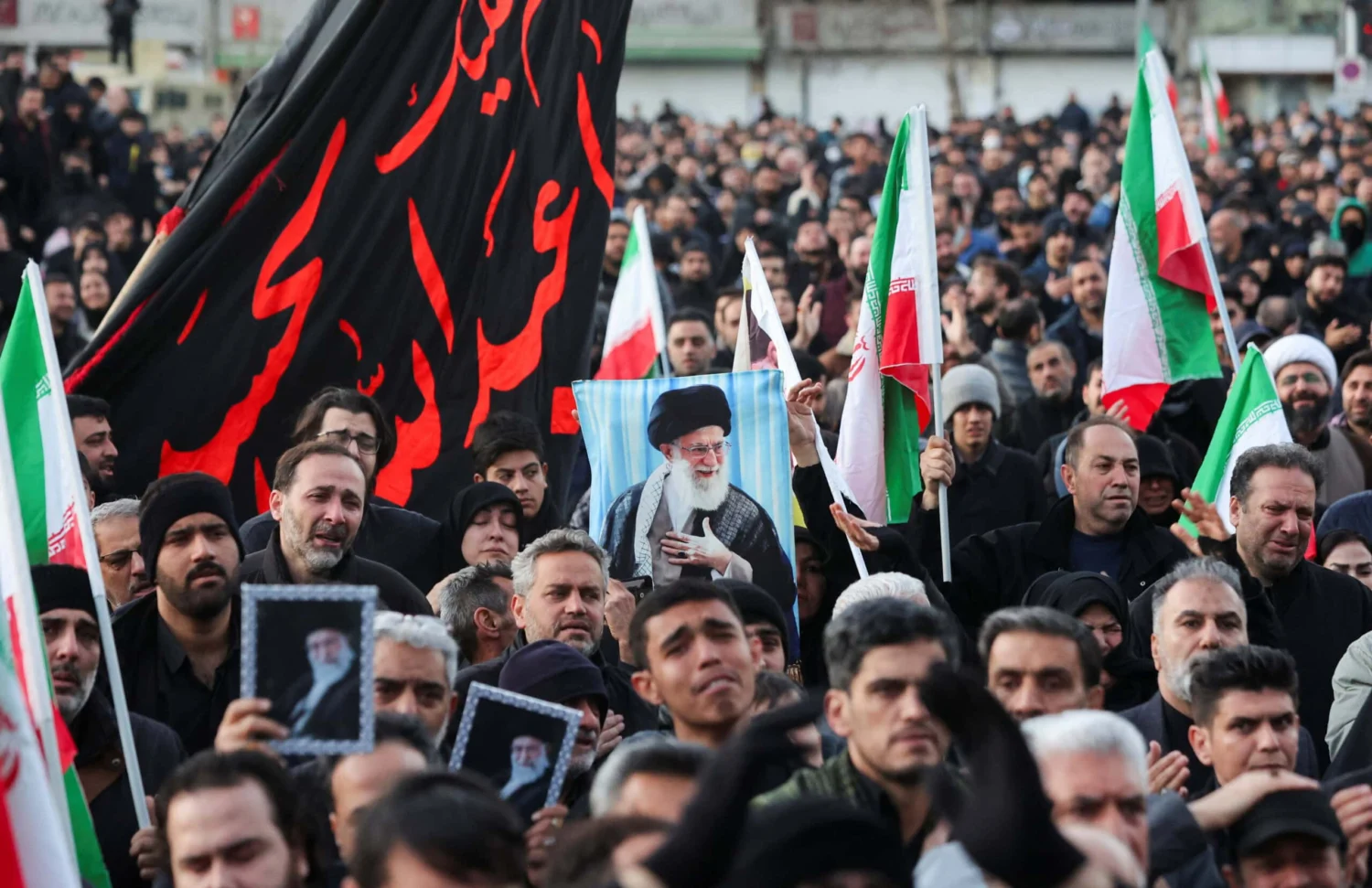
However, less than 24 hours after Iran responded with attacks on Israel and Bahrain, Kuwait, Qatar, and the UAE, all of whom host U.S. military bases. The attacks killed Supreme Leader Ayatollah Ali Khamenei and at least forty other Iranian officials.
In contrast to the U.S. attacks on Iran in July, which had a limited goal of compelling Iran into a ceasefire with Israel during the twelve day war, these recent “major combat operations” appear to have a much broader goal: cause regime change in Iran without the deployment of U.S. troops in the country.
We asked Cairo Review contributors for their opinion on Trump’s goals, whether they can be achieved, and what the future holds for Iran and its people.
Political scientist, author, and professor emeritus in the Department of Politics at the University of Virginia.
This is Trump’s war entirely, with encouragement from Netanyahu. There has been no open debate in Congress, little real discussion in the media, and Trump spent only three minutes in his recent lengthy State of the Union speech to the American people on the crisis with Iran.
In short, all we can do is look at the list of things he has said: No nuclear weapons for Iran. No enrichment of uranium for Iran. No missiles for Iran. And, most importantly, the regime should be overthrown—but not by sending American soldiers into Iran. In short, he wants a military conflict like the twelve day war in 2025, but with a much more ambitious outcome. This strikes me as not only impossible to achieve, but also not in America’s national interest.
Finally, we were in negotiations with Iran which seemed to be making progress, so this attack was totally unnecessary. However, Trump loves to be unpredictable, and we will just have to hope that he and his pathetically ill-informed advisers come to their senses. He may even calculate that this will help his party in the upcoming midterm elections. He is quite likely wrong on that point.
Iranian journalist and media studies researcher with a master’s degree in political journalism from Columbia University
This war of aggression against Iran has communicated to bad actors that disregarding international law can be affordable, and depending on who violates the law, accountability may never be required. Even if the war ends right now, every actor in the conflict has already lost the race for principles. The Iranian government’s authoritarianism has dragged it into this abyss. The U.S. government has failed the Iranian people through decades of onerous sanctions that have strangulated them. Meanwhile, the Israeli regime has now added Iranians to its list of expendable civilians.
It is almost impossible to try to foretell the ramifications, but it’s abundantly clear, both from historical precedent and the emerging signs, that what will ensue from this period of chaos will not be self-determination for the people of Iran. They have already been ex-communicated and do not have a say in what’s happening to them and their future, so it’s highly unlikely that a thriving, fully-functioning democracy will be the outcome of this campaign of violence.
Paris-based Middle East advisor, non-resident fellow at the Arab Gulf States Institute, and a Sultan Qaboos Cultural Center research fellow for 2025-26
The attacks on Iran by the United States and Israel appear designed to support regime change in Iran. Though the Supreme Leader has been killed, much uncertainty remains as to whether the Islamic Republic will be a less—and not more—dangerous actor in the region and globally. Gulf countries, which are close partners and allies of the United States, remain on the front line of regional shifts involving Iran and have suffered alarming attacks and disruptions stemming from Iranian retaliation. These governments will seek to be critical inputs for Washington as the Trump administration clarifies its objectives going forward in this fast-moving situation.
Senior fellow at the Middle East Institute
With President Trump, the end goal could be a moving target: he has declared regime change as an official end goal, but might downgrade that goal to a ceasefire followed by a deal if the war drags on and proves too costly.
Senior visiting fellow at the German Marshall Fund and a senior fellow for International Security and Geopolitics at the Hague Centre for Strategic Studies
For weeks now, it has been a question of when—not if—the U.S would attack Iran. Once again, under the fog of ongoing negotiations, the United States and Israel struck Iran. It seems there was never a deal to be had, casting another blow to the credibility of U.S. diplomacy. With the assassination of Iran’s Supreme Leader Ayatollah Ali Khamanei, the United States and Israel will achieve the sought leadership change in Tehran. Less certain is whether the desired regime change will follow.
Middle East security and nuclear policy specialist at Princeton University and former spokesman for Iran in its nuclear negotiations with the European Union (2003-2005)
As of now, most countries around the world believe that the military attack by the United States and Israel constitutes a clear violation of the UN Charter and the norms and regulations of international law.
In 2018, the United States undermined a UNSC-Resolution 2231 by withdrawing from the JCPOA; in 2025-2026, through direct military strikes against Iran, it has been accused of violating core principles of the UN Charter, particularly those related to sovereignty, the prohibition of the use of force, and non-interference in internal affairs of other countries.
According to Oman’s foreign minister, both the U.S.–Israeli military strike on Iran in June 2025 and the subsequent attack in February 2026 occurred at moments when negotiations had reportedly achieved significant progress. As Oman served as a mediator, this statement implies that Washington bombed diplomacy at critical junctures. From this perspective, diplomacy has effectively been placed in the critical care unit, perhaps for an indefinite period, as many countries now believe that the negotiations were conducted not as a genuine path to compromise but as a strategic instrument.
The consequences of assassinating Ayatollah Khamenei could go beyond the killing of a head of state. He was one of the leading religious authorities (marajiʿ) in the Shiite world, and the U.S. action could be interpreted as a declaration of war against Shiite religious authorities. Consequently, some Shiite clerics have already issued fatwas of jihad and have called on Muslims around the world to avenge the assassination of Ayatollah Khamenei by targeting the United States and Israel. Attacks have taken place against U.S. diplomatic missions in Pakistan and Iraq, and dozens of Shiites have been killed or injured. Washington must therefore be concerned about a long-term ideological hostility from religious Shiites across the globe.
The collapse of the government in Iran as a result of military attack is not a simple matter. Even assuming that the United States and Israel succeed in bringing about regime change, they would still be the losers. Because:
- For the first time since World War II, the most important U.S. military bases have come under attack—a reputational blow to the United States’s prestige far greater than the hostage-taking of American diplomats in Iran.
- Israel and Iran have entered an existential phase of conflict. Iran has sustained severe military blows, while Israel has faced the most intense military attacks on its territory since World War II. Iran’s heavy missile strikes against Israel have exposed the fragility of Israel’s military and security structures.
Following the assassination of Iran’s leader, within less than 48 hours a three-member leadership council was formed in accordance with the constitution, and the next leader of Iran will be appointed by the Assembly of Experts.
With the second U.S. and Israeli military attack, several significant and troubling developments have occurred. First, by assassinating Iran’s leader, the United States crossed a red line of Iran’s current system of governance. Second, the United States officially declared that its objective is the collapse of the Iranian government; therefore, Iran’s response is framed as a defense of its very existence. Third, it was already clear that the conflict would become regional—which it has—and Iran has launched missile attacks against U.S. facilities in the region.
Ultimately, it would be better for President Trump to take the initiative for an immediate ceasefire in order to prevent further catastrophes.