Internet Influencers and the Far-Right—with Dr. Scott Burnett: CR Amplified ep. 8
Judi Yassin (JY): Welcome to CR Amplified, the Cairo Review‘s podcast where we talk to experts and policymakers about relevant issues on the world stage. I’m Judi Yassin. Today we’re going to be talking about gendered fascism in the contemporary world with Dr. Scott Burnett. Dr. Burnett is an assistant professor of African Studies and Women’s, Gender, and Sexuality Studies at Pennsylvania State University. He was the lead investigator and organizer of the “Birthing the Nation” seminar, which focused on gender, sex, and reproduction in ethnonationalist imaginaries. He’s produced substantial research on masculinism in the white supremacist alt-right online.
Hello, Dr. Burnett. Thank you so much for taking the time.
Dr. Scott Burnett: Thanks so much, Judy.
JY: My first question would be, in your “Birthing the Nation” project, you describe a kind of crisis of modernity that you said is “particularly felt by men”. Can you unpack what that means a bit—the crisis—and why you think it’s more felt by men in this age?
Burnett: That’s a really good question. One of the things that we’ve been exploring is how to think about the historical material basis for the rise of fascism—for when people, at least in the West, seem to hold onto their masculinity and their nation in what we might think of as a profoundly problematic or even pathological way.
One of the historical parallels between our current moment and the 1920s and 30s in Western Europe is a profound social change associated both with social progress and with economic crisis. What we know about the beginning of the 20th century is that there were the suffragette movements, women were getting the vote, and women were working more and more visible in public life. More visible in popular culture, driving cars, doing things that were breaking some of the 19th-century assumptions about what women could and couldn’t do. You then have that combined with the profound economic crisis of the late 20s, and that creates a particular situation for men and for masculinity.
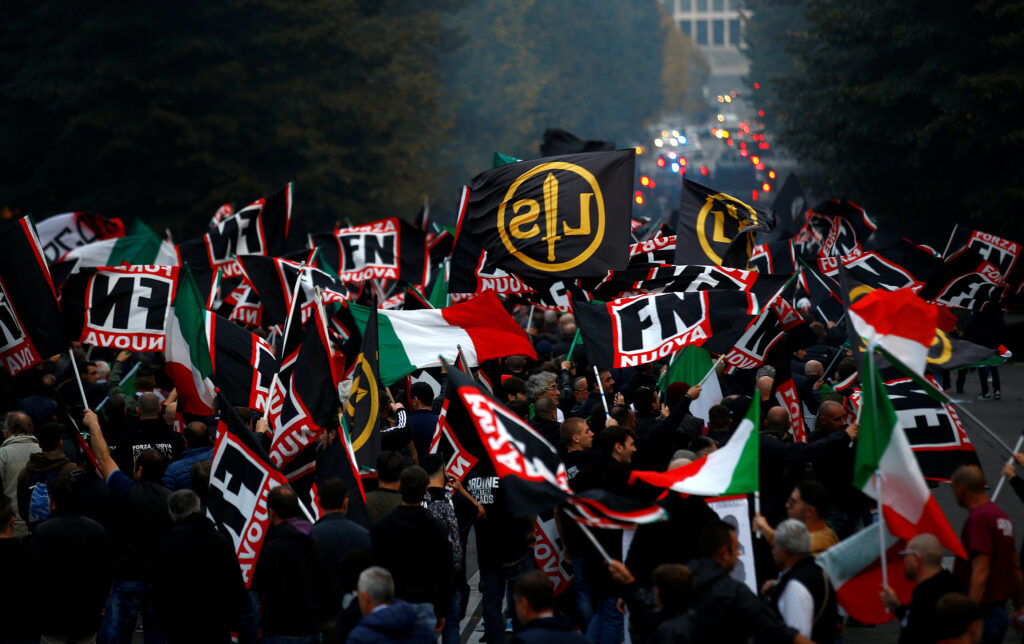
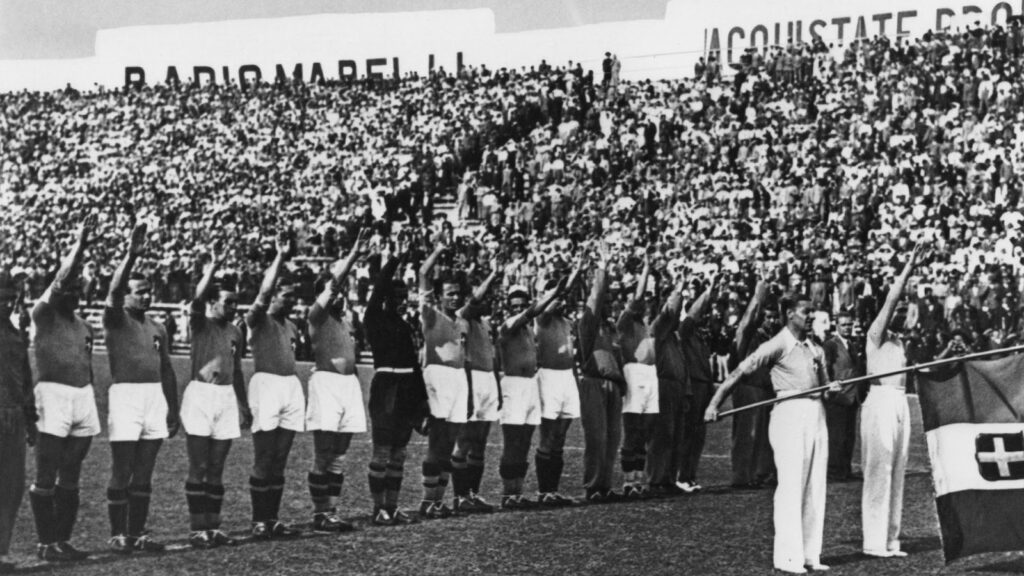
Of course, Italian fascism was already in full swing from the early 20s. Mussolini was responding to a great extent to what became constructed as the feminizing influences of socialism and feminism. Mussolini was a socialist before he invented fascism and the need for a hard, masculine force to oppose those influences in society. What he was able to do was turn his former socialist comrades into the scapegoats for a feeling of national malaise—a feeling of not having done well in the First World War, being looked down upon, having lost territory, etc. All of these things he was able to give a gendered reading to.
What the early 20th-century fascists were able to do is read the economic and political climate and give it a gendered meaning. Essentially, that women were too powerful, that modernity had given us these masculinized women and feminized men. And that everything wrong in our society is because these eternal boundaries of maleness and femaleness were being violated by feminism and socialism. So we need to be strong again; we need to collect ourselves together in a way that is hard, virile, and masculine.
There’s also been quite a lot of work on proto-Nazism in Germany in the 1920s. There are very famous books by a writer named Klaus Theweleit, whose doctoral dissertation in the late 70s focused on the post-World War I vigilante commando groups that emerged in Germany. Very similar to what was going on in Italy, they were going around smashing socialists, committing terrible acts of violence, using the Weimar period in Germany as an incubation for what was to become Nazism and what Adolf Hitler was able to turn into the Third Reich.
So that crisis of modernity in the early 20th century was felt very much as a crisis of masculinity. We see almost exactly the same ideas being recycled in the present day, of course with many differences. It’s not necessarily that women are working in factories and driving cars; it’s that women of color are rising to positions of cultural and political prominence. It’s that the assumptions about race, gender, and the societal order built around white men have been undermined. They’ve lost their assumption of hegemony. That, again, is combined with economic crisis and what has happened because of globalization, neoliberal policymaking, and the erosion of the welfare state. The West again is moving into this moment of crisis.
The crisis is also different this time around because we’ve got the ecological crisis, demands for equality, and demands for a new world order coming from a multipolar world system. So a lot is different, but there are a lot of things in common between this early 21st century and the early 20th century.
JY: You mentioned the economic crisis and the political climate that this gendered fascism thrives in. Do you think that gendered fascism is generally, historically and today, a feature of certain economic and political circumstances?
Burnett: I think it can be read in that way. I don’t think it’s necessarily so predictable; it’s not that we know exactly what is going to cause this. Of course, these ideas never really went away. And they didn’t necessarily start in the early 20th century. One of the things we were exploring with scholars at our recent conference were the 17th-century roots of some of these ideas. One of our speakers talked about the idea of the nation as a kind of body, and of the marriage bed as where the nation is produced.
The regulation of reproduction as being central to national development even existed in supposedly a pre-national age, before the big age of nationalism in the 19th century. There were early liberal thinkers, people like John Locke, republican thinkers who were trying to think about what a country should look like if it’s not monarchical.
From the earliest days, some of those ideas were using gendered relationships as the foundational building blocks for what the nation should be in a proto-nationalist way. The idea that you should have racially pure or, you know, English women and English men creating English children, and that that is the foundation for Englishness, goes back hundreds of years. Or German women and German men. Even before there was a Germany—Prussian women and Prussian men.
So it’s something that’s been there in these European—and of course then more broadly in the settler-colonial—worlds where white nations have taken root on stolen land. It becomes fascist because it becomes about reproducing the race, enforcing that through violence, and denying democratic processes whenever they threaten to change that very fragile unity of the identical heterosexual couple creating the nation from the marriage bed.
JY: And to that point, I think you highlight the way that fascist and ethnonationalist imaginaries often center around this idea of controlling women’s bodies, to put it simply. Can you elaborate a bit on that point?
Burnett: I’ll go to the early 20th century because there’s some interesting stuff that goes on there. Some of the earliest fascists in the UK, Sweden, the Netherlands, and Italy—and of course the word “fascist” was from Italy, though people were taking inspiration elsewhere like Spain—some of the earliest people that got involved were women, and some of the early suffragettes even got involved. Which is one of the interesting paradoxes of the supposed crisis of masculinity: in the early days, women were just as convinced that there was a gendered crisis.
Some of those women had been fighting for women’s rights. What they were getting out of fascism, as a number of researchers have shown, was increased access to reproductive healthcare, including child care, better postpartum care, and a number of social programs that were implemented, for example, in Italy. Fascism is always balancing this pro-natal idea—that you should be supported in having children, which takes women’s work very seriously—with the obverse of that, which is that women need to be controlled. They can’t be having sex with “the others” because then they’re not going to have racially pure children.
That control of women’s bodies is sometimes also conflated into a proud and ardent motherliness, which some women throughout history have found very attractive. We see that in the various women’s brigades of fascism and the important leadership role many early fascist women played.
And we see it today in the “Tradwives.” We see it in the way that, for example, in the MAGA movement, you’ve got prominent female leaders playing a role of saying, “As a woman, I know what my role is.” Whether that role is to be aggressively motherly—a grizzly bear mom with a rifle—ultimately it’s still about a particular kind of control of what motherhood should be.
Within fascist imaginaries, you get both the ardent, passionate protector of children and the home sphere, and then you get the very soft, feminine TradWife where everything is lace and flouncy blouses. My colleague Cat Tibaldi has written extensively about the way that side makes itself soft; everything has to be articulated around an aesthetic of softness. Whereas the more martial, grizzly, motherly figures are also present within fascist and ethnonational imaginaries.
JY: Understanding this modern gendered fascism as a recurring pattern in history, there’s a very clear difference between fascism in the 20th century and now, which is new media and the internet. That seems to be a central feature of the modern version of this phenomenon. How do you see new media shaping contemporary far-right or fascist movements?
Burnett: One of the members of our seminar who has explored this extensively is Professor Ico Maly at Tilburg University in the Netherlands, and he presented recently at our conference. So what I’m going to say is to a large extent the version that Ico has been studying.
The internet was an absolute godsend for the right. It has provided exactly the kinds of media affordances and business models the right can use to gain the social prominence it now has. That’s not to say the internet is essentially right-wing; it just means they’ve been good at exploiting the full power of the internet.
After that period of social change that climaxed around 1968 with the student revolts in Western Europe, there was a sense that the right had lost. They’d lost youth culture and the mainstream — they’ve lost the arguments. A group of intellectuals on the French New Right, including Alain de Benoist and Guillaume Faye, started thinking of a way to bring the right back to prominence not necessarily through politics, but what they called metapolitics. The idea was that we need to influence culture; we need to become the edgy people who can capture the attention of the intellectuals.
De Benoist was convinced they should focus only on high art and philosophy. And that they should put all their energy into that sort of high-minded pursuits, whereas Faye was a lot more tactical and willing to exploit whichever trend there was; it didn’t need to be super intellectual. It was ultimately Guillaume Faye’s approach that has been taken up by so many right-wing influencers in Europe and the US. The idea is that you need to do anything to capture the attention of taste-makers and opinion-makers. It’s less about ideological purity and more about the spectacle of a right-wing culture that is unafraid to say exactly what it thinks—to be racist, to be sexist, to be funny, to be ridiculous, to put itself on display in ways that perhaps traditional political movements would not do.
They’ve been extremely effective at advancing an ideological spectacle online—on YouTube, Twitter, Gab, and Parler—that gets people angry and gets their attention. That’s why some of them call themselves “edgelords.” Even when they’re testing the limits of what is sayable, they don’t really care whether or not they’re being ideologically pure; they care about getting us angry, getting us to pay attention, getting more clicks, likes, and views.
People in the public sphere that we now take for granted—from Stefan Molyneux to Jordan B. Peterson to The Golden One, to slightly more centrist guys like Joe Rogan—all of them are part of a similar media ecology. A particular model of the influencer comes to prominence, they build their own media brands, and they are completely supported in that through platform capitalism. They’re able to make money out of their ideological work.
Essentially, De Benoist and Guillaume Faye have been proven right. Acolytes in Generation Identity and ultimately the Steve Bannons and Richard Spencers of this world imbibed those ideas and they make them relevant to the local concept. They’ve been proven right that if you can achieve a cultural shift, it will translate into a political shift. People will start to think differently, vote differently, act differently if you can shift the culture. And arguably, the response of the democratic establishment to these movements has not been very effective in actually understanding their strategies and working to fight them.
JY: Can you talk to me a bit about what kinds of ethos and narratives these figures actually spread, and what effects are observed in real-life society out of these narratives?
Burnett: A key idea—and I want to cite a colleague who’s currently in Berlin who just moved from Colombia , Aya Labanieh, who just wrote a fantastic paper about self-help—is the centrality of neoliberal discourses of personal development to what is happening in these gendered spaces. One of the really clever things in the world of online influence is that right-wing influencers appeal to our anxieties about being people, being strong men, successful men, good women, good mothers, whatever it might be.
They use the neoliberal atomization of society. Neoliberal thinking, which gained institutional heft in the 1970s, sees the sovereign individual as being at the core of a model of what the world could look like. They don’t really believe in society, social bonds, solidarity, or social structure. They’re all about individuals competing with each other on markets.
So the principle of neoliberalism separates people out and undercuts any notion of a structural argument. Under this logic, it’s not good enough to say, “I am a working-class person and I am being exploited by capitalists.” That doesn’t make sense to them. You must just work harder. The reason you don’t earn a salary is because you’re not grinding enough. You need to work harder, you need to get XY and Z. Critique at the level of social structure is completely invalidated. As motivational speakers like to say, the bad news is it’s your fault, and the good news is that it’s your fault—because if it’s your fault, you can do something about it. So neoliberalism appeal so the sense that you are individual in competition with other individuals and your future is in your hands now goo and make yourself a success.
Neoliberalism channels any kind of social critique we might have about gender, racial, or class inequality into this narrow idea of “it’s your fault, you do something about it.” So, guys, go and work out in the gym. You might feel out of control of your life but it’s okay you can be strong. You can achieve your financial goals, invest in crypto, and start your own business. And you can become a crypto billionaire overnight like me. And you can do it if you follow my advice. That’s the paradox of self-help: I am thinking of myself as an individual who is totally in control of my life, while relying on you to tell me what to do.
It is this very interesting kind of tension where you get given this recipe for how to be a real man or a real woman. It typically involves what to eat, what to say, your posture, how much to work out, which books to read. They’re all about these lists of things that you absolutely have to do. And one of those things is that you’re supposed to abstain from masturbation; you’re not supposed to watch porn. Not all of them follow this. But the whole idea is, if you can get a whole generation of young people online following your instructions, you are creating your own political force and ideological center around these essentialistic, individualistic, and violent notions of what men and women should be.
JY: Do you think that attracting specifically young men is particularly important for these figures, and why do you think these online environments can be so effective at doing so?
Burnett: Because in a neoliberal world where we’re constantly looking for ways to overcome the anxieties we have around succeeding as atomized individuals, we will go to the internet for advice and help you wouldn’t necessarily ask a friend . When bonds of family, class solidarity, or social justice are eroded, we go to the internet to find ways of dealing with our anxiety without necessarily making ourselves vulnerable to other people—except the influencer whose advice you’re going to take.
Adolescence is a time of anxiety. It’s a time of coming into yourself, thinking about what you want to be. It’s also a time when your body is changing. In so many cultures, we have these very strong normative notions of what our bodies should look like, how much sex we should be having or not having, how much we should be masturbating, what our genitalia should look like, or hair should look like, or what our body structure should look like. Or whatever it is, but we’ve got these very very strong normative notions of what the gendered body looks like that can be very difficult to deal with as an adolescent.
So I think young men are absolutely crucial to this movement. That’s why you find that some of the guys who are into Andrew Tate are 11 or 12 years old. It’s a time of immense anxiety, and you’re enjoying this idea that there is this guy out there who presents himself as super wealthy, super strong [totally bizzare], who understands your anxiety and is looking out for you. He’s going to tell you how to become rich, how to not let women control you, how to drive that sports car and not give a damn about anybody else.
Young men, their anxiety but also their energy and idealism. Young people are passionate about political questions and get involved in movements to drive social change. They drive new ideas. They might not care about voting or stuff like that but they will go out there and they will make ideas happe.They will live their politics. And the other side of these things is that politics starts to live you. If you’re following a recipe for practices—eating the food, working out in the way you’re told—your practices become the ideology that you are putting out into the world and reproducing, as my colleague Melody Dev presented at the conference. You not only believe it cognitively, but you embody it completely.
JY: From what you’re saying, it seems like the idea of worship figures or role models is a big part of this contemporary gendered fascism scope. I did want to ask about the obsessive fixation on sexual frustration and abstaining from masturbation. What effect do these ideas have psychologically on the people exposed to them?
Burnett: Well, there are significant downsides to always believing that it is your fault and your behavior that lies at the root of your inability to achieve. There’s been some research done by Dr. Nicole Prause in California on NoFap forums. She did a survey I think. She found that a relapse event—when you start masturbating again—is often associated with very bad affect, like suicidal ideation, self-blame, thinking of self-harm.
I’m not a psychologist, but I do think there is a real danger in constantly looking for the reasons for your individual success or failure only within yourself. We are fundamentally social creatures; human civilization is about collectives working together. Not everything is in your control. Believing that you can be this Übermensch figure totally in charge of your sex life and financial life is the path to depression and disappointment. It’s not a sustainable way to live your life. And it’s also very alienating, because we’re only appreciating other people as points of likeness or unlikeness to an essential notion of gender.
“Are you a real man? I don’t want to be a beta cuck. I don’t want to be a ‘coomer'”—which is a word they use to describe somebody who is weak, sitting behind their computer ejaculating too much. The idea is you’re losing all of your masculine energy to these nebulous forces on the internet, all of these fake girls, watching the woman you want to have real sex with having sex with someone else or more than one person, or black people, often a racial other. Your personal failure is wound up in your inability to have sex with that particular porn star.
It taps into a very real thing, because people are sitting behind their computer screens masturbating. So it’s true, that does happen. What’s clever about NoFap is that it takes a real issue—where people feel down on themselves because they haven’t left the house all day, in the dark just watching porn or whatever—and turns it into a political motivation. It turns into a story about how they want you to be weak. They want you to not want you to have sex with real women. It’s given a fascist interpretation, a racist interpretation, and in certain instances an antisemitic interpretation where the idea is that Jewish people control the porn companies and mainstream media, they control or degenerate culture and they want you behind the computer screen weak and not having real sex that would result in white men so you don’t produce white babies.
But there are versions of this that have nothing to do with whiteness. There are versions in African-American grind culture, in Persian men’s forums, in the Arabic world versions of this. Everybody has their own ideological articulation of why it’s important that you not waste your sexual energy on masturbation and porn because some dark social force wants you to do that. What you instead need to do is go outside and have real sex with real women.
JY: That was actually going to be my next question about how scholars have described the online manosphere diversifying with the participation of people of color as well. How does that intersectionality complicate the narrative?
Burnett: From the earliest days I started looking at NoFap, it’s always been multiracial. It was never only about white men. It’s more fundamentally about grind culture, personal improvement, and being all the man that you can be. I even found women on NoFap, and broadly queer, and sex workers publishing erotic content who think NoFap helps them meet their personal goals. Some of these ideas have a very broad application.
Where it gets to the specifically racist and fascist sides of things, we know that’s not only the preserve of Western European white people. In the context of India, there is a thriving, muscular Hindu nationalism—a real-world political phenomenon in Hindutva—that is fascist. It is about breaking opposition, opposing democracy, and opposing a racial other in terms of the Muslim, as constructed in BJP propaganda. Colleagues of mine at Penn State, Aparna Parikh and Hazel Velasco Palacios, have been working on these ideas.
It is not necessarily white people. The interesting thing about Hindutva is they are using the imperial structure of the British state and historical distinctions between fair and darker skin, including caste-based hatred, as a means to implement their racialized view of the world. Another colleague, Samrat Sharma, showed that there are some Hijra people in India who use their performance of a particular Hindu national feeling as a way to achieve social advancement. It’s built like fascism and looks like Western fascism, except it’s got its own local peculiarities.
So it doesn’t always have to be about whiteness, although to a certain extent, whiteness is the pattern being followed. The colonial domination of the planet during the colonial era gave white people an unprecedented opportunity to model these forms of repressive politics. But it’s definitely not all about white nations.
JY: Dr. Burnett, you are from South Africa. You grew up there during the latter stages of the apartheid era. I wanted to ask how that experience affects the way you view modern gendered fascism, or modern fascism in general.
Burnett: I think so. When I started my doctoral work in 2015 at the University of the Witwatersrand in Johannesburg, I was looking at environmental discourses from a critical whiteness studies perspective. Growing up in the transition under the first democratic administration from 1994, I was always anti-racist. But I’ve only really come to appreciate 10 years later the extent to which what we had in South Africa is just one instantiation of a much bigger problem around the world.
The problem is based on a particular model of where value comes from: turning nature into a commodity and turning other people into commodities. The logic of capitalism starts treating the energy you get from another person to do work for you as your right to exploit—whether through chattel slavery, indentured labor, or industrial capitalism in the factories. The people who can do that supposedly earned the right to live wonderful lives because they are “more rational” or “more moral.” And anybody unable to achieve that is supposedly lacking innate ability or not trying hard enough.
It’s these overlapping systems of colonialism, capitalism, and hierarchizing humanity through race or gender. What we’ve seen in the United States is that gains in racial equity and gender equity are at the surface level; they can be so easily undone. There is so much popular sentiment in a country like this—still a white-majority country—that would just happily sweep all of that away.
I’m busy writing a paper about white liberals in South Africa. When someone’s a white liberal there, it doesn’t mean they are left-wing; it just means they hold liberal values. You see deep ideologies of, “I’ve earned my wealth, I’ve earned my property, I’ve earned my position in society. And anybody who tries to tell me I haven’t earned that is dangerous, violent, stupid.” Every bad thing a person could be is attributed to the person who tells me I haven’t earned my social standing as a white person.
JY: That’s all the questions I have for you today, Dr. Burnett. I’m very pleased with our conversation. Thank you so much for taking the time to speak with me.
Burnett: Of course. It’s my great pleasure. It’s lovely speaking to you, Judy. Thank you, and best of luck putting this together.
JY: That concludes this episode of CR Amplified on gendered fascism in the contemporary world. I’d like to thank Dr. Burnett for his thoughtful insights and for taking the time to speak with me.
That’s all. Thanks for tuning in.
Cruel Capitalism and the Rise of the Right—with Dr. AJ Bauer and Dr. Paula Chakravartty: CR Amplified ep. 7
Judi Yassin (JY): Welcome to CR Amplified, the Cairo Review‘s podcast where we talk to experts and policymakers about relevant issues on the world stage. I’m Judi Yassin.
Today we’re joined by Dr. AJ Bauer and Dr. Paula Chakravartty, who will be discussing their recent forum on media and fascism. Dr. Bauer is an assistant professor in the Department of Journalism and Creative Media at the University of Alabama. His essays have appeared in outlets like The Guardian, American Journalism, and The New Inquiry.
Dr. Chakravartty is the James Weldon Johnson Associate Professor at the Gallatin School and the Department of Media, Culture, and Communication at New York University. She has written several books on media and politics and is the editor of the journal Communication, Culture, and Critique.
The forum that will be discussed in this episode was published in Communication, Culture, and Critique in June of this year and features several articles on the relationship between media and fascism in the US today.
Hello, Dr. Bauer and Dr. Chakravartty. First, I’d just like to begin by asking you to give me a bit of background on the forum itself.
Dr. Paula Chakravartty: Do you want me to start, AJ?
Dr. AJ Bauer: Yeah, you can get started since you started, and I can add.
Chakravartty: So yes, we formed a new editorial collective to guide the objectives of the journal Communication, Culture, and Critique, which was set up in September of last academic year—September 2024. From the beginning, the idea was to use forums to address more topical concerns of the day. More pressing, urgent kinds of concerns that are harder to address through the peer-review structure, which takes much longer.
One of the first things we did in the journal was—I think we’re the first journal, as far as I know, in our field that published a solidarity statement on the genocide in Gaza. That was in our first issue. We also in that first issue had a discussion thinking about comparative authoritarianism and the media, which AJ actually edited, since AJ is a scholar of media on the right in the US. That was a conversation that AJ facilitated with Srirupa Roy, who’s an editorial collective member who works on India, and Verónica Gago, who’s also an editorial collective member who works on Argentina. That was looking more at the political facet of the rise of right-wing authoritarianism and the relationship between media and right-wing populist politics.
We felt that there was a need to also talk about the political-economic dimensions of the rise of the right, specifically thinking about the election of Donald Trump this year. It feels like it’s been many years already, but in fact just this year. And so this second forum was a more focused attempt to think about the political-economic context of media and authoritarianism, the rise of the right in the US, specifically around the elections of November of 2024. So that’s the background, and we brought together an interdisciplinary range of scholars to address a range of issues, and we can talk more about that. AJ, you should add whatever I missed.
Bauer: Yeah. And so another part of the forum that we tried to do was focus on the experiences of communities who are particularly affected by the incoming, and now Trump, regime. So, we’ve got a couple of contributors that are focusing on Trump’s rhetoric and policies around transgender people, as well as immigrants, migrants, and other folks who are facing undue pressure at the moment. The journal is obviously communication and cultural studies, so there are some pieces that are kind of about media strategy as well, but we were trying to be deliberate about prioritizing populations that are feeling the brunt even more than the rest of us perhaps at the Trump administration.
JY: I did want to ask about Trump’s role in all of this because he does come up a lot in the articles in the forum. So I wanted to ask why he is such a strong representation of far-right leanings that we’re seeing almost everywhere now.
Bauer: I think one of the things that is so interesting about Trump is his willingness to push against norms and other kinds of cultural and political expectations. I think that his doing so, obviously in the US context, is undermining our democratic institutions in a way that is really problematic and probably will be irreversible or very difficult to reverse. But I think that a lot of other leaders around the world see in him a kind of a license. They can then point to him and say, “Hey, I can violate norms or institutions here too if Trump can do it,” and vice versa.
I also think that Trump has been, perhaps even more so than previous US presidents, willing to look at other examples of right-authoritarian leaders across the globe and get inspiration. A lot of what he’s been doing to crack down on universities in the United States, for example, draws really heavily from a playbook that was developed by Viktor Orbán in Hungary. A lot of his anti-migrant policies and the kind of bombing of boats off the coast of Venezuela—using warfare methods to target drug cartels, etc.—in some ways borrows from the Duterte regime in the Philippines, who is no longer in power but nevertheless is an inspiration to Trump. And so I think it kind of cuts both ways: Trump is a form of license for a lot of right-wing authoritarians across the globe, but he’s also drawing from their example as well.
Chakravartty: Yeah. And I would just add that for us, the focus is on Trump because the journal itself is a global journal, but many of us are based in the US academy. The International Communication Association, which hosts the journal, is based in the US. But I think more importantly, we have to think of the US’s role as an imperial force and think about Trump, and the rise of Trump, in the global context—not just in relation to other figures like Trump, you know, Modi or Bolsonaro, etc.
We have to think about the role of the US, which certainly under different iterations of liberalism also practiced kinds of authoritarian and extrajudicial violence in the Global South. But there is something now, when we see perhaps the decline of certain forms of American legitimacy and American imperialism in the world, you see the rawness of this overt power and overt violence, which is something that is worth noting and worth thinking through. And so the focus on Trump and the focus on the US is not just a national question, it speaks to the broader geopolitics of American imperial power, which precedes Trump and will last us post-Trump.
There are many things about the Trump regime that are exceptional, but the focus of thinking about the politics of the moment is to also situate it in longer lineages where you’ve had these contradictions between American commitments to democracy, freedom of information, and liberalism on the one hand, and yet its exercise of brute power and violence both within the US against subjugated minority communities, but also against much of the world—the global majority in Asia, Africa, Latin America, and what we call the Middle East. So that’s another reason why we focus on Trump.
JY: Can you talk to me a bit about specifically his use of alternative media, social media, new media during both of his electoral campaigns?
Bauer: Yeah. So, in some regards, this is somewhat of an older phenomenon. There’s been a long history in the US of presidents and others running for president using new and other forms of alternative media to get around the mainstream press. A good historical example of this is the Roosevelt administration during the New Deal. Most of the newspapers were opposed to the New Deal, and so Franklin Roosevelt went on the air with his famous fireside chats on the radio to speak directly to the American people.
I think that you could see Trump’s use of social media, especially Twitter, as kind of similar. Especially when he ran in 2015 into 2016, he wasn’t taken all that seriously. There were conservatives within the conservative movement who opposed him. That was the short-lived “Never Trump” phenomenon, which lingers on in The Bulwark today, which is a center-right, formerly neoconservative Weekly Standard that’s converted into a more liberal-friendly outlet. But Trump, because he was seen as unserious and volatile and a threat to American traditions and norms, had to use those kind of alternative media in order to reach his followers.
I think what you saw—and Reece Peck writes about this in our forum—is that one of the things Trump did in 2015-16 was rely heavily on podcasts and alternative right-wing influencers to get his voice across. To the point that by 2020 and 2024, when he was running for president again, he was able to go back to the well, basically. He had already developed a relationship with those podcasters, with those audiences. This partly explains why somebody like Kamala Harris, who did try to employ alternative media and podcasts in the 2024 election, didn’t quite land, according to Peck. She was relatively new to those audiences and hadn’t spent the time cultivating that relationship.
Sometimes when we think about media, we tend to think about it in a very old-fashioned, unidirectional way—a hypodermic needle model—that people simply passively consume whatever media it is. So the idea is that if Trump is on alternative media, the people listening are simply buying and consuming it. But it’s really important to think about the role of alternative media and that it creates a distinction between the media people are consuming and some other media. “Alternative” means there’s some legacy or mainstream media it’s referring to. The benefit of right-wing media that Trump capitalized on was not just that there were right-wing media outlets. It was also that there is what I call a “critical disposition” toward the mainstream press that causes those conservatives to invest in right-wing outlets, trust them more, and be skeptical of those mainstream outlets which might have been critical of Trump. You don’t have exactly that same dynamic among liberals in the United States, which is one reason why Harris didn’t have quite the same ability to leverage those newer platforms.
Chakravartty: Yeah. And I would just add on the alternative media: one of the other dimensions of this is, of course, the role of Big Tech in shaping the rise of the Trump agenda, especially this second time around. This is something that Johan Farkas and Aurélien Mondon address in their article called “The Roots of Reactionary Tech Oligarchy and the Need for Radical Democratic Alternatives,” and we address this a little bit in our intro essay as well.
They look at the seeming disparity between a tech industry that, through the 1990s and the first two decades of this century, has been aligned with more socially liberal causes. You’ll remember the role of many tech companies lining up after the George Floyd assassination calling for racial justice, standing up for things like abortion rights or immigration rights. Those same tech companies now transmute into a cultural right-wing, authoritarian stance. They trace how you get from one to the other, and I think this has a lot to do with the political-economic structure of the tech industry, which has been allowed to expand into all dimensions of our lives in a way that is unregulated, and very dangerous for democracy.
The agreement between a liberal order and a neoliberal tech oligarchy that seemed to hold in a reasonable way—which, of course, had a lot of inequalities and violence that we didn’t see as clearly as we see today—gave way to this neoliberal and authoritarian present that we’re in. It’s important to trace how you don’t have this exceptional turn into an authoritarian present, but increasingly from the 1990s, the lack of regulation, the lack of public say over what these tech companies can do within the US and transnationally has led us to this moment where increasingly around the world, democratic orders are threatened by Big Tech. So that’s an important part of the story to trace as well.
JY: I wanted to actually discuss that article that you’re mentioning now a bit more in depth. I mean, is that what is meant when the article says what it calls “liberal post-democracy” has given rise to this kind of authoritarian system, especially with regards to tech?
Chakravartty: We’re speaking to you at the Cairo Review, so we can think about the moment of the Arab Uprisings and Tahrir Square, and this moment in which there were wild assumptions about the role of corporate Big Tech in shaping our democratic futures. As I’m sure you know, Tahrir Square and the Arab Uprisings were often called things like the “Facebook Revolution.” In many parts of the world, not just in the Middle East but in the Global South, there is an assumption—often advertised and heightened by these corporate actors themselves—that corporate technology allows democratic freedom against state authoritarian power.
While there is some truth in terms of certain contexts like 2011 that allowed for grassroots movements, and student movements, and labor movements, to rise up and use these platforms at a certain juncture, it isn’t the technology itself or the benevolence of these tech companies that leads to democratic outcomes. As we saw in the Arab world, that period was followed by mass repression, and that repression was also accepted happily by the big tech companies who had supposedly gifted that part of the world with democracy and revolution.
What the authors argue in this paper—and something critical scholars of tech for decades have been warning us about—is that this promise of liberalism as a gift that Big Tech holds for us despite it circumvents any kind of regulatory effort and institutional checks to its power, nationally and internationally. The arguments that critics have made for decades are playing out today. You see a kind of neoliberal enclosure where one of the things you can’t democratically discuss is the regulation of tech itself. You can’t talk about our political-economic futures; those things are cordoned off. That cordoning off leads to more autocratic futures. In fact, it’s not a future anymore; it’s the present. So that’s the lineage that this article and I think other work that takes a more critical position on tech has laid out. Yeah, it seems counterintuitive in a world where, for decades, certain social actors promoted the idea that freedom is technological freedom. We have to do a lot of work to rethink the assumptions of that formulation. I am sure AJ has more to add.
Bauer: Yeah. And I think another thing these more critical approaches are doing is pulling back from the abstract and idealized ways we’ve tended to talk about the internet and social media in the last 20 years. They’re getting back to: what are the balance of forces and how does that shape the way tech functions? When we’re talking about Twitter today, we’re not talking about the same Twitter that existed in 2016 or 2011 during the Arab Spring or Occupy Wall Street. You see increasing collaboration between platforms and authoritarian governments, as well as the development of alternative internets with firewalls in places like China or Russia that block users or makes friction from these liberatory technologies.
Another thing you see, especially since Donald Trump won the presidency in 2016, is an uptick of what I call a “mis- and disinformation paradigm.” The dominant narrative was that the reason he won, the reason Brexit happened, was the circulation of disinformation tricking people into voting against their interests. As a result, tech companies like Facebook, Meta, Google, and Twitter started adding safeguards to prevent the spread of hate speech and disinformation. There was a considerable backlash to that by 2019/2020 and as we continued today. A lot of those platforms felt burned. After Biden won in 2020, there was a series of right-wing tech growths—platforms like Parler, Gettr, and Truth Social—which is the Donald Trump endorsed today . The creation of those alternative apps created additional pressure on the mainstream omnibus apps to re-platform right-wing actors and to scale back their disinformation regulations.
Especially once Trump won again, now they’re all wanting to curry favor with him. It’s important to talk about where the rubber meets the road. As Paula mentioned, the US is not effectively engaging in any regulation of the tech sector, including mergers and acquisitions. As a result, the sector is more concerned with preventing the government from regulating them, and so will line up with any politician, right or left, that’s willing to give them what they want.
JY: The opening article of the forum, the one that was written by you, mentions Elon Musk—also an interesting dimension. So can you talk to me a bit about how he plays into this environment?
Chakravartty: I feel like you have more to say probably about Elon Musk than I do, AJ, but I guess I would say that to me, the racial dimension here is important. The title of our essay is called “Cruel Capitalism,” and for me, this was a play off of the idea of “cool capitalism,” an argument made by economic sociologists Luc Boltanski and Ève Chiapello in a book called The New Spirit of Capitalism. It was tracking the way corporations went from being top-down organizations to embracing critiques of the 1960s student movements. Corporations transformed, and CEOs emerged not as button-down corporate patriarchs, but as “cool capitalists.” They reinvented their image as passionate entrepreneurs.
What we see today with the merging of a fascist politics and a tech entrepreneurial culture is the revelation that these cool capitalists are actually cruel capitalists. Underneath these socially progressive transformations of capital, you have a history where promoters of a neoliberal economic future have always embraced arguments of social Darwinism and eugenics—notions that certain people are wealthy because they are more capable, and certain people end up poor not because of social systems, but having to do with innate qualities based on repackaged notions of racial hierarchy, gender differences, and nationality.
So the fact that you have a white South African immigrant who embraces the Trump agenda and wields that “chainsaw” that we talk about—the chainsaw which is representative of cutting down the Amazonian rainforest and decimating Indigenous peoples of Brazil and Argentina—is not accidental. The settler-colonial histories of countries like Brazil, Argentina, the US, South Africa, and Israel come to the fore in the world these cruel capitalists imagine. Elon Musk, the richest man in the universe, is a great representative of that cruelty and violence we see on display every day.
Bauer: Yeah. And I think one of the fun things about putting this piece together is Paula was coming at it from the “cruel capitalism” perspective, but I was thinking about Lauren Berlant’s Cruel Optimism. I think Elon Musk sits right at the edge of these two concepts nicely, which is why we led with him. Plus, he was involved in a massive cost-cutting initiative he called DOGE, named after his favorite cryptocurrency.
Cruel Optimism is this idea that capitalism provides optimism about the benefits of meritocracy, or in Musk’s case, this science fiction utopic vision of the best and brightest coming together without government regulation to create a mission to Mars. The reason Musk had been so celebrated even among liberals was because of this utopic vision and positive outcomes for humanity. But these utopic visions also involve a valorization of hierarchy, which speaks to the racialization Paula was talking about. It posits hierarchies where the “capable” people are rewarded, and we won’t say much about the other folks.
We also wanted to emphasize that even for the people “benefiting” from the fascism promoted by Trump and Musk, the benefits are actually inhibiting their human flourishing. The government scaling back funds for healthcare and SNAP benefits, or the harassment of immigrants picked up by ICE—these authoritarian crackdowns provide a televisual experience for Trump supporters that allows them to feel pleasure at the “bad” people suffering and the “good” people thriving. But those processes, like the militarization of the US, are going to come back and bite the people celebrating them. They are also going to be victims of an authoritarian country that has the capacity to police at scale. The benefit is fleeting—it might be a salve on top of the authoritarianism that comes for us all in the end.
Chakravartty: One thing I would just add is that many of our articles also imagine more radical democratic futures. The authors in our collection are doing something the Democratic Party in this country is not doing—like Zohran Mamdani and the left side of the party—which is imagining a normative worldview that is oppositional and antithetical to this horrendous, cruel, and limiting understanding of politics.
Naomi Paik’s piece on “abolitionist sanctuary” makes an important case connecting the George Floyd uprisings to the movement for immigrant justice. The opposite to criminalizing migrants based on racist assumptions about “good” versus “bad” migrants is not to say we should be deporting immigrants who committed a minor infraction like getting a parking ticket or being late on a child support payment. The solution is not separating the good from the bad migrant or criminalizing certain groups. She makes a compelling case for an abolitionist sanctuary. We have to see this moment today as a reactionary moment that came in the aftermath of uprisings—beginning with the Arab Uprisings, which was an anti-colonial uprising, and continuing globally against racial hierarchies and economic inequality. Presenting a normative vision for a democratic vision that is more radical than the confines that we live in, I think, is also important, and several of our articles try and do that.
JY: One of the interesting things was the article discussing the underrepresentation of Christian Zionism in US media. So I wanted to ask about how that fits into this overarching theme of contemporary fascism.
Bauer: Yeah, for sure. The contribution by Gil Hochberg is pointing out that a lot of the focus on Zionism in the US and globally is focused on Israel. But a really important component of global Zionism is Christian Zionism and its support for the Israeli state, with peculiar and, one could say, antisemitic assumptions underwriting it. A lot of Christian Zionists want Jewish folks to be in control in the Middle East partly because they think that the rebuilding of a Second Temple will initiate the end of the world. It’s an idea that, in the midterm, is supportive of a Jewish state in Israel, but ultimately towards Jesus coming back and, in that philosophy, Jewish folks presumably being cast into hellfire.
Zionism as a project is promoted in advance because the state of Israel has been successful at getting funds from the United States to engage in its settler-colonial project in Palestine by convincing these Christian Zionists to support their mission.
One other unfortunate thing about how this plays out in US politics is the hyper-fixation on electoralism. Too much of the Gaza genocide has been filtered through a “vote for Democrats or vote for Republicans” lens. Which is a problem, partly because the Democratic party under Biden was full-throatedly in favor of the Gaza genocide, extremely resistant to ceasefires, basically allowing Netanyahu to do whatever he saw fit. As an outcome, you see a perverse gloating among certain corners of the Democratic party now that Trump is in power and promising to auction off Gaza. There’s a kind of, “See what you did? You should have voted blue, and that somehow would have made the Palestinians’ lives better.” We’re really stumped in the US context by a constrained discourse that can’t see atrocity committed by the US and US-supported states in any terms other than point-scoring in a domestic electoral circumstance. That, and the violent crackdowns under both Biden and Trump against activists supporting the Palestinians.
Chakravartty: I will just add one small note. Part of what Gil Hochberg—who is the chair of the Middle East Studies department at Columbia University, the site of a lot of political attention in the last few years—is doing that’s important is problematizing the way that antisemitism has been used as a cudgel to silence critics of a genocide. And also to make invisible anti-Zionist Jews who are in alliance and solidarity, certainly in the US diaspora and among younger Jewish populations, who have played an important role in calling for an end to the genocide.
As AJ is pointing out, the Democrats are the ones under whom this unprecedented repression of speech on our campuses and the horrific silence on the Gaza genocide in places like The New York Times occurred, done in the name of protecting against antisemitism. But what she’s showing is that both the liberal use and the authoritarian fascist use of this are equally problematic, as it lets off the hook the Christian fundamentalist, white supremacist Zionists who are rooted in a racist and colonial understanding of the world. Unpacking that is really important, and this piece was probably read the most out of all the pieces in our forum. Today under Trump, you have complete repression not just of activism around Gaza, but all forms of political dissent on campuses and city streets.
Bauer: And just one last thing. A stark depiction of that dynamic is lately you see right-wing Christian antisemites—people like Tucker Carlson and Marjorie Taylor Greene, with the conspiracy that Jews control a space laser—making statements nominally in favor of Palestinians or against the Israeli genocide. I’ve seen some colleagues on the left who’ve been like, “Maybe these are people we can ally with.” But Gil’s piece points out that just because they’re speaking out against the genocide doesn’t mean they’re people we need to build alliances with. As Paula mentioned, they still subscribe to racist and colonial visions that would be totally happy with the destruction of Palestinian people. They also just happen to think that Jewish folks should also be destroyed. Once you peel back the baseline assumptions of antisemitism versus Zionism, you see clearly why these subtle forms of political alliance present risks.
JY: I wanted to end by asking you guys if there’s any specific thing that you found interesting that you’d like to highlight. Maybe we should talk about Cass’s piece, and I was thinking about the two pieces on transgender issues.
Bauer: Yeah, please. One thing I mentioned earlier was after the 2016 election, there was a big emphasis on mis- and disinformation and fact-checking. The presumption is that people just have misapprehensions, and once they understand the truth, we can get back to business.
Cassius Adair’s piece pushes back against that: what does it mean for a trans person to constantly feel the need to debunk or prove their worth or their existence? It’s quite exhausting, and to expect that of folks is limiting as a political project. The critical move that piece makes is: what if, instead of constantly responding to the onslaught of bad-faith disinformation about the trans community to convince an ambiguous liberal public, we envision a trans-focused politics about trans flourishing? Carving out space to allow trans people to exist, which in the United States right now is a radical act. Finding ways to engage in a politics around gender that doesn’t put folks in a position where they’re constantly having to do politics just to survive in spite of severe state repression. It’s an engaging visioning that we see very absent in a Democratic party which at this moment is basically trying to figure out how best to throw trans people under the bus so that they can get elected.
Chakravartty: I guess I would add one thing since you asked. One of the things we’re trying to do here is to say that this is fascism. It may not feel like fascism from the 1930s and 40s for all people involved, but we are defining this as a turn to authoritarianism. We are also warning that perhaps the ways in which fascism was understood—how Europe got to fascism, answered by European intellectuals in the aftermath—is something we are questioning.
In the piece, we reference Aimé Césaire and the work of Denise Ferreira da Silva. We talk about Frantz Fanon, we talk about Antonio Gramsci—scholars for whom there was not a clear distinction between liberal democracy at home and authoritarian violence abroad in the form of colonialism, colonial extermination, and colonial genocide. To explain this moment as a moment of irrationality in a lineage of rational liberal democratic politics where the fourth estate worked great until Trump came along shockingly in 2016 is what we want to get away from. We really want to think about the colonial, capitalist, racial origins of this moment and that lineage.
JY: I think that’s a poignant point to end on. I really, really want to thank you for this discussion. Your answers were really insightful.
Bauer & Chakravartty: Thanks for having us.
JY: That concludes this episode of CR Amplified on media and fascism. I’d like to thank Dr. Bauer and Dr. Chakravartty for their thoughtful insights and for taking the time to speak with me. That’s all. Thanks for tuning in.
Minnesota’s Perfect ICE Storm
If there’s one thing Minnesotans know about, it’s the perfect conditions for a storm. But over the past decade, the snowy state has been facing a storm of a different kind. As the recurring center of national debates and unrest, the recent political violence and subsequent protests have left many Americans (and the global community) wondering: why Minnesota?
The ICE takeover of Minneapolis and subsequent murders of two American citizens have exacerbated the tensions long bubbling near the surface. The protests following George Floyd’s death transformed the city of Minneapolis; these changes, combined with the Trump Administration’s personal political vendetta with the city, have created the perfect icy environment for highly charged conflict. Even with Kristi Noem’s recent removal as Secretary of Homeland Security, the spotlight on Minneapolis continues to shine.
The repeated historic incidents occurring in Minnesota—some of the most famous American police killings mere blocks from each other—are not random. The political events that have occurred in Minneapolis since 2020 have created cracks in the sheen of ice that glazes the city, cracks that have grown wider with each tragedy. What connects these events is not some grand conspiracy but rather a feedback loop of tragedy upon tragedy, deepening the turmoil within the city.
The Eye of January’s Storm
With Trump stoking conflict for the sake of retribution, as well as the poignant nature of racial conflict with law enforcement for Minnesotans, battle lines have emerged. The Atlantic’s reporter Robert Worth wasn’t shy about comparing the tensions he saw in Minnesota to the displays of the 2011 Arab Spring.
Renee Good’s death on January 7 put a human face to the dangerously faceless ICE operations carried out by masked agents taking unknown numbers of migrants off the street. The killing of a U.S. citizen awakened many to the fact that ICE’s unchecked power went beyond the rhetoric of the administration. There was a clear breakdown between public perception and the official narrative, as cellphone footage of the death contradicted Trump’s initial statement that Good “violently, willfully, and viciously ran over the ICE officer” and Kristi Noem’s statement that Good was a “domestic terrorist.” Instead, Good sat in her car, unmoving, while she was shot in the head. Seeing the murder of a civilian, Minneapolis’s citizens felt the need to return to the streets and raise their voices in protest.
George Floyd’s Lasting Legacy
Not far from where Renee Good was killed, George Floyd lost his life at the hands of Minneapolis police officer Derek Chauvin in May 2020. This event was a national tipping point for the Black Lives Matter (BLM) movement, which had existed in the United States since 2013. What followed was a summer of non-stop protests in this once-quiet Northern corner of middle America. The legacy of these protests have shaped the institutions that are now interacting with ICE, from local law enforcement to community organizers.
The main demand of the BLM protests was to defund the Minneapolis Police Department (MPD). They were successful in reshaping the MPD, leading to a reduction in force and an increased focus on de-escalation training. After 2020, the MPD diminished from 900 officers to around 550, and is currently up to 600, a small number for a city of 400,000 people. In sanctuary cities that have been targeted by ICE, local law enforcement has sometimes stood as the only barrier between aggressive federal officers and protestors. Without the local law enforcement’s ability to mediate highly charged interactions, protests have turned deadly. Additionally, there is a low level of trust between authorities and citizens due to the abuses that were brought to light during the BLM protests, and this trust is continuing to break down further. Considering how sensitive policing is for Minnesotans, the onslaught of ICE agents was primed to reawaken dormant tensions.
The detention of five-year-old Liam Ramos on January 20 was a further step in stirring the city into unshakable action. Ramos was used as bait to capture both him and his father early one morning before school, in the driveway of their suburban home. An asylum seeker from Ecuador who was following the legal path to citizenship, Ramos was the fourth child to be taken from the Minneapolis area. Ramos’ capture comes on the heels of another youth tragedy in Minneapolis, the mass shooting that took place at a Catholic school in August 2025. Seeing the image of Ramos in a bunny hat, blankly staring as federal agents placed him in a detention center, reopened another of the city’s old wounds. If the issue wasn’t already personal, it became more so. Ramos’ capture was a further moral turning point.
The summer 2020 protests have given Minnesotans an advantage when confronting ICE agents: they know how to organize. From neighborhood watches that have been around since 2020, to NGOs that have been giving training in the area for years, the citizens of Minneapolis are familiar with what it takes to organize. Chants and tactics first practiced five-and-a-half years ago have been refined and shared across the community. The people of Minneapolis are not novices at mass protest; they know how to spread a message and how to bring attention to their issue. This is evidenced not only by the daily protests that have occurred in Minneapolis since ICE entered the city, but also in the targeted practices like the general economic strike that took place on January 23rd, 2026.
Finally, Alex Pretti’s murder on January 24 cemented that what had happened to Good was not a fluke. It was a pattern. For some, this was a final wake-up call. Pretti, an ICU nurse, had approached ICE agents with a cellphone and was brutally beaten and shot. After his death, the Trump administration painted him as a “would-be assassin” who would have caused a “massacre”. The overwhelming feeling in Minnesota and across the United States was that no one was safe anymore, and if the community didn’t stand up now, there’d be no community to return to.
As the three events across January 2026 woke up the dormant organizers across the city, the Trump administration only became more aggravated. As a politician who often uses the tactic of overwhelming the opponent and escalating the fight, Trump was not one to back down. His initial response was to triple the number of ICE agents in Minneapolis and continue exerting federal power.
ICE As Payback
It is no surprise to close watchers of the Trump administration that the president’s actions rarely follow normal patterns of political decorum. In his second term especially, retribution seems to be a common theme in how the administration spread its resources. Retribution was particularly central to the 2024 campaign, which the president himself claimed in a 2023 speech, stating: “I am your retribution”.
Using ICE as a way to attack liberal strongholds, while against the political status quo, is in line with the president’s agenda. It is also a way for the administration to test the limits of federal overreach, and push the boundaries of a force they are already eager to overexert. An escalation of federal force as retribution, both in Minneapolis and in cities such as Chicago, Portland, and Los Angeles, continues to exhaust the news cycle and pull public attention in more directions than it can handle.
Trump’s dislike of Minneapolis and his willingness to deploy ICE agents there might stem from his inability to temper the BLM protests. The president additionally lost the electoral vote in Minnesota in 2016, 2020, and 2024, although he recently made the false claim that he had won all three. As a blue holdout with a strong labor background in an increasingly red region, Minnesota is high on the president’s radar. His initial outward reasoning for deploying federal agents to Minneapolis, which is a migrant sanctuary city, was to combat fraud that he alleged was committed by the Somali community. He additionally described members of the Somali diaspora as “low-IQ people” and “garbage.” He followed these claims with an online post, stating: “FEAR NOT, GREAT PEOPLE OF MINNESOTA, THE DAY OF RECKONING & RETRIBUTION IS COMING!”
By targeting Somali migrants in Minneapolis, ICE agents are picking at the deep wound of racial tensions in the city. Members of the Somali community have felt afraid to leave their homes over the fear that they will be taken by ICE based on their skin color. For many, this is reminiscent of the pressures of the summer of 2020, hitting a soft spot for both the Somali diaspora and the larger black community in Minnesota.
Trump’s claims of fraud in Minnesota weren’t only targeted at the Somali community, but also at Governor Tim Walz, who Trump alleges knew about the fraud and was working to cover it up. Walz was selected to be Kamala Harris’s Vice President in her 2024 presidential bid, another person in the long list of those Trump has placed on his retaliatory agenda. This correlation became even clearer when Attorney General Pam Bondi called on Walz to release sensitive voter registration information to the Department of Justice in return for ICE agents leaving the city. The administration’s targeting of Minneapolis is not only correlated with the state’s inability to align with the Trump agenda in the past, but also the hope that the administration can force it to align in the future.
This wouldn’t be the first time Trump has used a scapegoat to go after Walz. Another national tragedy that circulates the ‘why Minnesota’ question is the politically motivated murder of Minnesota Speaker of the House Melissa Hortman and her husband in June 2025. Trump recently reposted a video on Truth Social that falsely insinuated that Walz was involved in the assassination, claiming Hortman was aware of the alleged fraud within the Somali community. Eager to besmirch Walz’s name, Trump has used both murdered politicians and entire diaspora communities to do it.
Walz is not the only political adversary that Trump hurt by going after the Somali community in Minneapolis. Ilhan Omar, who represents Minnesota’s Fifth Congressional District, is a longtime Trump critic, and one who gets under his skin. Recently, he claimed that she was linked to ISIS and said that she should be jailed and sent back to Somalia. Trump’s consistent unwillingness to back down, and even calling for two thousand more ICE agents to come to Minneapolis after Renee Good’s death, shows just how far he is willing to take federal forces when challenged and bury Minneapolis further under ICE.
The Potential to Defrost
With the heightened protests and national attention following Pretti’s death, the administration instructed 700 ICE agents to leave Minneapolis. While this merely meant re-routing ICE agents to other American cities, it did display that Minnesota’s show of force was enough to cause the administration to back off from the North Star City. Border Patrol Chief Greg Bovino was demoted, Kristi Noem was eventually removed as Secretary of Homeland Security, and Republicans in Congress became increasingly critical of ICE’s actions in Minneapolis. Liam Ramos has been released from an ICE detention center in Texas, but Good and Pretti remain dead, their families remain in mourning.
Even though the conflict in Minneapolis has started to thaw, there are important lessons that both Americans and the international community can take from it and into the next three years of the Trump administration. Firstly, the public must trust their own eyes. The official statements in both murders were contrary to what the video evidence displayed. This will continue happening, and American citizens and watchers abroad must be critical of official statements and use primary sources when forming opinions on political events. Secondly, the public must let the issue become personal. The more politically motivated violence becomes desensitized, the more it can be forgotten that real people are being taken by ICE. Those being taken every day are not faceless migrants, no more than Liam Ramos or Renee Good are faceless. They have lives, and that must be seen. Lastly, the public cannot be afraid of the threat of retribution. When a storm is brewing, it might not feel natural to run into the sleet and wind. If any lessons can be learned from Minnesota, it’s that the only way to brave the cold is by pushing through and breaking the ice.
From Vietnam to Campus Encampments & Anti-Ice Protests: A Legal History of Federal Cases On Student First Amendment Rights
The White House recently released an article entitled 365 WINS IN 365 DAYS: President Trump’s Return Marks New Era of Success, Prosperity. In examining the endless catalog of 365 apparent successes of the Trump administration, one comes across repeated points on how the White House appears to be influencing universities across the United States:
Point 17: “Revoked visas tied to pro-Hamas agitators on college campuses, restoring safety, free speech, and American values to universities across the nation.”
Point 22: Cut the number of new foreign students in the U.S. by 17%.
Point 251: Revoked waivers that allowed certain colleges to divert federal funds intended for low-income students and students with disabilities to illegal immigrants.
Point 255: Held higher education institutions accountable for their discriminatory ‘diversity, equity, and inclusion’ policies and for allowing anti-Semitism to flourish on their campuses, driving settlements with some universities like; Northwestern University, Cornell University, the University of Virginia, Brown University, Columbia University, and the University of Pennsylvania.
During his second term, Trump has sought to reshape higher education according to his doctrine, and universities that fail to meet his demands will face consequences, including massive defunding and withdrawal of federal grants. On the other hand, universities that appease Trump’s efforts will receive preferential treatment and a leg up on research funding.
In April of last year, Trump froze almost 800 million in federal funding as part of a wider investigation from the Department of Education into 60 universities “for allegedly failing to protect Jewish students on campus.” Recently, Northwestern University capitulated to the Trump Administration by agreeing to a $75-million payout in exchange for access to the previously frozen federal research funding. Naturally, these concessions from university administrations have affected students in the worst way. According to Northwestern professor Heidi Kitrosser, a constitutional law expert, this raises “troubling free speech concerns” given that “Northwestern clearly made the deal at the barrel of a gun.”
Many Northwestern students rejected the deal on the basis that it undermined political speech. P.H.D candidate Laura Jaliff asserted that “anyone who’s read the deal can see that Northwestern is entering a new formalized stage of surveillance.” The deal will significantly restrict student activism as it explicates the prohibition of “on-campus displays, including flyers, banners, chalking, and 3-D installations outside of areas specifically designated by Northwestern.” In a sign of the administration’s contempt towards the encampments that protested against the ongoing violence perpetrated against the Palestinian civilian population, pitching tents has now been specifically outlawed.
Students on U.S. campuses have had their First Amendment targeted either indirectly through the leveraging of defunding threats or directly through deportations and unlawful detentions. For example, last year Tufts’s Rumeysa Ozturk was hauled off the street in Somerville, Massachusetts by masked ICE officers for simply coauthoring an article that called out her university for its inability to divest from Israeli companies and acknowledge the genocide in Palestine. To be clear, this is a human rights crisis where, as of June 2025, “women and children make up more than half of the 55,000” who have died since October 7th, 2023.
It is important to place Trump’s policies in a larger timeline of attacks against student free speech. From Vietnam to Palestine, and the current protests against ICE, student activism has historically increased during times of glaring violence against civilian populations. This article provides a brief legal history of Supreme Court rulings on student free speech during the 1960s and 1970s, when anti-war protests mobilized students across the country. This helps contextualize current first amendment violations so students can understand how the government has historically contorted academic environments according to their agenda or policy approach. More importantly, students can inform themselves on legal frameworks that protect them from punitive government policies.
Tinker v. Des Moines Independent Community School District
The 1969 Tinker v. Des Moines Independent Community School District case ushered the principle of student free speech into the sphere of public consciousness. In December 1965, John Tinker (age 15), Christopher Eckhart (Age 16), and Mary Bell Tinker (Age 13) organized a protest against the Vietnam War by wearing black armbands to their respective schools. That year marked a turning point in the war’s escalation with the United States inflicting mass atrocities on Vietnamese civilians through aerial bombardment—730,000 were forced to flee into refugee camps. Moreover, the number of American troops deployed in Vietnam rose from 23,000 in January 1965 to 180,000 in December of that same year.
Prior to the student demonstration, school officials learned of the protests and quickly instituted a policy that would suspend anyone wearing the armbands in school, citing fear of disrupting the academic environment and inciting counterprotests. The students ignored this attempt to silence the demonstrations, which led to the suspension of the young protestors. A lawsuit was filed against the school district under the assertion that students’ First Amendment rights had been violated. Eventually, the case reached the Supreme Court and was ruled 7-2 in favor of the students. Judge Abe Fortas, who gave the majority decision, explained that students do not lose their First Amendment right at the schoolhouse gate, that the state could not prohibit speech in public schools simply because it does not align with government ideology, and that schools needed to be a place where civic discourse was encouraged.
Justin R. Driver, Professor at Yale Law School, explains in his book, The School House Gate, that Tinker “reconceptualized the role of both the student and the school in American Society,” and that knowledge should not only be produced by teachers but also cultivated by the student body.
Despite the Supreme Court’s ruling in favor of the student protestors, the sentiment that students should be afforded first amendment rights was not ubiquitous. Supreme Court Justice Hugo Black’s public dissent displayed a deep displeasure towards the ruling and insisted that “taxpayers send children to school on the premise that at their age they need to learn, not teach.” Moreover, the Chicago Tribune criticized the decision by saying that it would undermine public schools’ ability to maintain discipline. A Gallup Poll taken in February 1969 noted that the lack of discipline was the primary problem facing American schools. Driver notes that public sentiment was rooted in the political climate and the general antagonism towards anti-war protestors, exemplified through President Nixon’s presidential campaign based on law and order.
While this case covered the first amendment rights of students in public schools, not universities, it was one of the first instances where the highest court in the United States grappled with the issue of student free speech. More importantly, a precedent was created where academic environments, despite being subsidized or under the jurisdiction of the government, were established as spaces for young people to exchange ideas and political opinions. However, Tinker also elucidated that there have always been American citizens and policymakers who believe that students’ sole purpose is to learn, not to express themselves freely.
University Students Protesting the Vietnam War
From the mid-1960s up until the withdrawal of American troops in March 1973, student protests against the Vietnam War engulfed universities across the U.S.Tens of thousands of students, faculty, and staff were protesting the killing of two million civilians, crimes against humanity including the use of Agent Orange and the targeting of women, children, and elderly in Vietnam.
May 2nd, 1964, marked the day of the first major nationwide student demonstration against the Vietnam War. More than 1000 students from Columbia University, New York University, City College, and Haverford College called for the withdrawal of U.S. military aid and troops from Vietnam. Students also marched in San Francisco, Boston, Madison, Wisconsin, and Seattle.
In March 1965, faculty and students staged the first ever “teach-in” at the University of Michigan. It was initiated by a letter labelled “Appeal to Our Students.” The letter, signed by 58 U of M professors, detailed that students were invited on “March 24-25 to seminars, lectures, informal discussions, and a protest rally to focus attention on this war, its consequences, and ways to stop it.”
The teach-in prompted fierce criticism from university administration and state government policymakers. Governor George Romney wrote in a letter to Arnold Kaufman, a professor of Philosophy, explains that the teach-in invites “anarchy in saying that (Kaufman), or any other person or group, (had) the right to decide when an issue is important enough to halt the regular activity of a public institution”. Despite external pressures against their constitutional rights, the teach-in proceeded as planned.
Potentially, the most notorious student protest of the 20th century was the Kent State University incident, which took place on May 4th, 1970. The protest began peacefully until tensions escalated between demonstrators and local police, leading Ohio Governor Jim Rhodes to send in the National Guard. By noon on May 4th, 3,000 demonstrators had gathered on campus. When General Robert Canterbury ordered the protestors to disperse, the protestors grew angry and began throwing rocks, prompting the General to instruct his men to load their weapons. According to the University, “between 61 and 67 shots were fired in a 13-second period,” leaving four dead and nine wounded. The Kent State massacre, as it came to be known in U.S. history, was felt by students throughout the nation. For example, all universities in the Boston area voted to strike, and the day after the catastrophe, 25,000 gathered at the state house to demonstrate at a rally organized by the Student Mobilization Committee.
The antiwar demonstrations that took place over the course of the 1960s and 1970s required intervention from the federal courts. Healy v. James (1972) determined that students attending public universities are still protected under the First Amendment of the Constitution. The case was associated with a Central Connecticut State College student group, Students for a Democratic Society, who, because of their association with violence on other university campuses, were blocked from forming a campus chapter. Dr. F. Donald James, the University President, explained that the group’s tenets were “antithetical to the school’s policies.”Catherine Healy, who was a student at the college, appealed the decision, which eventually made its way to the Supreme Court. The Supreme Court ruling was partially based on the precedent established by Tinker.
“At the outset, we note that state colleges and universities are not enclaves immune from the sweep of the First Amendment,” Justice Lewis Powell delivered the opinion of the Court and explained that Judge Fortas established in Tinker that the need to institute order does not override freedom of speech protections on college campuses. Justice William Douglas’s opinion also made clear that those who believed that the anti-war and anti-racism movement threatened American values ignore the notion that the U.S. is inherently revolutionary. “We face a vibrant, far-reaching reassertion of what this country claims, what it has always claimed it is.”
Similarly, Hess v. Indiana (1973)saw the U.S. Supreme Court reverse an Indiana Supreme Court decision that ruled in favor of the conviction of undergraduate student Gregory Hess, who was arrested on Indiana University Bloomington’s campus in May 1970 during an anti-war protest. The Indiana courts determined that while the police were dispersing the crowd, Hess yelled “we’ll take the F%!@ street later,” which violated state laws regarding disorderly conduct. The basis of his conviction was that Hess intended to incite further violence, but the Supreme Court overruled the Indiana court as there “was no evidence that they were intended and likely to produce imminent disorder” and that his First Amendment rights were violated.
While the Supreme Court ruled in favor of Tinker, Healy, and Hess, these cases illustrated that attempts to quell free speech were evident at both the state and federal levels, and that college students have a long-standing history in the legal fight for First Amendment rights.
Ultimately, students have faced backlash when their principles, whether or not they are moral and rooted in nonviolence, clash with those in power.
Student Movement Against Vietnam Contextualizes Recent First Amendment Attacks
In the Spring of 2024, over 3,000 students in the U.S. were arrested for protesting human rights violations in Gaza. At Northeastern University, I saw 29 students and 6 faculty members arrested, many of whom I knew. Trump has not attempted to hide the punitive nature of his policy; the fact sheet for his executive order on “combating anti-semitism in the United States” states:
“To all the resident aliens who joined in the pro-jihadist protests, we put you on notice: come 2025, we will find you, and we will deport you. I will also quickly cancel the student visas of all Hamas sympathizers on college campuses, which have been infested with radicalism like never before.”
Professor of Political Studies and Human Rights at Bard University, Roger Berkowitz explains that “with the retreat and cowardice of Congress in the United States, the judiciary is the only branch of the federal government standing between the President and his wished-for dictatorial power.” This has proved to be somewhat true as court rulings have recently gone in favor of students exercising free speech.
According to the ACLU, last December, a federal district court “issued a preliminary injunction ordering the federal government to restore Rümeysa Öztürk’s SEVIS student record, which was unlawfully terminated in March by U.S. Immigration and Customs Enforcement.” This allows Öztürk to continue employment and research opportunities, which are necessary for the completion of her studies. Her immigration lawyer, Mahsa Khanbaba, stated that she hopes for a future where immigration courts are fair, and federal government overreach does not upend First Amendment rights.
Unfortunately, the current Trump administration is dead set on silencing voices across American college campuses. In early February, U.S. Attorney Mark Sauter appealed the ruling that reinstated Öztürk’s SEVIS student record. For the ruling to be reversed, the government would have to prove that reinstating Öztürk’s SEVIS record would cause irreparable harm. Meanwhile, Sauter has previously claimed that the record’s termination did not violate any legal statute. This is despite the fact that Öztürk was deported and had her SEVIS record terminated for only co-authoring an article that was based on thousands of Palestinian civilians who have died from the Israeli onslaught—which have led even Israeli academics like Amos Goldberg to state plainly that “what is happening in Gaza is a genocide”.
Similar to the government reactions against Vietnam protests, the Trump administration will maintain a rigid stance against those who reject his agenda and critique his policies. Students who deem the arbitrary detention of their peers morally unjust will continue to face consequences that undermine their rights. Still, students are taught in university to engage in discourse and critical thought. The government is meant to protect students in this endeavor as it is their constitutional right. Justice Fortas explained this in Tinker, “The Nation’s future depends upon leaders trained through wide exposure to that robust exchange of ideas which discovers truth out of a multitude of tongues, [rather] than through any kind of authoritative selection.“
Students are entering another battle against the government as campuses across the country have risen up against violence perpetrated by ICE. In 2026 alone, eight people have either been killed by federal agents or have died in ICE custody. Since being elected, the Trump administration has deported more than 600,000 people. Students who reject these policies are being arrested and deported without due process for simply exercising their constitutional right. Most recently, a dozen Columbia University faculty and students were arrested for protesting Trump’s immigration policies.
However, these attacks should not be viewed in a vacuum as for decades students have confronted those in power by upholding their moral and civic duty to speak up against violence and human rights violations. Mary Beth Tinker, in reflecting on how her protests against the Vietnam War helps contextualize the recent protests against human rights violations in Palestine, explained that “students need freedom of speech in order to advocate for their interests and discuss the issues of their lives.” Amidst this deportation surge, students still hope that the federal courts will protect them from the Trump administration’s attacks against their freedom of speech. In spite of this, it is important that young people continue to participate in dissent to ensure that the current abuse of power does not go unchecked.
When European Semi-Fascism and Israeli Occupation Converge
Israel’s claims of ‘self-defence’ to justify the mass killing of Palestinians and other repressive practices of occupation and annexation have lost global support over the course of its military campaigns in Gaza. In response, and to boost its nation-building narrative, Israel has gradually resorted to broader claims to garner support.
At the same time, semi-fascist parties—such as the AfD in Germany and the FPÖ in Austria—have gained political influence and power across Europe. These groups often echo such broader Israeli claims because they align with their own views on social inclusion and exclusion, help securitize popular views of ‘the other’ (i.e. Muslims), whitewash their often antisemitic pasts, and show how a more homogenous society can be created by a mix of legislation and radical violence.
In the short-term, the impact of European semi-fascist parties using Israeli narratives prolongs the suffering of the Palestinian people and creates new risks for Israel. But their use of Israeli narratives that justify exclusion and repression also provides a stark warning of what may happen once European semi-fascist parties are in power.
The Double Agenda ofIsrael’s Extremists
Israel’s political landscape is gripped by a mix of ultra-nationalist/religious fervour that produces external atrocities and domestic political strife. On the one hand, its ultra-nationalist and religious policies reject recognition of the Palestinians as a people outright and instead paint them as ‘the other’ who needs to be made to submit, ‘tamed’, and, if necessary, killed. The destruction of Gaza and continuous settler rampages in the West Bank show this mindset in action.
On the other hand, the same ultra-nationalist and religious political forces are at work domestically to turn Israel into a more authoritarian state in which countervailing institutional powers to the executive are eliminated. Their targets include(d) the Supreme Court, the Advocate General, the head of the Shin Bet, the Chief of Staff of the army, and the military advocate general. Once accomplished, it will prove to be a short(er) step to imposing the tenets of ultra-nationalism and -religiosity by branding political dissenters as traitors and secularists as heretics.
These ultra-nationalist and-religious political forces, currently led by Prime Minister Benjamin Netanyahu, include political parties such as Likud (with individuals like Defense Minister Israel Katz and Diaspora Minister Amichai Chikli), Jewish Power (led by far-right Israeli politician Itamar Ben Gvir), New Right (led by former Prime Minister Naftali Bennett and former Minister of the Interior Ayelet Shaked), and Religious Zionism (led by Finance Minister Bezalel Smotrich); settler movements like Gush Emunim, Nachala, and the Yesha Council; as well as parts of the Israeli administration, police force, and army. Nationalist and religious convictions run strong in the military’s Kfir brigade, for example, with its history of brutal violence against Palestinians. The same is true of the Netzah Yehuda unit that is staffed by Haredi (ultra-orthodox) volunteers, and the Desert Frontier platoons, which are manned by Hilltop Youth, an extremist settler militia.
It is important to note that these forces are not homogenous and that each has its own origins and objectives. They share a desire to maintain occupation, but do not necessarily see eye to eye on its end state. For example, Ben Gvir is a latter-day disciple of ultra-nationalist politician Meir Kahane who was mostly concerned about the homogeneity and purity of the inhabitants of Israel within the 1967 borders. Likud came to power in 1977 under Menachim Begin by virtue of the votes of marginalized Jewish migrants that had been relegated to the country’s poorer peripheries. And Bezalel Smotrich is a violent revisionist who believes in Israel’s right to annex and, if necessary, empty the occupied territories of its Palestinian inhabitants by coercive means.
The horrors of October 7, 2023 and the self-reliant, introverted siege mentality of much of Israeli society have so far prevented acknowledgement of the fact that its disparate and often factitious ultra-nationalist and religious political forces have enabled a military campaign with genocidaleffects in Gaza. The brutal military decimation of Gaza has, however, already destroyed the country’s moral standing across the globe, traumatizedthousands of its own soldiers, and is likely to haunt future generations of Israelis.
The ‘Self-Defense’ Approach Falters
With waning support for its occupation around the world, Israel’s political elites have repositioned themselves as the vanguard of protecting Western civilization by any means, including as many breaches of international law as necessary. They are dusting off an old narrative and turning it into a new global influencing strategy that portrays Israel as forming a bulwark of the ‘West’ against terrorism and Islam.
Former general and Israeli prime minister Ehud Barak compared his country to “a villa in the jungle” in 1996. On October 5, 2025, Netahyahu reiterated that claim when he said, “We are fighting the battle of the free world, to prevent barbarians from storming Europe”. Israeli minister Chikli also used this frame on October 17, 2025 in the Times of India: “This is a global war against a super radical and super sophisticated ideology…its end goal is to make sure Islam is dominant and people submit to Sharia law, losing their liberties, losing their way of life”.
As part of this resurgent narrative of “Israel against Islam on behalf of the West”, critics of Israeli policies are increasingly countered with fever-pitch accusations of antisemitism along the lines of the IHRA definition which, unlike the much more precise Jerusalem Declaration, has been purposefully instrumentalized to equate anti-Zionism with antisemitism. In addition to creating a conceptual fallacy, this disregards strong anti-Zionist stances from the likes of Jewish thinkers like Hannah Arendt, Martin Buber, and Yeshayahu Leibowitz.
European Semi-fascists Ride to the Rescue?
Israel has found enthusiastic support for its anti-Islamic “savior of Western civilization” framework among the leaders of European parties that incorporate elements offascism.
According to existing academic literature, fascism can be described as a political ideology that calls for a strong leader while demanding loyalty to that leader as well as the nation. Fascism is also ultra-nationalistic and xenophobic in nature in the sense of wanting to restore a patriotic and ‘pure’ population (a.k.a. nativism). As a result, it rejects social and political pluralism and seeks to establish party (or coalition) dominance over the state—in particular, the so-called ‘deep state’, which is viewed as undermining the ‘will of the people’ that fascist parties presumably represent. Finally, fascist parties have tended towards a state-controlled economy (this point has become less relevant in the 21st century), and a willingness to resort to authoritarian means to achieve objectives.
It is useful to note that alternative labels for (semi-)fascism exist, such as ‘(populist) far-right’ or ‘hard-right’. Yet they can be confusing because several such parties combine more left-wing policies favouring their ‘in-group’ with strict right-wing measures against what they define as the ‘out-group’.
Several European parties meet one, two or more of the criteria listed above and can be analytically treated as ‘semi-fascist’. The list includes, but is not limited to, the PVV and FVD (Netherlands), AfD (Germany), Rassemblement Nationale (France), Vox (Spain), FPÖ (Austria), Danish People’s Party (Denmark), Vlaams Belang (Belgium) and Fidesz (Hungary). As with the Israeli political scene, it should be kept in mind that these parties have different origins and objectives, including in relation to the Israeli state. But they share (at least some) ideological tenets of fascism, just as Israel’s ultra-nationalist/religious political actors have commonalities regarding occupation.
A good example of a European semi-fascist politician echoing an Israeli claim that seeks to justify the latter’s violence and occupation is Geert Wilders of the Dutch PVV. In June 2025, he suggested that “If Jerusalem falls, Athens, Paris or Amsterdam are next”. In January 2026, he remarked that “We must unconditionally support Israel in battle”, referring to Gaza. Together, these statements amount to a validation of Israel’s military campaigns to continue its occupation.
Israeli right-wing politicians appear to be capitalizing on this semi-fascist support. For example, Santiago Abascal (the leader of Vox, Spain) met with diaspora minister Chikli and agriculture minister Avi Dichter in late 2023 to strengthen ties with Likud and discuss ‘stopping radical Islam’ and defending ‘European values’. “It [Israel] faces the hatred of Islamic fundamentalism, which also hates the West and is penetrating European societies. What happened in Israel could happen to us in the future,” Abascal said.
It was in the same vein that Minister Chikli invited Tommy Robinson (a British right-wing extremist) to visit Israel in October 2025 to build stronger bridges of solidarity, fight terrorism, and ‘defend Western civilization’.
Jordan Bardella of the Rassemblement Nationale (France) echoed such views by painting Israel’s offensive in Gaza as a war of “civilization against barbarism” during a visit to Israel in March 2025 (he added it should be conducted in line with international law). On March 27, 2025 at an antisemitism conference in Jerusalem, Bardella said that “Islamism is the totalitarianism of the 21st century. It threatens to destroy everything that is not like it”.
There is also deeper similarity between Israeli “civilizational narratives” of Jewish primacy—and hence the ‘justified necessity’ of displacing Palestinians—and the aversion that European semi-fascist parties show to refugees. Both share the common trait of framing Islam as a threat.
For example, Alexander Gauland of the AfD had already commented in October 2017 that “refugees were endangering the German way of life” while noting that “We don’t like Islamic invasion”, and promised to “take his country back from refugees”. On November 25, 2023, senior figures of his party—such as Roland Hartwig and Ulrich Siegmund—faced backlash after discussing plans for mass deportations from Germany at the Adlon Mansion in Potsdam with a few CDU members and Martin Sellner, a well-known Austrian right-wing extremist.
The tragic irony is that some European semi-fascist parties also have antisemitic legacies, or even current viewpoints, which today tends to be airbrushed away for the sake of convenience. Consider for example Fidesz, the Rassemblement Nationale, the FPÖ, and the AFD that all have rich seams of antisemitism in their past. An individual like Tommy Robinson, for example, used to be a member of the antisemitic British National Party. One might then reasonably expect Israeli politicians of all stripes to avoid such parties and individuals. Instead, many of Europe’s semi-fascist political parties are on good terms with the Israeli government, and the Likud party in particular. It is hence useful to explore why and how Israeli ethno-nationalism inspires and obtains support from European semi-fascists.
Motives and Opportunism
Broadly speaking, Israeli narratives which justify the occupation of Palestinian lands have three functions that are useful to European semi-fascist political parties. To begin with, they are a source of inspiration in the sense that some European political parties admire Israel for being unapologetic about the superiority and dominance of its Jewish identity to the exclusion of groups like the Palestinians, Druze, and Arabs; its ruthlessness in securing the privileges and rights of the Jewish in-group; and its expansion of territorial control by claiming ownership over the entire mandate area of Palestine, subjugating or expelling ‘the other’ in the process. Geert Wilders articulated this succinctly in 2018 when he stated that “The more Israeli settlements in Judea and Samaria, the better, for that land is Jewish—and Jordan is Palestine”.
It must be noted that the power of inspiration is not necessarily based on either Israel or Jewish identity. This becomes apparent in the simultaneous existence of antisemitic and pro-Israel strands in parties like the AFD and FPÖ. Ultimately, it is the functional precedent that inspires. In other words, Israel is a relatable case study of how ethnic-nationalist supremacy can be realized through an extended powerplay of ‘might makes right’. Israel sits closer to European imagination and identity than other places where similar dynamics of repression and/or forced displacement are at work, like India (Kashmir), Turkey (the Kurds), Myanmar (Rohingya), or Sudan (Darfur).
Even though the context differs substantially and Israel represents an extreme case, one can see the conceptual echoes of Israeli practices in Europe, such as those mentioned in the manifestos or proposals of some semi-fascist parties to revoke citizenship under particular conditions; criminalize peaceful protest; expedite the expulsion of refugees without due process if they violate the law; launch smear campaigns against the legal system (or initiatives to co-opt it) as well as against left-wing opposition parties. Citizen border controls against refugees offer another example, notably those that are dark-skinned or Muslim (e.g. in Germany, Poland, and the Netherlands).
Finally, by framing Israel as valiantly fighting against the tides of a violent and radical Islam that is bent on the destruction of both Israel and the West, Europe’s semi-fascists can establish the notion that some threats must be countered by any means necessary, including violence. This is a useful image and response mechanism to amplify given their own conviction that Western civilization is under threat. Moreover, this framing makes the fight against Islam existential in nature, which works to the same effect. In this context, a shared Judeo-Christian heritage is at times evoked to justify Western support.
However, facts struggle to sway emotive frames grounded in decades of political rhetoric about the ‘war on terror’, the ‘dangers of Islam’, and the ‘threat of refugees’ in a context of globalization that brings the ‘other’ closer without having brought promised prosperity to all. It is likely a more instructive undertaking to examine the implications of Europe’s semi-fascists supporting and repeating Israeli narratives and frames that justify occupation, and hence repressive violence. At least three are worth highlighting.
A first implication is that Europe’s semi-fascist political parties—and their voters—prolong the suffering of the Palestinian people. This simple observation calls the moral character of these parties into question. Briefly put, it suggests they are willing to support the idea of inflicting substantial angst and discomfort on out-groups that they view as standing in the way of a desire to create a more homogeneous society, whether defined in ethnic, racial, religious, or other exclusive terms.
A side-effect of doing so is that Europe’s semi-fascist parties cause substantial harm to the continent’s global reputation because sizeable parts of the world views Israel’s occupation through the lenses of apartheid, genocide, and neocolonialism. There is an international cost to prioritizing Israeli interests and good bilateral relations over international law and human rights.
A second implication is the creation of new, longer-term risks to the Israeli state and the Jewish people in general. This is the case because European parties that strive for the restoration of nativist identities and homogeneous social structures seem to play a double game by using and amplifying accusations of antisemitism as a method to invalidate criticism of Israeli government policies and actions regarding occupation.
After all, they support one out-group (e.g. Jewish citizens of Israel and Jewish citizens in their own countries) to demonize another out-group (e.g. Muslims the world over and Muslim refugees, residents, and citizens in their own countries). What is to say they will not tomorrow turn on today’s ‘friends’ from the same nativist mindset?
Either way, transactional pragmatism currently dominates the relationship between Israeli ultra-nationalist/religious forces and European semi-fascist parties, as highlighted by Likud joining the Patriots for Europe grouping in the European Parliament as an observer in February 2025. Nevertheless, another problematic side-effect of using antisemitism accusations to support Israel’s occupation is that it degrades a real problem, namely violent racist incidents against Europe’s Jewish citizens.
A final implication of Europe’s semi-fascists supporting Israeli claims that justify occupation—and its authoritarian, repressive, and exclusive practices—is that they may follow this recipe themselves once in power, probably in diluted form. In other words, they may copy Israel’s strategy by seeking to manipulate democratic mechanisms, discourage dissent, and gradually exclude groups from society that are perceived as non-native. Hungary comes to mind as a more advanced example of such dynamics at work.
In extremis, Europe’s semi-fascists seek an end of liberal democracy to create the society they prefer since there is, for now, no majority that actively supports their radical projects. Yet there might be a silent plurality or even majority that is willing to tolerate their (partial) realization. This happens to be precisely the trajectory upon which Israel’s ultra-nationalists and religious political forces seem to travel. They do so at a higher speed than Europe’s semi-fascists because they operate in a more violent physical environment even though this is in large partof their own making. The legal, repressive and violent exclusion of ‘the other’ that Israel’s ultra-nationalist/religious political forces practice internally and externally as a matter of course should serve as a warning to Europe’s citizens. The current situation in Israel, Gaza and the West Bank suggests it is a dangerous path to follow.
Winter 2026
Growing up in Yugoslavia in the 1970s, I was mesmerized by a nationalistic TV series called Otpisani in which partizani (guerilla partisan fighters) Tihi and Prle fought to end fascist tyranny in their country. World War II had ended some 30 years earlier, and Europe was still stifling the remnants of the old Third Reich amid a Cold War that seemed—at least then—likely to drag on. “Smrt Fascizma, Sloboda Narod” was the TV serial’s mantra: “Death to fascism, liberty for the people.”
But fascism, and the politics of the far-right, never truly went out of fashion. Fifty years later, a wave of anti-immigration zeal is sweeping through Europe, North America, and elsewhere. Fascism doesn’t announce itself as it may have done thirty years ago—with fanfare, street protests, or by burning down housing units allocated to immigrants in Europe. It has adapted, embracing democratic institutions and the right to assembly and free speech. It has moved out of the shadows, replacing whispers and beer hall vitriol with composed, media-savvy speeches in public spaces. It has replaced the regalia of order and concentration camps with Armani suits, polished shoes, and warm smiles as it asks for your vote.
A century after the then-nascent Nazis made full use of free elections, fascism is once again trying to woo the voting public through smart advertising, innocuous Instagram pages promoting nationalism and masculinity, and free trade slogans.
In 2020, the right-wing populist Austrian Freedom Party (FPO) used an aggressive anti-immigrant campaign to win votes. “No way. You will not make Austria Home”, was used to promote tighter border measures to ensure that refugees don’t stream into Austria from neighboring countries. The party, established by a former Nazi SS officer in 1956, boasts itself as a defender of Austrian national identity. In September 2024, the FPO won a general election but was shut out of a ruling coalition formed by the Conservatives (OVP) and the Center-Left (SPO). Since then, its popularity has surged to unprecedented levels.
Across the border, in Hungary, former liberal politician Viktor Orban rose to power by campaigning on an anti-immigrant, Hungarians-first platform. Part of his campaign focused on the fears that Hungarians would eventually be ‘replaced’ by other races—chiefly, immigrant Muslims. One popular campaign slogan that gained traction during his 16-year-rule was “We want Hungarian Children”, aiming to encourage white Hungarian families to have more children.
European and global populist movements look to Orban’s ultra-conservative anti-LGBTQ policies for inspiration. U.S. President Donald Trump has repeatedly lauded Orban as a fierce defender of European identity and vanguard against immigration. Orban, whom the European press have labeled as Trump’s best friend in Europe, has championed the American President’s criticism of EU liberal policies. On February 5, 2026 Trump yet again endorsed Orban in Hungary’s upcoming April election.
The alarming power these populist politicians hold over the general public has been growing steadily. In its Resolution 2128, the Council of Europe’s Parliamentary Assembly warned of a rising number of incidents involving “physical violence, labour exploitation, trafficking, sexual harassment and abuse, discrimination and hate speech”.
In addition to decrying the lack of momentum to combat this violence, the resolution also shed light on the abuse and human rights violations of women and children migrants in detention centers and holding facilities. It warned that “anti-migrant rhetoric has been widely used by populist parties and mass media, provoking stigmatisation, intolerance and xenophobia”.
It’s a simple formula: during times of economic hardship, parties with anti-immigrant foundations become more popular. An Associated Press study of European anti-immigrant rhetoric found that parties who call for extremist measures—such as mass deportations of immigrants—are the ones likely to top opinion polls. It names Reform UK and Germany’s AfD as examples of populist political movements that have recently surged in the polls.
That is why we dedicated this issue to highlight the dangers in the rise of the right; a rise (or reich) which has the potential to bring about severe consequences, both in terms of human rights and international policy.
In her article on fascist imagery, distinguished professor of history at the City University of New York Dagmar Herzog links anti-Jewish pornography from the Third Reich with contemporary political imagery used to sexually fearmonger Germans into xenophobic voting at the ballot box.
“The fundamental themes of AfD messaging follow from this Nazi paradigm: vehement contempt for the ideals of human equality and solidarity and viciousness toward any and all groups identified as vulnerable; a profusion of racialized scapegoats for complicated economic and social dynamics; and a persistent concern with appealing to narcissistic longings for national and personal greatness,” Herzog writes. “Everything is about the promise of feeling superior. Even the loopily ludicrous guidance for boosting young white males’ self-esteem fits this overall picture.”
Narrative building is key to proponents of fascism and defenders of democracy, as writer and researcher Mariam Mohsen explores in her review of Omar El Akkad’s 2017 novel American War. As state violence against civilians increases in the United States, Mohsen draws our attention to the dire warning El Akkad expresses in his dystopian prediction of a future America ravaged by civil war and climate change.
“Reading American War today feels like peering into a funhouse mirror of our present. The book was meant as speculation, but in 2026 it reads more worryingly like prophecy and political parable. El Akkad himself has described the novel as ‘an account of a future US ravaged by war and climate disaster’, born of his years covering America’s wars abroad as a journalist. Now those wars’ echoes are at all Americans’ doorstep. The scenes on American streets—armed troops in Los Angeles, protesters clashing with federal forces in Minneapolis—uncannily resemble the novel’s descriptions of a nation at war with itself,” she writes.
But how did the pillars of equality, human rights, and rights of man (and woman) crumble so quickly under the brown boot of fascism?
Distinguished Canadian scholar Henry Giroux points to an education system infiltrated by fascist government forces who have systematically dismantled its liberal and inclusive components from within.
Giroux writes: “To reclaim education as a public good is, therefore, to reclaim the means through which consciousness becomes political, and politics becomes collective. The question before us is not merely whether education matters, but whether it can still awaken a public imagination capable of turning thought into resistance, and resistance into mass action. This politics of disinformation does not circulate in a vacuum. It is amplified, legitimized, and normalized by a powerful media ecosystem that routinely privileges propaganda over truth.”
As education falters in the face of fascist government, right-wing sentiments have also rediscovered support in sports, especially within European football clubs. Some Ultras, hyper-dedicated football fans, are using the group mentality of their shared love of football to build bases of fascist supporters. Stadiums are increasingly witnessing racist chants and far-right symbols from their most impassioned fans.The beautiful game, it seems, is turning ugly, as former AUC journalism professor Gabriele Cosentino warns.
Cosentino sounds the alarm about Europe’s football stadiums “becoming grounds—in Italy and elsewhere in Europe—where young people are groomed and recruited to join far right organizations and militias”. Taking advantage of the excitement and passion that the youth has for their favourite teams, extremists with neo-fascist and neo-nazi agendas can exploit vulnerable people and entice them to join their ranks, he writes.
The essays in this issue aim to explain why fascism has reemerged with such force and lay a path for how to resist it. As Tihi and Prle fought to end tyranny, so too must we. Smrt Fascizma.
Cairo Review Managing Editor,
Firas Al-Atraqchi
Fascism in Football: How the Beautiful Game Turned Ugly
December 26, 2018 was supposed to be an exciting day for Italian football fans: it was the first time matches of the top national league, Serie A, were scheduled during the Christmas holidays, to add some sports fun to the festive season. The big match of the day was Inter Milan vs Napoli, a classic face-off between two of the most prominent teams in Italy. The post-match TV coverage, however, did not dwell on scored goals or athletic feats, but rather on the violent riots among Inter and Napoli fans that left one man dead.
During the riots, Daniele Belardinelli, a supporter of the Italian team Varese, was mowed down by an SUV driven by a Napoli fan. Belardinelli was an ultrà, a slang term used to identify hardcore football fans, in Italy and across Europe. Ultras are a fixture of Italian football, well known for expressing their diehard fandom through colorful, sometimes scurrilous chants and highly choreographic banners. Unfortunately, they are also notorious for their racist and violent behavior and, increasingly, engagement in political extremism and illegal activities.
While some ultras groups subscribe to progressive or leftist ideology, the great majority lean to the far-right. Often, groups supporting different teams form bonds along ideological lines. Ultras of Varese and Inter are both far-right oriented and have a long history of political alignment and mutual support. Belardinelli had joined fans of Inter Milan in an ambush against a busload of Napoli fans. Despite the attack’s careful planning—which managed to defy the police intervention—he was caught off guard by the car that rammed into the crowd of Inter fans and took his life.
The Growing Presence of Fascism in Football Fans
This was not the first time that an ultra had died in clashes among rival supporters, a history of violence dating back to the late 1970s that has left a trail of victims (23 deaths over the last four decades). But the death of Belardinelli—who was a key member of a neo-nazi group of Varese supporters called Blood and Honor—put a spotlight on the recent infiltration of neo-fascist and neo-nazi groups among Italian football fans, as well as on their networks of affiliates across Italy and Europe.
The fans of Inter and Varese—with further support of another group of extremists hailing from Nice, France—had launched the attack against the Napolitaneans not simply because of a football rivalry, but to advance their racist and far-right political agenda. Napoli are a team from Southern Italy, traditionally a target of racist attacks by northern Italian ultras, and one of their star players at the time was Kalidou Koulibaly, a Senegalese defender who had often been at the receiving end of racist taunts and insults for his skin color by ultras groups across Italy.
Blood and Honor are part of a galaxy of neo-nazi groups active in northern Italy, originally emanating from the UK and with a strong presence in Germany. While small in number, they have cast an outsized shadow among Varese fans for years. Blood and Honor—a name that is an explicit reference to a motto used by the infamous paramilitary group SS in Nazi Germany—had waged a campaign against the team signing players of color, vandalized the team stadium, engaged in criminal activities, and clashed with the police on various occasions.
As extreme as they might appear, the far-right ultras from Varese are not an exception. Veneto Fronte Skinheads, the largest and best organized xenophobic and anti-semitic group in Italy, has been part of the ultras group of Verona Football Club since the late 1980s. When Verona acquired its first player of African descent in the mid 1990s , far-right ultrasstaged a protest donning Ku Klux Klan style attire while holding a dark-skinned puppet hanging from a noose. Members of the Veneto Fronte Skinheads have also staged attacks and protests against charity or progressive organizations in Verona assisting migrants and refugees.
Fans of the Lazio team—the second most popular team in Rome—are also notorious for their fascist sympathies and have strong ties with the far-right organization Forza Nuova. In 2013 and 2017, Lazio fans distributed stickers and posters throughout Rome carrying a doctored image of the well-known known Holocaust victim and writer Anne Frank, pictured wearing a jersey of AS Roma, Lazio’s main rival. The image was meant to taunt Roma fans through an obvious anti-semitic message. Anti-semitic tropes are part and parcel of Lazio ultras’ lore, many of whom never renounced their allegiance to the legacy of Italian fascism and its involvement with the Holocaust during World War II. On a recent occasion in 2024, Lazio supporters in Germany sang fascist songs at the Hofbrauhaus am Platzl, the pub where Adolf Hitler announced the founding of the Nazi Party.
Supporters of Italy’s far-right Forza Nuova party wave flags during a demonstration in Rome, Italy in 2017 (REUTERS/Stefano Rellandini)
While other teams—including major ones such as Inter, Juventus and AC Milan—have more moderate right-wing supporters than Verona or Lazio, far-right politics have made significant inroads into their fan groups in the past decades. Inter fans have increasingly drifted towards more radical positions, while also interacting with powerful organized crime cartels, such as Ndrangheta from the Calabria region. As a result, most ultras in Italy have displayed openly racist or bigoted behavior during football matches since the early 2000s: booing or mocking players of African descent, displaying anti-semitic and Islamophobic messages, expressing transphobic or anti-LGBTQ messages, or even parading symbols reminiscent of the Nazi or Fascist era, such as the Swastika or the Celtic Cross.
How Far-Right Politics Found a Foothold in Italy (Again)
Until a decade ago, the impact and influence of far right ultras on the broader Italian culture and politics was limited. Openly racist comments or displaying controversial symbols such as the fascist salute were generally frowned upon and in some cases even sanctioned or prosecuted. Paolo Di Canio—a Lazio player unapologetic about his fascist sympathies—received strong backlash for his frequent use of the fascist salute and his endorsement of far right politics during his professional career in the early 2000s, both in Italy and in England.
Throughout the second half of the 20th century, the Italian political establishment and public opinion firmly rejected the radical messaging and agenda of far-right movements, parties, and personalities, who were de-facto ostracized. The trauma brought on by two decades of totalitarian fascist rule and by War World II left deep scars in the collective psyche of the country, and laws were enacted to prevent the reestablishment of fascist parties and the display of fascist symbols.
However, after the 1992 Tangentopoli corruption scandal and the following collapse of the party system that ruled post-war Italy, far-right and neo-fascist parties exploited the political vacuum to reenter the political sphere. Furthermore, in Italy as in other countries in Europe, unexpected cultural shifts triggered by globalization at the turn of the millennium brought on a return of political and cultural conservatism and nationalism, creating a hospitable climate for the resurfacing of far-right politics. Nostalgic or positive views on the fascist era—once considered taboo—gradually crept back into the public sphere and were met with less backlash, or even openly espoused.
As a result, since the beginning of the 21st century, far-right politicians and movements have made significant gains in local and national elections. This trend has become especially visible since the late 2010s, culminating with the appointment of Giorgia Meloni as Prime Minister in 2022, member of the far right party Fratelli d’Italia (a national-conservative and right-wing populist party). Meloni, who in her youth belonged to neo-fascist and far-right organizations, has never completely condemned fascism.
Ultras groups have also become involved in far-right politics. Activists belonging to Inter Milan ultras have campaigned for Fratelli d’Italia politician Carlo Fidanza—recently involved in a corruption scandal—in the 2019 European elections. Following the mainstreaming of previously fringe political ideas in Italian society, far-right ultras have seen their influence increase, expanding their power in the organization of club fan bases and engaging in a plurality of business activities adjacent to football matches, such as the illegal or unregulated sale of tickets, fast food, or merchandise outside of the stadium.
The Politicization of Sport in Italy
Italy is not completely unprepared for an overlap between politics and football. Such an interpenetration of the two spheres has already happened, and has taken many forms. For instance, the use of football to advance a far-right political agenda in the country can actually be traced back to Italian fascist dictator Benito Mussolini, who turned the 1934 World Cup into a propaganda tool to promote his National Fascist Party. In this sense, far-right politics and football in Italy go a long way back. The final match of the 1934 World Cup—won by Italy—was played in a stadium in Rome dedicated to the National Fascist Party.
The Italian team performs a fascist salute before the 1934 World Cup Final in Rome. Photo: Keystone/Hulton Archive/Getty
More recently, the late Silvio Berlusconi was for many years both the Italian prime minister and the president of AC Milan, one of Italy’s most successful football clubs. Berlusconi was a football and media tycoon-cum-politician that brought many significant innovations to Italian politics. He was able to create an unprecedented synergy among his media, football, and political enterprises, turning his successful persona into a broader ‘brand’ that allowed his football fans to merge with his voters, and vice versa. The very name of his political party, Forza Italia, was inspired by chants by fans of the Italian national football team.
Milan team celebrate with the trophy at the end of the 2007 Champions League with former Italian prime minister Silvio Berlusconi (Action Images / Michael Regan)
While a center-right conservative, Berlusconi was a shrewd politician who was responsible for the re-legitimization of far-right parties. On multiple occasions, he created political coalitions with far-right parties such as Alleanza Nazionale, Lega Nord and Fratelli d’Italia, gradually allowing them to gain more national exposure and legitimacy. Meanwhile, Berlusconi actively contributed to the politicization of football by frequently using expressions and metaphors from the sport (famously, his political debut in 1994 was framed as an ‘entrance into the football arena’), and boasting about his AC Milan’s victories during political debates.
While the Berlusconi era of ‘football politics’ effectively ended in 2013 with the electoral defeat of his party and the later sale of AC Milan club, his broader legacy can still be felt in Italy. His anti-socialist views, patriarchal attitude, and nationalist outlook have left an imprint on Italian society and culture, which over the past decade has drifted to the right.
The growing clout of far-right fans in the broader community of football lovers in Italy has also begun to creep into the supporters of the Italian national team. Aside from its use as a tool for propaganda in the fascist era, the national team has traditionally been associated with a very mainstream and moderate type of football fandom. Matches of the national team—Azzurri, meaning ‘the blue ones’, from the color of the jersey—were occasions for the whole country to join together and overcome social or political fissures. The World Cup victory in 1982 is still remembered as a joyous moment of celebration that helped the country heal from the political troubles and ideological divisions of the 1970s.
Recently, however, a group of supporters of the national team calling itself Ultras Italia has made headlines for displaying the fascist salute, donning coordinated black shirts—reminiscent of the black shirts worn by armed militias during the fascist era—and criticizing players of mixed African-Italian heritage. Hailing primarily from the South of Italy and well-connected with groups of supporters residing abroad, the rising profile of Ultras Italia shows that a far-right leaning is not just a feature of ultras of individual clubs, but has also reached the fan base of the national team.
Fascism Grows in Football Across Europe
While far-right politics have been a trait of the football fandom in Italy for several decades, it is only recently that the radical agenda and discourse of ultras has found a more receptive public opinion and political leaders who represent and amplify their views and rhetoric to a wider audience. A similar alignment between far-right football fans and politicians can be also seen in the UK, another country with a long and troubled history of football hooliganism.
A case in point is Reform UK, the far-right party expected to be the main challenger to the incumbent Labour Party at the next general election. Led by controversial politician Nigel Farage—a fervent supporter of Donald Trump and a key figure behind the Brexit referendum—Reform UK has gained traction because of its strong anti-immigration rhetoric. As Reform UK has risen in the polls, British flags carrying the phrase ‘Stop the Boats’ (referencing a UK government policy to decrease boat crossings by asylum seekers) have started to appear at matches of the England national team, while fans distributed stickers bearing the motto “On the charge with Nigel Farage”.
England fan wearing a Nigel Farage face mask inside stadium (REUTERS/John Sibley)
The last and most troublesome aspect of the overlap between football fans and far right extremists is that football stands are becoming grounds—in Italy and elsewhere in Europe—where young people are groomed and recruited to join far right organizations and militias. Taking advantage of the excitement and passion that the youth has for their favourite teams, extremists with neo-fascist and neo-nazi agendas can exploit vulnerable people and entice them to join their ranks.
By dangerously embracing far-right politics, football fans are allowing into the arena racism, bigotry, and even violence, turning the beautiful game into an ugly spectacle. If this trend continues, it will be a loss for everyone who loves football and a threat for society at large.
Book Review: 2017 Novel Warns of Decay of American Democracy
A frigid morning on Nicollet Avenue in Minneapolis. Sirens wail as a crowd scatters through plumes of tear gas. Minutes earlier, Alex Pretti, a 37-year-old ICU nurse and father, lay dying—shot by a federal agent during what should have been a peaceful protest. His killing, the second of a civilian by agents in January 2026, ignites fury. Protesters hurl chants and snowballs; riot police answer with rubber bullets.
Watching the shaky livestream on my phone, I feel a chilling déjà vu. I’ve seen this before, I think, only last time it was fiction. Last time, it was in the pages of Egyptian-Canadian Omar El Akkad’s American War.
The Thin Line Between Novel and News
This haunting novel, published in 2017 and nominated for several awards, envisioned a future United States shattered by its own second civil war, a war that feels less unthinkable with each night like this. American War opens late in the 21st century, after rising seas have swallowed Florida and droughts have ravaged the heartland. In 2074, the Southern states defy a federal ban on fossil fuels and secede, igniting a brutal conflict between North and South.
El Akkad introduces us to Sarat Chestnut, a young girl from Louisiana, whose family is displaced by the war’s climate disasters and sent to Camp Patience, a sprawling refugee camp on the banks of the Mississippi. In one striking scene, Sarat’s family arrives at Camp Patience by boat, joining thousands of fellow Americans living under tents and tarps, a fate eerily reminiscent of real Red Cross shelters after the real world’s own recent hurricanes and wildfires.
The novel’s war burns for over 20 years, breeding atrocities on American soil that evoke the worst of Iraq, Syria, or Gaza. By the end, Sarat, once an innocent child, has been scarred by loss and radicalized into delivering a final act of vengeance: unleashing a deadly plague that forever poisons the North.
Reading American War today feels like peering into a funhouse mirror of our present. The book was meant as speculation, but in 2026 it reads more worryingly like prophecy and political parable. El Akkad himself has described the novel as “an account of a future US ravaged by war and climate disaster”, born of his years covering America’s wars abroad as a journalist.
Now those wars’ echoes are at all Americans’ doorstep. The scenes on American streets—armed troops in Los Angeles, protesters clashing with federal forces in Minneapolis—uncannily resemble the novel’s descriptions of a nation at war with itself.
In June 2025, Los Angeles was rocked by unrest after militarized ICE raids led President Trump to deploy 4,000 National Guard troops and 700 Marines into the city’s streets. Reuters reported it as the fiercest domestic crackdown of Trump’s term, “a focal point in a national debate over…the use of federal force in domestic affairs”.
Americans witnessed soldiers in full combat gear patrolling Sunset Boulevard and Blackhawk helicopters thundering over city blocks, images that could be outtakes from American War’s battle of Birmingham.
And just this month, Minneapolis’s grief and anger over two fatal shootings by immigration agents has prompted what former President Bill Clinton described as “horrible scenes” of conflict and a crisis of legitimacy. Clinton warned that “at every turn, the people in charge have lied to us…pushed increasingly aggressive and antagonistic tactics”—eroding 250 years of democratic norms. The American experiment, Clinton cautioned, is at a crossroads: “If we give our freedoms away after 250 years, we might never get them back”.
It’s not just politicians sounding the alarm. Scholars see the cracks in democracy turning into chasms. Barbara F. Walter, a political scientist at the University of California San Diego who has studied civil wars worldwide, notes that by every measurable risk factor “the U.S. has them all”.
According to Walter, we have become what experts call an “anocracy”, a weakened democracy teetering in the unstable zone where internal conflict erupts. Walter points to a deadly convergence of conditions: partisan hatred along identity lines, a flood of guns, and leaders who encourage violence.
Indeed, rather than tamping down violence, many American elites are fanning it. When a public official was assassinated in Minnesota last year, extremist media hailed her as a martyr of a “coming war”, and far-right commentators openly use “war” framing to mobilize supporters.
Walter’s conclusion is bleak: the United States is likely entering “a 10-20 year period of sustained instability and violence”, absent a dramatic change of course.
In American War, Sarat’s radicalization begins with her losing faith in the nation, watching her father die in a suicide bombing and her camp get massacred by Northern drones. How many real Americans are likewise losing faith now, seduced by extremist ideologies after seeing government violence or dysfunction?
The novel’s great warning is that when the social contract shatters, ordinary people can be driven to unthinkable revenge. Sarat was not born a killer; America’s war made her one. The current trajectory, many fear, could breed real Sarat Chestsnuts in the years ahead.
The Climate Siege
While political violence pulls America apart, American War also shines a light on another slow-burning catalyst of conflict: climate change and mass displacement. The novel’s civil war is triggered by a climate policy (fossil fuel prohibition) and intensified by ecological catastrophe.
Its refugees in Camp Patience recall today’s climate migrants, except today’s are no longer confined to distant islands or what they call the Global South. They are present in Great America, ominous in the real world.
In 2025, the U.S. was battered by record disasters: wildfires raged even in winter, and by July nearly half a million people worldwide had already been forced from their homes by wildfires, the highest mid-year total in decades. Astonishingly, Los Angeles County saw 260,000 wildfire displacements in January alone, almost as many internal evacuees as the entire country saw in all of 2024.
Over the summer, a historic flash flood in Central Texas killed at least 135 people when the Guadalupe River rose 31 feet in just 90 minutes. Thousands of Texans fled to emergency shelters on higher ground, a scene not unlike the drowned Gulf Coast that Sarat’s family escapes.
Koko Warner, a United Nations climate migration expert, has warned that such “climate shocks” are no longer sporadic anomalies but a trend now “influencing…security and stability” worldwide.
These are essentially the prequels to American War’s nightmare: resource depletion and displaced populations setting the stage for conflict. The novel’s haunting tableau of the Mississippi burning and camps overflowing feels like a foretaste of what a hotter, harsher world could bring if we don’t act.
Already, phrases like ‘America’s climate refugees’ have entered our lexicon as coastal towns relocate inland and wildfire survivors wonder if they can ever return home.
Perhaps the most jarring inversion in American War is its portrayal of the United States not as a global policeman, but as a ravaged land on the receiving end of foreign intervention. In the book, the rest of the world has moved on, a new superpower called the Bouazizi Empire (born from the Arab Spring’s embers) and a rising China broker peace and send aid to the shattered United States.
The novel pointedly imagines foreign drones bombing Georgia and international peacekeepers herding Americans in camps, a role reversal aimed at Western readers who are used to seeing such tragedies play out in other countries. It forces the question: What if we became the next Gaza, the next Syria?
The Imperial Boomerang
As Omar El Akkad said in a recent interview, he grew up in the Arab world watching Western wars and always thought “I’m sitting on the side that’s launching the bombs”, never imagining that side could be us. His faith in the “free world” was deeply shaken by the 2023–25 war in Gaza, when the United States unflinchingly backed Israel’s devastating bombardment.
American War flips that script: an America reduced to ruins, reliant on others’ mercy. It’s a provocation, and a reminder of how quickly empires fall.
Consider the United States’ current foreign policy choices. In Gaza, the United States is still underwriting Israel’s siege in the name of security, even as children freeze to death in winter rubble for lack of aid. In Davos in January, President Trump unveiled a glitzy “New Gaza” redevelopment plan, calling the war-torn enclave “great real estate”, all while Gaza’s actual residents shiver in tents waiting for food and medicine.
The disconnect is staggering. Amr Adly, a political scientist at the American University in Cairo, blasted Trump’s approach to Gaza as “shocking and extremely dangerous”. When Trump floated the idea last year of relocating Gaza’s entire population to Egypt or Jordan, Dr. Adly warned it would “destabilize the region as a whole”, effectively compromising Egypt’s security and echoing the Nakba, the mass displacement Palestinians suffered in 1948.
To many in the Middle East, America greenlighting what they see as ethnic cleansing in Gaza confirms the worst hypocrisies of an empire that preaches human rights but picks and chooses when they apply. El Akkad captures this global revulsion. Reflecting on Gaza, he wrote that the West’s moral authority has crumbled, and “the bombardment of Gaza…will be remembered as the moment millions of people looked at the west, the rules-based order, …and said: I want nothing to do with this.”
And then there’s Venezuela—another theater where American power is on display, for better or worse.Amid the 2025 holiday rush, the respectable U.S government carried out a stunning operation: the capture and removal of Venezuela’s strongman Nicolás Maduro, who is now sitting in a U.S. jail awaiting trial.
After years of economic sanctions strangling Venezuela, the Trump administration suddenly shifted tactics. By early 2026 it began “rolling back” oil sanctions on Venezuela, not out of mercy, but to exploit Venezuela’s oil as we squeeze Russia. Leaked plans show U.S. officials courting oil companies to invest in Venezuela’s oilfields now that Maduro is gone.
It is a classic oil-fueled regime change play, straight from the 20th-century imperial playbook. In fact, Washington insiders are openly discussing Venezuela in terms of “post-regime transition.” Yet even on U.S bases, the blowback is brewing: Congress, including members of Trump’s own party, is so uneasy with his adventurism that they’ve moved to limit his military authority in Venezuela. Five Republican senators joined Democrats to demand a future vote to limit the President’s powers regarding the conflict with Venezuela, wary of sliding into another open-ended conflict.
The irony is rich: as the United States projects force abroad, its own Union is fraying. The more the administration flexes the empire’s muscle in places like Gaza and Caracas, the more it resembles the hubris of ancient Rome, arrogant, overextended, and blind to the rot from within, an allegory well-illustrated in American War.
One of El Akkad’s most poignant subplots is the global aid shift: in the late stages of the Second American Civil War, a Chinese ship named Běijīng anchors in Chesapeake Bay, delivering relief supplies to destitute Americans while Washington lies in ruins.
“In the real world, one wonders: if our political violence and climate disasters continue on current trend, how long before we are appealing to the U.N. for humanitarian aid or peacekeepers on our soil?”, an American from Minneapolis told the Cairo Review.
The Next Chapter
When one reads Sarat’s journey, from a child who only wanted to live by a quiet river, to an extremist molded by pain, one can’t help but think of all the young lives today being shaped by violence and division: the child in Gaza who has lost her entire family, the teenager in Ohio falling down an online hate rabbit-hole, the migrant kid in Texas staring through barbed wire in a detention camp.
Our current trajectory is not destiny; it’s a call to action. Maya Wiley, a U.S. civil rights leader, said it best during last year’s turmoil: “Our democracy is under siege from coordinated attacks…We must act with urgency, clarity, and unity to resist these threats and uphold the Constitution.”
American War reminds us that radicalization is born from trauma and despair. It is a warning that only America can help itself. The alternative is concerning: if injustice, climate chaos, and democratic decay are allowed to fester, the great American ideal could decay creating a generation of Sarat Chestnuts, with nothing left to lose.
Urbicide and the Brutal Unmaking of the City in Gaza
The war in Gaza speaks volumes about the future of warfare—privatized by mercenaries, automated by the large-scale deployment of AI-enabled weaponry, mediated by the live transmission of atrocities, and totally urbanized as they erase life in city centres. Although the human losses in Gaza are staggering—killing 70 thousand people, amounting to outright ‘genocide’—the war has also resulted in large-scale ‘urbicide’ through the annihilation of Gaza’s city spaces. Yet, this aspect of war will not end as the dust of destruction settles; it may resume with a new peace plan that opens Gaza to global capital to reshape its future, as envisioned by Trump.
Urbanized Warfare and Urbicide
Modern military operations are no longer conducted in “the middle of nowhere” but in “the middle of everywhere”, as strategist and counterinsurgency expert David Kilcullen says about the terrain densely populated by civilian buildings, infrastructure, roads, streets, historical buildings, and networks of wires and concrete. By 2050, it is predicted that about 68% of the world’s population will live in highly urbanized, littoral, connected, and globalized cities; so too will be their warfare.
MOUTs (Military Operations in Urbanized Terrain)—whether insurgency, counterinsurgency, combatting organized crime, or inter-state conflicts—will likely take place in streets and sub-terrains. This type of fighting results in the massive destruction of physical space, producing “feral cities” where minimum conditions of safety and security are absent. Most of this destruction in MOUTs occurs due to the extensive use of the concrete environment for tactical and operational purposes. Consider the grisly scenes of the battles in Mogadishu (1993), Grozny (199-2000), Fallujah (2004), Aleppo (2012-2016), Mosul (2016-2017), Raqqa (2017), Marawi (2017), Mariupol (2022), Khartoum (2023-present), and others to come.
While it is often controversial to determine if the destruction of these urban centres was intentional or merely collateral damage on a large scale, in Gaza, the destruction of urban space has been deliberate and for the strategic purpose of liquidating the Strip as a living space. For Israeli military planners and decision-makers, it is a component of strategy not only to annihilate Hamas and the Palestinian resistance but to drain the ‘demographic swamp’ that produces it. It is a “final solution” akin to genocide.
This specific form of destruction is referred to as urbicide. Resurfacing in strategic discourse during the ethnic cleansing of the Bosnian War, the term refers to the deliberate, planned ‘killing’ of a city. Like genocide, urbicide entails destroying the national character of the oppressed group to impose that of the oppressor. It targets buildings not merely as physical structures, but as the constitutive elements of urbanity itself. The logic here is the destruction of urbanity for its own sake—erasing the very possibilities of the place. Consequently, urbicide is a fundamentally political act—it forecloses the potential for self-governance and development in targeted cities, which constitutes the core logic of Israel’s destruction of Palestine.
Palestine as an Urbicidal Lab
The most recent destruction of Gaza is merely a harsh culmination of the consistent urbicide Israel has practiced across the Occupied Territories for the last few decades. This is evident in the erasure of the thriving indigenous Palestinian urbanity in the historical coastal centres of Haifa, Jaffa, and Acre, and in Jerusalem during the Nakba (1948) and in the aftermath of the 1967 war. It is intrinsic to Zionism as a settler-colonial project.
In response, Forensic architecture is a practical approach developed in Palestine to examine whether Israel’s destruction in the Occupied Territories is intentional. Led by scholars like British Israeli architect Eyal Weizman, it uses spatial data and the study of buildings to investigate acts of state violence and human rights abuses. In the 2023 edition of his book Hollow Land, Weizman discusses how architecture and city planning shape political control and dominance in the Israeli-Palestinian conflict. He examines how settlements and roads are strategically placed to restrict movement and divide Palestinian land. He also claims that the repeated destruction and reconstruction of Gaza’s infrastructure—such as water, power, and hospitals—is a deliberate form of urbicide, aimed at keeping the area unstable and hindering long-term development and self-rule.
Stephen Graham, professor of cities and society at Newcastle University’s School of Architecture, and other scholars suggest that Israel’s military and political leaders view Palestinian urban development as a security risk, which leads them to intentionally dismantle these environments. Graham’s analysis of Israeli practices during the Second Intifada (2000-2005), especially the destruction of homes in Jenin in 2002, concludes that such actions are part of a systematic “de-territorialization” strategy. This approach targets both the land and civilians, aiming to erase Palestinian spaces and reinforce Israeli control. This paradigm of urbicide and de-territorialization in Palestine makes it a laboratory to develop oppressive policies for use around the world that become more violent and chaotic as elites seek greater control over unruly urban centres ridden by violence, crime, and poverty.
The Unique Urbanism of Gaza
Prior to the war, Gaza stood out as one of the most highly urbanized areas in the region. The densely populated strip formed a continuous urban environment, with official figures indicating that about 87% of its land was classified as urban. Yet, ongoing issues like limited arable land and the Israeli blockade meant that clear boundaries between ‘rural,’ ‘urban’, and ‘camp’ areas did not really exist.
Gaza also exhibits a distinctive and highly urbanized socio-spatial composition. The urban density in Gaza surpasses that of many major global centres, yet the region has access to only limited infrastructure. Resource and infrastructure stress has intensified due to a 3% annual population growth rate per annum. Prior to the conflict, density—not simply the proportion of urban residents—was the most significant characteristic of Gaza, with an average population density of approximately 6,000 persons per square kilometre. In certain areas, particularly within refugee camps, this density increased substantially, ranging from 26,000 to 50,000 persons per square kilometre.
Gaza’s urban landscape is defined not just by its density, but by a kind of ‘enforced urbanization’ with no way in or out. This pattern developed after the Nakba of 1948, when the Strip was shaped along ceasefire lines to shelter families displaced from regions like the Negev and cities such as Isdud, Acre, and Haifa. Within Gaza, areas labeled as “refugee camps”—including Jabalia, Al-Shati, and Nuseirat—have, over the past 75 years, transformed from tent encampments into concrete shantytowns and then into crowded, multi-story urban neighbourhoods. While these places are legally recognized by the UN as camps, their physical structure has evolved, blending with the surrounding city and turning into extremely dense slums. This compelled, concentrated growth has effectively made the entire territory resemble a vast ‘mega-city’ of confinement, leaving almost no open land for organic expansion.
Unmaking Urbanity of Gaza
Whereas it is problematic to prove the crucial component of ‘intent’ in genocide under the UN convention, establishing a case for urbicide offers more accessible paths under international humanitarian law. In Gaza, it is straightforward to prove the deliberate erasure of living space through piles of satellite imagery, videos captured and proudly streamed by IDF troopers, surveillance cameras, and other verified sources. The piling evidence for urbicide can be found in ‘domicide’, a derivative of urbicide referring to the deliberate destruction of the domestic sphere and the removal of private houses as secure spaces. Legally, these acts align with war crimes defined under Article 8 of the Rome Statute, particularly the deliberate targeting of civilian objects and cultural monuments, where the scale of physical scale destruction provides primary evidence of a policy to render the territory uninhabitable.
By the end of 2024 and the beginning of 2025, assessments conducted by the United Nations and satellite imagery showed that more than 80% of Gaza’s buildings sustained damage or were destroyed. This figure encompasses approximately 320,000 housing units; this translates into over one million individuals being displaced from their permanent residences. Furthermore, the IDF was determined to flatten entire neighbourhoods along with their social networks and commercial significance. In the south, most of Rafah turned into rubble, and in the north, the Al-Rimal district—once a commercial and cultural hub of Gaza City—was flattened.
Gaza’s cultural fabric has also been decimated. More than 972 schoolteachers and administrators, as well as 95 university deans and professors, have been killed. The educational infrastructure, including schools and universities, suffered extensive damage, with entire institutions such as the Islamic University of Gaza and Al-Azhar University being leveled. This systematic targeting of academics and destruction of educational facilities has raised concerns among UN experts and human rights organizations, who refer to these actions as “scholasticide“.
Killing the city requires erasing its historical memory as well. The campaign of urbicide in Gaza has included the targeting of cultural and historical sites that once anchored the population’s identity. More than 200 buildings of cultural and historical significance have been reduced to rubble, including mosques, cemeteries, and museums. Gaza’s Omari Mosque, built in the 7th century—though its history as a house of worship traces back to the Bronze Age and the establishment of Gaza by the Sea Peoples—was severely damaged by Israeli bombardment. Once a focal point of Palestinian history and culture, its walls collapsed and its minaret was significantly damaged. Additionally, the Church of Saint Porphyrius (the third oldest church in the world) and the Central Archives of Gaza City were severely damaged or destroyed.
To ensure the uninhabitability of Gaza, targeting the health sector was a major focus during the Israeli operation. A United Nations report covering events from October 7, 2023, to June 30, 2024, notes that at least 136 attacks were carried out on 27 hospitals—of Gaza’s 36 total—as well as 12 other medical facilities. Many suffered severe damage or destruction. In addition, essential water infrastructure such as desalination plants and sewage treatment facilities was deliberately targeted. As a result, the coastal aquifer became contaminated, leading to outbreaks of waterborne diseases like Hepatitis A and Polio. This transformed the city’s water supply from a source of life into a carrier of death. Even as the ceasefire has halted the official fighting, the threat of urbicide continues in post-war plans.
Urbicide by Other Means
The ceasefire agreement, signed by U.S. President Donald Trump and mediators in Sharm El Sheikh (October 9) and adopted by the UN Security Council on November 17, 2025, ended hostilities—or rather, the Israeli atrocities and genocide—but it did not end the urbicide of Gaza; it gave it other means. In a broader sense, urbicide can occur through urban planning that prioritizes profit and global capital, leading to displacement, gentrification, and the destruction of affordable, diverse public spaces for the sake of real estate development and luxury consumption.
The physical, violent destruction of the living space paved the way for an economic phase of urbicide under the cloak of reconstruction sanctioned by Trump’s peace plan. It creates a tabula rasa (clean slate) for these schemes, stained only by rubble and resilient people. Trump’s 20-point plan for Gaza aims to end the historical struggle over Palestine through the same neoliberal approach that seeks to bypass the historical, political, and religious complications of the conflict in favor of ‘economic peace’.
Even during the heydays of bloodshed and destruction, Trump did not shy away from explicitly sharing “his dreams for Gaza” as a “Riviera of the Middle East” via his own social media platforms, utilizing its Mediterranean location for luxury real estate and tourism rather than conflict. Furthermore, the plan proposes the development of “high-tech megacities” along the coast, modeled after the rapid modernization seen in Gulf states like Dubai or the NEOM megaproject in Saudi Arabia.
Obviously, the plan addresses some immediate needs of the population, specifically regarding the flow of aid, the restoration of water desalination, electricity grids, and sewage plants, in addition to clearing the estimated 50 million tons of debris to enable reconstruction. Nevertheless, it shares the logic of violent urbicide by replacing the resistance-based, self-sufficient economy led by Hamas with a globally managed, high-investment model.
Characteristically, Trump’s model for peace bets on private investments from “thriving modern miracle cities in the Middle East” (alluding to Saudi Arabia, the UAE, and Qatar) to fund the estimated $50–$70 billion reconstruction bill. It prioritizes private equity and real estate investment over traditional humanitarian grants. This type of planned urbicide, managed by a colonial-mandate-style “Council for Peace”, aims to erase all legacy of the conflict in Gaza by burying the densely crowded space created by decades of occupation and blockade under a space dominated by global elites, exclusivity, and the exclusion of the indigenous people of Gaza.
While the implementation of Trump’s plan remains precarious, tethered to the fragility of the ceasefire, the irreversible reality of the destruction is already established. The unprecedented scale of devastation in Gaza demonstrates that cities are no longer incidental backdrops or collateral victims of warfare; they are now intentional, strategic targets. As an architecture of violence, urbicide does not merely scar the city; it kills it as a macro-organism, erasing the history, culture, and life it sustains. Consequently, true post-conflict reconstruction cannot simply be an exercise in physical rehabilitation. It must be a resurrection of urbanity itself—restoring not just the walls, but the extinguished spirit of the place.
Using Sex to Sell Racism: How AfD Policies Defy Logic
Ever since 2017, when the far-right Alternative für Deutschland populist party in Germany revived its own political fortunes by splashing a provocative new campaign of titillating and entertaining images across dozens of cityscapes and millions of personal computer screens, commentators have sought to explain the contradictory relationship between the party’s programmatic demands to return to ‘old-fashioned’ values and the imagery it uses to capture the popular imagination.
An extraordinary amount of ink continues to be spilled on the presumed puzzle: officially, the party wants to restore the ‘traditional’ heteronormative family model (a salary-earning father and a childrearing-prioritizing mother with multiple children), yet its leading figure, Alice Weidel, is an out lesbian, formerly worked as an investment banker for Goldman Sachs and Credit Suisse, has a PhD in economics, and lives in a civil partnership with a Swiss woman of Sri Lankan heritage, with whom she is raising two sons.
Is Weidel simply “the perfect fig leaf” for a party that is otherwise given to vicious homophobia in addition to its relentless völkisch racism against migrants and refugees, especially those hailing from predominantly Muslim countries? What all the speculations about this supposed great paradox miss is that strategic contradictoriness is not an aberration for the AfD; it’s a deliberate method.
Indeed, the contradictoriness is highly functional: it expands potential audiences, keeps opponents guessing, entertains with shrewd humor, and provides plausible deniability in case of critical rebuke. It is especially visible in the party’s sexual politics—whose main purpose is not so much to police the populace’s intimate choices, but rather to use sex to sell racism. Moreover, the sexy racism messaging, which does not shy away from borrowing Nazi iconography, has gone through a revealing evolution over time—from cute to cruel.
Sexy Racism
The first iteration of this strategy was best captured on a poster with attractive young (white) females in exceedingly skimpy bathing suits heading to the beach, supplemented by the taglines “Burkas? We prefer bikinis” and “Our land. Our rules”.
An election campaign poster for the upcoming general elections of the anti-immigration party Alternative for Germany (AFD) is pictured in Berlin, Germany, August 23, 2017. The poster reads “Burqa? We like bikinis.” REUTERS/Fabrizio Bensch
Here viewers could delight in the women’s behinds, while the racism remained implicit; the self-reflexive cleverness was evident in the vibe of seemingly light-hearted fun. A related image contrasted burkas with burgundy wine being offered by buxom barmaids.
An election campaign poster for the upcoming general elections of the anti-immigration party Alternative for Germany (AfD) is pictured in Berlin, Germany August 24, 2017. The words read, “Burqa? I like Burgundy wine, more.” REUTERS/Fabrizio Bensch
And yet another showed the sensual pregnant belly of a young white woman with the tagline “New Germans? We make them ourselves”.
Two years later, the imagery shifted to something more overtly pornographic—even as it simultaneously centered the purported threat posed by migrant men to white womanhood. One poster from the 2019 state election campaign in Saxony showed a naked blonde handcuffed to a radiator while a dark silhouette of a man with a knife hovered ominously in the corner. The tagline read: “Pepper spray doesn’t always help. Good politics does. Therefore now vote AfD”. Similarly, for the European elections of 2019, the Berlin branch of the AfD filled public spaces with a repurposed copy of the nineteenth-century artwork, The Slave Market, by French painter Jean-Léon Gérôme. Here, a lovely and light-skinned naked woman is being aggressively manhandled by brown men in turbans and the headline read: “So that Europe does not become ‘Eurabia”.
Photo of an AfD political street advertisement published by AfD Berlin on Facebook, 2019
The visual echoes of these anti-Muslim representations with anti-Jewish pornography from the Third Reich are noteworthy. From the late 1920s into the early years of the regime, the Nazi newspaper Der Stürmer recurrently featured a naked blonde being violated by Jewish men or by snakes with Jewish names. The point, of course, was that these images conveyed a double effect: even as they stirred moral indignation at the menace supposedly emanating from men of color, they also invited all to gaze on nude female flesh.
More recently, in 2024, the images have become creepier and more brutal—as was the case in the music video and AfD party song “Remigration Hit”. Here, gyrating attractive female flight attendants dressed in AfD blue and “Aryan” pilots celebrate while herding droves of dejected and humiliated brown and black men into hundreds of airplanes and flying them off into the distance. The video then concludes with a huge rally signaling AfD rule and general revelry. The video contains boastful references to the infamous May 2024 dance party on the island of Sylt (during which elite young Germans were captured on film singing “Germany for the Germans, foreigners out”) as it includes unmistakably Nazi iconography.
Here we find a novel form of arousal. Rather than brown and black men being portrayed as menacing threats (as in the Saxony ad), this video portrays the men of color as abject and the white men as virile and superior. The video also mocks the purportedly “woke” white allies seeking to rescue the men of color. Instead of selling fear, sex is used to sell the elation of triumph.
While sexualized fear-mongering has by no means gone away in German political discourse—in fact the other parties, from the Christian Democrats to the Greens, have jumped on that bandwagon, too—what is manifest in the video is instead a mode of full-on braggadocio, where Schadenfreude reigns and—as the American journalist Adam Serwer put it about Trumpism—“the cruelty is the point”. This is dominance posturing and triumphalism. It is also sexy racism. When a liberal politician filed a criminal complaint noting that the song, when publicly performed, was an “incitement to hatred”, AfD politicians fired back that it was just a joke—young people testing limits and having innocent fun. Plausible deniability is found again in the blurred space between humor and sincerity.
Strategic Contradictoriness
The AfD, then, needs to be understood as a self-consciously postmodern political phenomenon: postmodern in the sense that the party’s messaging is not just self-reflexively clever but also unapologetically inconsistent. Indeed, the party plays, gleefully, with the inevitable contestedness and instability of truth, and is unabashed about advancing manifestly outrageous assertions. No claim is too absurd so long as it serves the purpose of either acquiring/maintaining power or muddling the audience’s grasp of facts. The classic example might be Weidel giggling with Elon Musk and declaring that Adolf Hitler was “this communist, socialist guy”.
This comfort with (and delight in) incoherence is also why, depending on context and target audience, the party can style itself as both anti-gay and pro-gay. On the one hand, AfD politicians have embraced a nationalistic “pride month” (Stolzmonat)—replete with the slogan “against rainbow shit and gender madness”—in their overt antagonism to what they consider left-wing queer pride advocacy. On the other hand, gay voters are appealed to via blunt racism with slogans such as: “My partner and I don’t value the acquaintance of Muslim immigrants, for whom our love is a deadly sin”.
In its published platforms, the party is officially opposed to further expansion of LGBT rights, sometimes calls for undoing the equality of marriage law passed in 2017, and expressly upholds reproductive, white, gender-polar heteronormativity. A Bavarian branch of the party has circulated a poster—self-consciously echoing Nazi anti-Bolshevism imagery, but also just campily silly—portraying a Conchita Wurst-resembling drag queen ‘threatening’ a child to represent the danger of tolerance-teaching sex education.
Sometimes the party rails against Christopher Street Day (Europe’s annual LGBTQ+ pride parades); other times, party advertisements imply the AfD is the only party that will protect the parade against homophobic migrants through posters emblazoned with photos of Weidel. The party also has an official organization of gay members (Alternative Homosexuelle), who cheerfully aver that the party is the furthest thing from homophobic.
The heterosexual messaging is similarly mixed. Yes, over and over, the party celebrates “traditional” families. Yet, it also jokingly recommends teen sex. And single parenting is by no means off-limits among its leadership. One clear priority for the party is to present the party’s official anti-abortion platform as an effort to create a “welcome culture” for all (white) children (a deliberate reappropriation of former Chancellor Angela Merkel’s “welcome culture” for Syrian refugees). This anti-abortion platform is intended to offset what AfD leaders allude to as the fearful prospect of a “Great Replacement” of white European populations by immigrants. This racism is no longer just implicit, it is made patently clear by a female AfD politician excitedly reporting the results of far-right Hungarian president Viktor Orbán’s latest success in incentivizing a rise in the birthrate expressly of “‘light-skinned’” (hellhäutige) children with baby bonus payments.
But the goal is not merely reproduction, nor is it traditional familialism per se. The goal is popularity and, again and above all, power. Most recently, the prominent—and avidly taboo-breaking—AfD politician Maximilian Krah (infamous for various remarks including that the Nazi SS were not all criminal, that “Europe should stay European and not become African”, and that “collective sexual abuse of European girls is the typical corollary effect of Oriental invasions”) turned to the right-wing manosphere for messages he could borrow and rework to reach young white men and boost their lagging self-esteem.
This meant providing ideological, nutritional, and dating advice. Krah warned that “every third young man has never had a girlfriend”, that “the testosterone level of young men is sinking and sinking”, that the vegan or vegetarian preference for soy-based foods kept muscles feeble and boys should instead eat meat, that young men should “not vote Green” and should “not let yourself be talked into the idea that you should be nice, soft, weak and leftist”. Krah went on TikTok to inform viewers that “Real men are right-wing”. According to Krah, if only these messages were taken to heart, then things would work out (sexually) with their girlfriends as well (dann klappt’s auch mit der Freundin). It was Krah’s most successful video ever.
Anti-Disability Hostility
There is one more distinctive feature in the AfD’s cacophonous political messaging which has been long underplayed by the party’s political opponents and not analyzed closely until recently: The AfD has an obsessive concern with amplifying and legitimating hostility to people with disabilities, especially intellectual disabilities. No other far-right party in the world compares to the AfD in its hostility toward people with impairments and its obsession with saying sly, nasty, and cruel things. As with its racism against refugees and immigrants, the party revels in a posture of taboo-breaking against what it perceives as goody-two-shoes kindness, borrowing time-honored strategies of stirring emotions (above all repugnance) and economic anxieties from the anti-disability playbook.
Already in its 2016 party platform, the AfD had railed against “ideologically motivated inclusion” of children with learning difficulties into mainstream classrooms (claiming not just that it cost “‘significant expenses’” but also would “hamper other children in their ‘learning successes’”). Once the AfD entered the Bundestag (Germany’s federal parliament), it got more crass: In March 2018, the party sought provocatively to stir revulsion against the disabled by presenting a formal “inquiry” to the government with regard to the (utterly fabricated) issue of migrant families producing disproportionately more children with cognitive impairments because of the (again, fantasized) prevalence of “incestuous” marriage between blood relatives among refugees.
As it turns out, and just as ugly stereotypes of Muslims have replaced the Nazis’ ugly stereotypes of Jews in the AfD’s political pornography, this anti-Muslim claim was actually grafted onto a century-old antisemitic trope, in which it was contended that Jews produced more cognitively disabled offspring than gentiles due to their—supposed—prevalence of marriages between blood relatives. This stunt was met with outraged response from social welfare organizations and churches. The federal government neutrally answered the inquiry with the information that 94 percent of significantly impaired individuals were in fact German citizens. But this had been no slip-up by the AfD; it was intentional, as the aim had been to arouse both disgust and voyeuristic curiosity.
The AfD continued unperturbed, claiming that posing such questions was merely ‘research’, going on in a further inquiry to rail against allegedly excessive social spending on people with mental illnesses, and lamenting the recently granted voting rights for people under guardianship—as if the latter did not deserve political representation. Notably, Krah joined in the anti-disability pile-on when he made a point of mocking the German television news program Tagesschau for offering “easy language” news for individuals with learning disabilities, calling it “news for idiots”. Although he insinuated that the program’s purpose was to spread “leftwing nonsense”, disability rights organizations understood immediately that his primary aim was to insult the disabled.
The AfD’s most vigorously consistent animus is directed against inclusion of children with disabilities into mainstream schools. Apparently, this has turned into the single most objectionable aspect of the recently won rights for people with disabilities, secured when Germany ratified the UN Convention on the Rights of Persons with Disabilities (UNCRPD) in 2009. Nearly every regional AfD party program contains a clear rejection of inclusion.
AfD politicians like Markus Frohnmaier and Karin Wilke in their campaign materials demand an end to a “cuddle-curriculum” (Kuschelunterricht) and call for the reinstatement of “the achievement-principle”—the implication being that the nondisabled children are slowed down by the mere presence of the disabled. AfD representative Josef Dörr went so far as to suggest that if children with Down syndrome spent time together in class with “normal, healthy” pupils, it was akin to placing people with “severe contagious diseases” on a hospital ward together with noninfected persons—as if Down Syndrome could be infectious.
Most notoriously, in a televised interview in summer 2023, extreme-right AfD front-runner Björn Höcke—who led the campaign in the German state Thuringia that won 32 percent of the popular vote—again attacked the mainstreaming of disabled children in schools on grounds that it harms the ability of the nondisabled to become the “skilled workers of the future”. “Healthy societies have healthy schools,” he declared, but presently German children were falling behind in the “most basic” German and math skills. The cause of this dismaying deterioration? The schools, he said, needed urgently to be “liberated” from “ideological projects such as inclusion”. These attacks on inclusion are all the more concerning as they need to be understood more as a ‘frontlash’ than a backlash—a kind of preemptive or anticipatory counterrevolution against the prospect of shared schooling, which has in Germany hardly yet been comprehensively established.
Racial Hatred vs. Racial Fear
The utterly peculiar conjunction in AfD campaigns of soft-core porn carrying racist anti-Muslim messaging with a tenacious concern to re-invisibilize children with learning challenges and keep them hidden away in a segregated special education system can seem simply bizarre to non-Germans. What could possibly be the relationship between the titillating celebration of “Aryan” dominance in the “Remigration Hit” video and the blatant, compulsively repetitive malice toward children with learning challenges? It is only intelligible against the background of the Nazi past.
As astute interpreters of the intricate relationships between the coercive sterilizations and the “euthanasia” murders of people with disabilities and the Holocaust of European Jewry have noted, Nazi racism had two complementary components: racial hatred (against those deemed to be outsiders to the Volk) and racial fear (the deep insecurity about imperfections within the would-be dominant group). After all, becoming the ‘master race’ was just a fantasy, not an already accomplished reality. The would-be dominant group was never naturally dominant, and the dream of disability-free perfection was meant to be implemented through brutality. People with disabilities were perceived as a shame and a burden on the Volk, both biologically and economically.
The fundamental themes of AfD messaging follow from this Nazi paradigm: vehement contempt for the ideals of human equality and solidarity and viciousness toward any and all groups identified as vulnerable; a profusion of racialized scapegoats for complicated economic and social dynamics; and a persistent concern with appealing to narcissistic longings for national and personal greatness. Everything is about the promise of feeling superior. Even the loopily ludicrous guidance for boosting young white males’ self-esteem fits this overall picture.
And it’s working. The AfD’s popularity is at an all-time high at 25 percent nationwide in recent opinion polls—neck and neck with the Christian Democrats—and ranging between 35 and 40 percent in states of the formerly Communist East of Germany. The party has its sights set not just on regional rule in the 2026 elections, but also on the nation’s chancellorship in 2029, as its “Project 2029” makes explicit.
A major debate currently roiling the media, legal experts, and political classes in Germany involves the question of whether the party could or should be formally banned. The discussion is based on the fact that the domestic intelligence service, the Bundesamt für Verfassungsschutz, has designated the AfD as “confirmed right-wing extremist” and has found hundreds of its leaders’ pronouncements and expressed goals to be in express violation of foundational points in Germany’s constitution. Some commentators fear that a ban would create a “martyr effect” and raise popular support for the party; they urge instead that new ways be found to engage the party’s adherents. Other commentators focus on whether and how a “firewall” can be maintained sufficiently so that the centrist and left-leaning parties remain steadfast in refusing collaboration and thereby keep the AfD out of power.
The most vigorous critics diligently promote the pertinent analysis that the AfD’s economic proposals will actually serve the rich and in no way be helpful to the disenfranchised and disgruntled working class it pretends to represent. Others, however, call attention to how frighteningly successful the AfD has already been: not only in shifting the entire national conversation about migration and asylum rightward as well as trivializing the Nazi past and the Holocaust, but literally in eroding from within multiple pillars of Germany’s once-strong democratic infrastructure.
Critical Education in the Age of Trump’s Fascist Politics
We live in a dangerous historical moment when fascist politics no longer lurk on the margins but occupy the centers of power. Across the globe—from the United States to Hungary, Chile, India, and Argentina, and elsewhere—authoritarian regimes are hollowing out democracy, merging violence with spectacle, and transforming education into a battlefield over truth itself. Journalists increasingly describe this shift as a “campaign of annihilation”.
What is under assault is not simply the university or the classroom, but the capacity to think, remember, and act collectively. The struggle over education is therefore the struggle over democracy’s very promise. To reclaim education as a public good is, therefore, to reclaim the means through which consciousness becomes political, and politics becomes collective. The question before us is not merely whether education matters, but whether it can still awaken a public imagination capable of turning thought into resistance, and resistance into mass action. In such times, the issue is also whether education can survive as a democratic force in an age of emerging fascism across the globe.
Disinformation: The Impetus for Authoritarianism
Under the Trump regime, ignorance has been manufactured and weaponized, twisted into a force that shrouds lies as truth and redefines education as an act of violence. In the United States, and across other authoritarian regimes, a culture of lies, along with the deliberate erasure of reality, serves as a mask for tyranny. Trump, with his grotesque parade of over 30,000 lies during his first term, continues to poison the public mind, even now refusing to concede his loss in 2020.
There are alarming examples of this disinformation, which now functions as a central weapon of authoritarian politics rather than a marginal pathology. Republican Senator Mike Lee, in a grotesque inversion of reality, blamed “Marxists” for the murder of a top Democratic state legislator in Minnesota and her husband, despite the fact that the perpetrator was a Trump supporter. In a similarly revealing display of fascist logic, the Trump administration claimed that the political left was responsible for the assassination of right-wing youth leader Charlie Kirk, converting right-wing violence into a pretext for further repression. These fabrications are not random acts of distortion; they are part of a broader strategy that casts dissent as treason and prepares the public for state violence. Accordingly, the administration has openly declared a war against so-called “enemies within”, a category that increasingly includes communists, leftists, journalists, educators, and anyone who challenges Trump’s authoritarian agenda.
This politics of disinformation does not circulate in a vacuum. It is amplified, legitimized, and normalized by a powerful media ecosystem that routinely privileges propaganda over truth. Right-wing media, spearheaded by Rupert Murdoch’s media empire, provides the most flagrant example. Murdoch’s Fox News lost a major legal battle with Dominion Voting Systems after knowingly broadcasting false claims that Dominion had helped steal the 2020 election, a lie that fueled the January 6 insurrection and further eroded democratic norms. Yet even after the settlement, conspiratorial rhetoric continues to spread largely unchecked, saturating public discourse and drowning reason in its wake.
The failure is not confined to the right. The mainstream press has shown a troubling reluctance to confront authoritarian violence directly, often sanitizing or minimizing it through euphemistic language. Coverage of Israeli Prime Minister Benjamin Netanyahu’s genocidal assault on Gaza, for instance, remained muted until the scale of devastation became impossible to deny.
Similarly, corporate media outlets routinely describe the Trump administration’s illegal abduction and kidnapping of Venezuelan President Nicolás Maduro as him being “captured”, adopting the language of state power rather than naming the crime itself. Such linguistic laundering does more than obscure reality; it normalizes lawlessness, erases accountability, and conditions the public to accept authoritarian violence as ordinary politics.
The mainstream media was also mostly silent in discussing Trump’s bombing of Iran in July 2025 as a violation of international law and a reckless act of militarized violence. It refuses to draw connections between Trump’s illegal military strikes against alleged cartel boats (resulting in over 100 deaths) to his deployment of U.S. troops to a number of American cities—both of which share a common contempt for due process and constitutional limits. It is difficult to imagine that Trump’s brutal, gangster-style assault on Venezuelan soil, including the kidnapping of the country’s elected leader and his wife, will be examined by the mainstream press as a violation of both international and domestic law. Nor is it likely to be named for what Trump himself has admitted it to be, a ruthless imperial intervention aimed at seizing control of Venezuela’s oil resources.
In the hands of the far right and MAGA mobs, truth has become a dangerous force to be neutralized or destroyed, and the mainstream media has increasingly enabled this assault through omission, normalization, and linguistic laundering. Critical thinking, once a defining feature of an informed society, is now being steadily exiled from libraries, schools, and much of the corporate press.
This has fast-tracked the American public’s sinking into a pit of civic illiteracy, a condition in which people lack knowledge of history, are unable to think critically, remain trapped in a culture of immediacy, and are incapable of connecting their private troubles to larger systemic forces. At danger here is what American cultural critic David Levi Strauss, citing philosopher Jerome Kohn, calls “the public spirit”—the essence of democracy, where citizens engage in dialogue, debate, and struggle, working together to promote the common good.
As civic consciousness wanes, culture decays simultaneously. This decay is evident in the “Disneyfication” of society, where sanitized illusions mask brutal truths, and in the rise of a zombie politics ruled by the living dead—soulless figures with blood on their lips. In this politics of the undead, power is held by the corrupt, the incompetent, the unethical, and the extremist, leaders who drain public life of meaning while advancing authoritarian agendas. As journalist Chris Hedges astutely observes, America is a decaying regime, its vitality drained, clinging to spectacles—like Trump’s grotesque military parade—that serve only to feed the pathologies of a diseased society.
Hedges speaks with precision when he writes: “The Disneyfication of America, the land of eternally happy thoughts and positive attitudes, the land where everything is possible, is peddled to mask the cruelty of economic stagnation and social inequality.”
In this world, the population is conditioned by a mass culture dominated by sexual commodification, mindless entertainment, and graphic depictions of violence. Thoughtlessness has not only been normalized as entertainment, it has become the precondition for authoritarianism, amplified by toxic social media ecosystems, endless scrolling that numbs critical judgment, and a culture of spectacle that prizes outrage over understanding.
The Collapse of Critical Education
Thus, the first casualty of authoritarianism is the critical mind. This is not only a political issue but an educational one. As Brazilian philosopher and educator Paulo Freire understood, education is never neutral. It either functions as an instrument to reproduce the existing order or becomes a tool for liberation. In the face of escalating fascism, education demands reclamation as a moral and political project whose task is to cultivate the knowledge, skills, values, and civic courage necessary to challenge injustice and imagine alternative futures. It must be rooted in critical pedagogy, a moral and political practice that enables students to speak, write, and act from positions of agency and empowerment.
In the age of the neoliberal university, many educational institutions have abandoned these responsibilities. Under the weight of privatization, standardization, and corporate influence, many institutions have hollowed out their democratic purpose. Universities have become sites of credentialing, training, and conformity rather than inquiry and critique.
Driven by the ideological and instrumental dictates of gangster capitalism, the logic of the market has reduced students to consumers, faculty to managed labor serfs, and knowledge to a commodity. Ranking systems, performance metrics, and austerity budgets have supplemented public investment, intellectual freedom, and pedagogical citizenship.
As universities submit to far-right ideological pressure, chase corporate funding, and no longer define themselves by a claim to democracy, they abandon the mission of cultivating critical, engaged citizens capable of imagining a radically different future. Aligned with the forces of predatory capitalism, they erode public conscience by celebrating unrestrained self-interest, extreme individualism, and privatization. Academic life is increasingly organized around high-stakes testing, narrow measures of individual achievement, and cut-throat competition for grants, producing a pedagogy of compliance rather than critique and a culture that prizes metrics over meaning, entrepreneurial self-interest over democratic imagination.
Yet, an even more insidious force is at work. In addition to market-driven logic, higher education is being re-engineered to serve authoritarian control. In both subtle and overt forms, universities are increasingly being transformed into an apparatus of white Christian nationalist indoctrination and citadels of fear. Curricula are being purged of so-called “divisive concepts”, anti-racist scholarship is demonized, and educators who teach about settler colonialism, gender, or Palestinian liberation are being censored, surveilled, or fired. What we witness across the United States is not merely the erosion of democratic education, but its replacement by a theocratic and ethnonationalist vision rooted in exclusion, historical erasure, and moral authoritarianism.
Under Trump, the assault on higher education has taken on the character of political extortion. Universities such as Columbia, Harvard, Brown, and Northwestern are threatened with funding cuts, targeted investigations, and public humiliation unless they align with the regime’s ideological demands. Faced with this mafia-like pressure, many institutions such as Texas A&M capitulate: syllabi are monitored or pre-approved, faculty self-censor, and entire fields—from gender studies to critical race scholarship—are quietly dismantled. Academic freedom becomes a permission granted by administrators rather than a right grounded in democratic life, and universities shrink into obedient service providers rather than spaces for critique and possibility
Journalist Indigo Olivier argues that Trump’s war on education extends beyond the suppression of campus dissent. It is a concerted effort to seize the very essence of higher learning, reshaping it in the image of authoritarian ideology, built on power, control, and the erasure of critical thought. She writes:
In recent months, Trump has: signed an executive order to dismantle the Department of Education, suspended student loan repayment programs and $400 million in funding to Columbia University, and threatened Harvard University’s tax-exempt status after freezing over $2 billion in federal funds. Dozens of universities now face federal investigations as part of Trump’s anti–diversity, equity, and inclusion campaign. Perhaps most disturbingly, he has encouraged U.S. Immigration and Customs Enforcement to target international students involved in Gaza solidarity protests for deportation; several are currently being held in a processing facility in Louisiana…Taken together, these actions have been widely seen as a chilling assault on academic freedom and institutional self-governance that threatens to undermine the character of American higher education itself.
This project mirrors, with chilling precision, the ideological reengineering of higher education under past fascist regimes. In Nazi Germany, universities were purged of Jewish professors and political dissidents, while academic disciplines were reshaped to propagate racial pseudoscience and Aryan supremacy. Professor of global engagement Iveta Silova notes how swiftly and systematically German universities were transformed under Hitler: “Within a few years, German universities no longer served knowledge, they served power.”
In Mussolini’s Italy, intellectuals were coerced into swearing loyalty to the fascist state, and scholarship became a tool of nationalist propaganda, intertwining classical myths with imperial ambition. As American history professor and political commentator Ruth Ben-Ghiat notes, “Leftists, liberals, and anyone who spoke out against the Fascists were sent to prison or forced into exile”.
In Franco’s Spain, the university was subjected to Catholic authoritarianism, with philosophy, history, and literature marshaled to serve an ultra-conservative, patriarchal order. In Chile, as Ben-Ghiat writes, under the brutal regime of dictator Augusto Pinochet, universities were condemned as “hotbeds of Marxism and targeted…for ‘cleansing’”. She notes that by 1975, 24,000 students, faculty, and staff had been dismissed, thousands imprisoned and tortured, and entire philosophy and social science departments disbanded.
The Trump administration’s efforts to dismantle DEI programs, censor dissenting faculty, and freeze funding to elite institutions like Columbia and Harvard echo this dangerous legacy. These are not random acts; they are part of a calculated attempt to remake higher education into an instrument of ideological control. The pattern is clear: authoritarian leaders understand that universities must either serve the state or be silenced.
Rebuilding Critical Consciousness
Yet, even amidst this reactionary onslaught, resistance is burgeoning. Across campuses in the United States, Canada, and around the world, students and educators are refusing to be conscripted into authoritarian narratives. From the pro-Palestinian encampments protesting genocide and scholasticide in Gaza, to the nationwide student walkouts opposing book bans and censorship, young people are transforming educational spaces into laboratories of dissent and collective imagination. These acts of defiance recall earlier waves of resistance, from the Free Speech Movement in Berkeley to the student uprisings in 1968 Paris, to the Black campus revolts of the 1970s, to the anti-apartheid university occupations of the 1980s, as well as the feminist struggles that reshaped the twentieth century, when women broke through the walls of misogyny by organizing for reproductive freedom, demanding equal pay and educational access, confronting gender-based violence, and insisting on the right to define their own lives.
Resonating with past movements, today’s students are reclaiming education as an act of resistance, not a preparation for conformity and ideological indoctrination. They are forming assemblies, teach-ins, and counter-courses, horizontal spaces of power where knowledge is co-created, solidarity is forged, and the university is reimagined as a site of justice rather than domination. Faculty, too, are pushing back, filing lawsuits, penning public letters, creating sanctuary classrooms, and insisting that pedagogy must serve not power but freedom.
In this context, critical pedagogy transcends mere academic method; it becomes a political act. It is a refusal to surrender the university to fascism and a commitment to making it a space where new forms of collective life can be imagined and fought for. In cities like Los Angeles, Chicago, and New York, students are joining with immigrants, workers, artists, activists, and politicians to resist Trump’s ruthless immigration policies, the criminalization of dissent, and seeks to consolidate power by placing the military under his personal control, turning the armed forces into an instrument of his rule.
This convergence of struggles signals a growing recognition that education cannot be separated from the broader fight for human rights, sanctuary, and democratic life—struggles that are now under threat from the unfolding authoritarianism of Trump’s regime. It is through these alliances that a new critical pedagogy of resistance is emerging, one rooted in memory, insurgent hope, and an unshakable belief in the possibility of a different future.
Drawing upon the lessons of history and the radical value of critical education, the Foro de Sevilla collective writes, “Auschwitz was much more than a concentration camp, it was a laboratory of dehumanization”. Gaza, too, has become such a site, where children, schools, and entire futures are being systematically annihilated. Education, in this context, is not just about knowledge transmission but about moral reckoning. It must preserve memory as a living force, capable of shaping civic courage and alerting us to the dangers of silence, complicity, and ideological manipulation. From Auschwitz to Gaza, from Nazi Germany to Trump’s America, we see the same dangerous arc: a politics of exclusion that depends on erasure, that turns classrooms into sites of fear rather than freedom.
Pedagogy that Matters
To meet this moment, educators must embrace a form of pedagogy that is inseparable from politics. Critical pedagogy begins not with answers, but with probing questions about history, justice, identity, power, and possibility. It refuses the notion that teaching is a technical act, a homage to empty instrumentalism, divorced from context. Instead, it insists that education is always implicated in the struggle over meaning and memory.
As French sociologist Pierre Bourdieu warned, some of the most powerful forms of domination are symbolic and pedagogical. If authoritarian regimes aim to control not only public institutions but the public imagination, then our task as educators is to illuminate, disrupt, protest, and reimagine. In this struggle, education and culture are not peripheral but central to politics, for the battle over shaping mass consciousness is the very bedrock of any genuine resistance.
Education exists not in a vacuum, but in the throes of a battleground for identities, values, and power. As such, it carries the potential to either suppress or empower—or often, to be a complex mix of both. Author Paulo Freire warns us that pedagogy can become a tool of oppression when it reinforces entrenched power structures. Yet, he powerfully extends this argument by emphasizing that education is a site of struggle, where its potential for both oppression and liberation is constantly negotiated. It can awaken consciousness, empower individuals, and resist the forces of injustice. In this sense, education becomes a critical site where the struggle for freedom, dignity, and transformation is waged.
Let us be clear: the relentless attacks on higher education by authoritarians like Prime Minister of Hungary Viktor Orbán, Prime Minister of India Narendra Modi, President of Turkey Recep Tayyip Erdoğan, and the Trump regime expose a deeper truth—universities have always been incubators of resistance to authoritarianism and its ever-shifting forms of fascist politics. This is precisely why they are viewed as such a threat. As institutions dedicated to the public good, their core mission is to defend and nurture democracy—however fragile or imperfect—making them a formidable challenge to those who seek to dismantle it.
This means embracing education as a public good and a site of collective responsibility. It requires curricula that foster a culture of inquiry, equip students with the knowledge and skills to hold power accountable, challenge dominant narratives, and cultivate a historical literacy that can dismantle the myths sustaining fascist ideologies. It calls for defending the university not as a corporate entity but as a democratic commons—a space where a culture of critique and academic freedom can thrive, and where students are empowered to define themselves and break free from the continuum of manufactured ignorance. It demands a language that links freedom with social responsibility, agency with solidarity, and critical thought with civic engagement.
As postcolonial theorist Homi Bhabha once said, civic education must disrupt the consensus of common sense. It must fracture the settled order of things to make space for the not-yet-imagined. In an age where language is stripped of meaning and culture is weaponized by the far-right, education must reclaim its capacity to name injustice and summon hope. We need a language of critique and a language of possibility. One that refuses both fatalism and false neutrality.
Philosopher Cornelius Castoriadis argues that there is no democracy without an educated public, no justice without a language to critique injustice. In dark times, education must do more than transmit knowledge; it must cultivate the political and moral imagination necessary to resist tyranny and build a future rooted in equality, dignity, and shared responsibility. To make education central to politics is to insist that the fight for democracy begins not only in the streets or at the ballot box, but in the classroom, in the slow, transformative work of teaching people to think otherwise, so they might act otherwise.
Castoriadis reminds us that democracy is not merely the absence of censorship or the formal guarantee of rights, it is the collective power of the people to shape the conditions of their own existence. The classroom is one of the last spaces where the future can still be imagined differently. That is why it is under siege—and why we must defend it with everything we have. To defend education is to defend the very capacity for politics itself: the slow, difficult work of shaping public consciousness against the tides of ignorance and authoritarianism. As cultural theorist Stuart Hall argued, culture, and by extension education, “is a critical site of social action and intervention, where power relations are both established and potentially unsettled”.
It is within classrooms, libraries, community centers, and public forums that citizens learn not only to read the word but to read the world—to connect private suffering to public issues, and to translate moral outrage into collective action. Every lesson that nurtures empathy, every discussion that rekindles historical memory, every act of critical questioning pushes back against the machinery of fascism and reclaims the political as an educational project, and education as a political act.
To confront fascism today is to reclaim education as a practice of becoming fully human, one rooted in the ability to listen deeply, remember truthfully, and imagine boldly. Critical pedagogy invites educators and cultural workers to create spaces where freedom can be practiced, tested, and lived, where the world rehearses the possibility of renewing itself. A radical democracy will emerge and endure only if we summon the courage to build a mass movement grounded in historical memory, collective imagination, and the willingness to act together in the name of justice.
In this struggle, schools and universities cannot stand aside. They must become laboratories of freedom—sites where democratic renewal is nurtured daily, and where the power to name injustice is inseparable from the collective will to confront and dismantle it. Only when educational institutions embrace this mandate can the work of resistance take root and help remake the world.