The Mecca Pact and Beijing’s Multipolarity Trap: Why China Should Worry About a Deal It Appears to Welcome
For Beijing, the new Muslim alliance may be a case of “be careful what you wish for”.
When Saudi Crown Prince Mohammed bin Salman, Turkish President Recep Tayyip Erdoğan and Pakistani Prime Minister Shehbaz Sharif signed the Mecca Joint Defence Agreement on August 7, two rival readings of the moment collided almost instantly.
The first, fashionable in Washington think tanks and echoed with quiet satisfaction in Chinese commentary, holds that the pact is another nail in the coffin of American dominance in the Gulf, and therefore, almost by definition, a win for Beijing. The second, far less comfortable reading is that China has just watched three of its most important Muslim-world partners build a security arrangement in which China has no seat, no veto, and no visibility.
Both readings cannot be right over the same stretch of time, and the gap between them raises two questions that will shadow Chinese policy for years. Does a pact that visibly weakens Washington’s hold on Gulf security automatically serve Chinese interests, or does it merely flatter Chinese vanity? And can Beijing live with a multipolar regional environment it did not design, does not lead, and cannot steer, especially when that world is taking shape on its own western flank, among nations whose religious identity touches China’s rawest domestic nerve?
In the short run, the answers please Beijing; but in the long run, they should trouble it deeply. The Mecca Pact is not the strategic gift to China that surface analysis may suggest. It may, in fact, be one of the more quietly damaging developments Beijing has faced in a decade of otherwise favourable drift in the Middle East.
The Seduction of the Short Term
Start with what Beijing genuinely gains, because the gains are real. The pact was born of a brutal lesson: eighteen months of war involving the United States, Israel, and Iran, during which Saudi territory absorbed drone and missile strikes while confidence in American protection visibly corroded. Riyadh’s conclusion—that outsourcing survival to a distracted superpower is no longer a strategy option—is one Beijing has spent twenty years encouraging. Every Gulf capital that hedges away from Washington confirms China’s favourite story: American power is receding, and sensible states should spread their bets.
The pact also lifts Pakistan, China’s closest partner, from a cash-strapped client into the military anchor of the Muslim world—the only nuclear-armed Muslim state, now formally committed to defending the Gulf’s richest treasury. A Pakistan that is solvent, respected, and needed is, on the face of it, a stronger asset for Beijing than a Pakistan forever one IMF tranche from insolvency. Saudi money flowing into Pakistani stability also lightens the load on Chinese lending and shields the China–Pakistan Economic Corridor from the chaos of state failure.
Add to this the sheer weight of symbolism. A defence pact signed in Mecca, without a single Western signatory, is a public humiliation for the old order, and Beijing enjoys nothing more than watching that order embarrass itself. If the analysis stopped here, Beijing could draw optimism forever out of it.
An Architecture Beijing Neither Built nor Controls
The deeper truth is that the Mecca Pact creates something China has never had to contend with in the Islamic world: an independent strategic pole. This is not a pro-American bloc, but neither is it a pro-Chinese one. It is a security community that answers to itself—equipped with Turkish technology, Saudi capital, Pakistani manpower, and nuclear deterrence—founded on the very idea of autonomy from outside patrons. Ankara has already declared the arrangement open to other “brotherly nations”, and Kuwait was talking to Islamabad even before the signing. What is being assembled, deliberately or not, is an Islamic collective-defence system with its own centre of gravity.
Beijing wants multipolarity but of a very particular nature, one in which the new poles drift away from Washington and closer to China. To that extent, Mecca in fact exposes the uncomfortable flip side to China because multipolarity can also produce poles that orbit no one. A region that has learned to live without America can, by the same logic, learn to live without China.
The irony is sharpest in Pakistan. China’s grip on Islamabad has always rested on Pakistan’s lack of alternatives: Chinese jets provided when Western ones were embargoed, Chinese loans facilitated when Western ones dried up, Chinese diplomatic cover offered when Western capitals scolded, and so on.
The Mecca Pact quietly breaks that monopoly because Saudi financing gives Pakistan a second wallet while Turkish drones, frigates, and electronic warfare systems give it a second armory. Overall, a three-way security identity gives it a second source of prestige. None of this makes Pakistan anti-Chinese, but all of it makes Pakistan less dependent when dependence, not affection, has been the true currency of the Beijing-Islamabad relationship. A Pakistan with options is a Pakistan that bargains harder over corridor terms, port access, and basing rights.
Worse still, from Beijing’s vantage point, the pact pulls Pakistan toward battlefields China wants it to avoid. Pakistan’s strategic value to Beijing has traditionally rested on three interconnected functions: helping constrain India’s strategic room for maneuver in South Asia; cooperating with China against militant networks that could threaten stability in Xinjiang; and providing the territorial backbone of CPEC, linking western China through Pakistan to Gwadar and the Arabian Sea. In this sense, Chinese investment in Pakistan assumes a Pakistan whose principal strategic attention remains concentrated on South Asia and the security of China’s western periphery. A Pakistan bound by treaty to treat an attack on Saudi Arabia as an attack on itself is a Pakistan that could be dragged into a Gulf war at Riyadh’s hour of choosing, not Beijing’s. For China, the concern is therefore not simply that Pakistan might become involved in another regional conflict, but that a key strategic partner could acquire defence obligations beyond the traditional China-Pakistan security framework. The military capacity Beijing has spent decades helping Pakistan develop could consequently be diverted toward crises involving Iran, Israel, or the wider Gulf- conflicts in which China has strong interests but little desire to become directly entangled.
Then there is Türkiye, whose role in the pact introduces a commercial and strategic complication for China that deserves greater attention. Beijing has long sought to expand its position in the Middle Eastern defense market by presenting Chinese weapons—particularly armed drones, missiles, and other relatively affordable systems—as alternatives to Western equipment that can be acquired with fewer political conditions. Saudi Arabia and other Gulf states have been important targets of this strategy. But Türkiye is increasingly competing for precisely this space, and it brings a different proposition: relatively affordable and increasingly combat-tested systems, greater willingness to pursue technology transfer and local production, and the political advantage of being both a Muslim-majority power and a longstanding NATO member.
The Saudi-Turkish defence relationship already illustrates this shift. Riyadh signed major acquisition agreements with Baykar in 2023 alongside arrangements to localise drone production and cooperate with Turkish firms on ammunition and sensors. Ankara and Riyadh have since explored deeper industrial cooperation, including possible Saudi participation in Türkiye’s KAAN fighter programme. The Mecca framework could accelerate this trend by moving Turkish-Gulf defence ties beyond individual purchases toward joint production, technology transfer, exercises, and longer-term military-industrial integration.
For Beijing, that competition matters because arms sales create relationships that extend far beyond the initial purchase. Training, maintenance, ammunition, software, communications systems, and joint exercises can lock militaries into particular technological ecosystems for decades. If Saudi, Pakistani, and Turkish forces increasingly train and operate together using Turkish or NATO-compatible platforms, Chinese manufacturers could find it harder to penetrate the same networks.
The danger for China is therefore larger than losing an occasional defence contract. Türkiye could help shape an emerging security architecture in which Gulf states become more autonomous from Washington without necessarily becoming more dependent on Beijing. That would turn one of China’s presumed advantages from American retrenchment into another expression of the multipolarity trap.
The Iran Dilemma and the Collapse of Balance
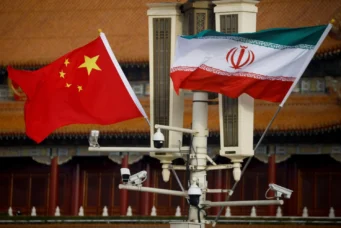
Nowhere is Beijing’s discomfort sharper than over Iran. China’s whole Middle East approach has rested on a delicate straddle: buy Iranian oil at a discount, sell Saudi Arabia a partnership, and pose as the broker who reconciled the two in 2023. That act assumed a region without hard blocs, but the Mecca Pact solidified one. Despite assurances by its members that the pact targets no one, Tehran will read it differently. It will see this Sunni-majority defence coalition—established in the middle of a war in which Iran is being pounded—as encirclement. If a battered, isolated Iran leans harder on Beijing, China inherits the cost of propping up a pariah. If China courts the pact’s members instead, it betrays the one Middle Eastern state most committed to it. The broker’s chair Beijing occupied so proudly in 2023 is being sawed down to a stool.
The Word Beijing Will Not Say: Xinjiang
Beneath all of this sits a sensitivity Chinese officials will never voice publicly. A growing Muslim security bloc, built on religious solidarity and announced in Islam’s holiest city, is precisely the kind of body that could one day find a collective voice on China’s treatment of Muslims in Xinjiang. Individually, the voices of discontent from Riyadh, Ankara and Islamabad have been purchasable silences, as each is too dependent on Beijing to raise the issue. A united bloc, financially self-sufficient and militarily confident, introduces a different calculation. The bloc need not confront China; it need only stop deferring to it. For a Chinese leadership that has worked hard to keep Muslim governments quiet on Xinjiang, a pan-Islamic pole with real leverage is a long-term nightmare dressed up as a short-term convenience.
This exposes the final, most cynical truth: China has prospered in the Muslim world precisely because that world was divided. Divided partners negotiate alone, sell oil alone, buy arms alone and swallow grievances alone. A third pole, neither in Washington’s camp nor Beijing’s, changes the arithmetic. Three states bargaining together over energy prices, arms purchases, corridor security or political red lines command a weight none carries individually. China has always preferred one-on-one dealings with weaker parties. The Mecca Pact is collective dealing among stronger ones.
None of this means China will oppose the pact openly. It will praise, rather, appreciate the regional thinking and the bloc members taking ‘security into their own hands’; it will probe for ways in. But that appreciation should not be mistaken for any Chinese satisfaction. The Mecca Joint Defence Agreement vindicates China’s slogan of multipolarity while hollowing out its substance—proof that the post-American regional order in the Middle East Beijing demanded is arriving without its permission or oversight, and possibly without Chinese involvement at all. China wished for a world of many poles. In Mecca, it got one, but unfortunately, it just isn’t China’s.