
Hybrid Writing: Authority, Ethics, Agency
Though generative artificial intelligence has facilitated the emulation of form, it cannot take responsibility for what is written. Agency remains at the heart of writing once all else can be automated
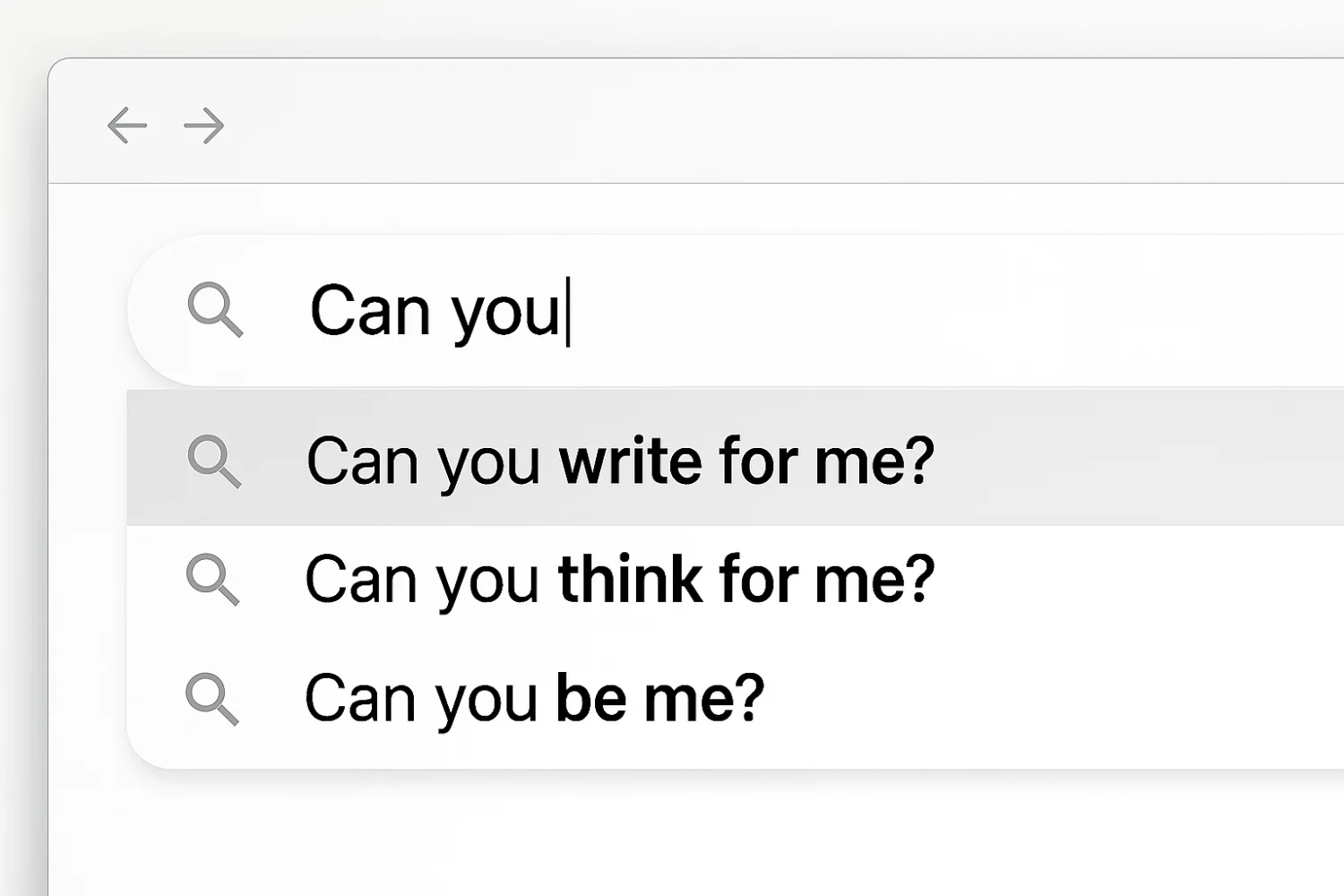
Hybrid writing is no longer a matter of the future. It is already here, quietly reshaping the texture of academic work. Across seminar rooms, publication pipelines, and feedback loops, something has shifted. We are not confronting a technological future in the abstract; we are living inside its mundane, daily iterations. What once appeared as peripheral assistance—search engines, citation tools, proofreading algorithms—has become entangled with the act of writing itself. Sentences now appear half-formed. Transitions are suggested before the thought is fully there. The rhythm of composition has begun to move differently, as if another presence were softly intervening in the flow.
The shift is subtle, but its implications are not. Hybrid writing is a co-creative process merging human intentionality with AI generative engines to produce dynamic textual output. It touches on the foundational coordinates of scholarly life: what it means to write, to author, to be responsible for thought. For generations, the university has trained its members to move through writing toward recognition—not just professional visibility, but epistemic clarity, an intelligible positioning of the self in relation to knowledge. Hybrid writing complicates that trajectory. The arrival of the sentence no longer guarantees that someone labored to shape it. Ideas arrive with fluency but without clear origin. Style remains, but authorship flickers.
This moment demands attention. The ease of hybrid writing should not distract us from the seriousness of what it calls into question. If the foundational practices of scholarship—authorship, ethical labor, agency—are being mediated, supplemented, and in some cases, bypassed, then we must ask with fresh urgency: what remains non-negotiable? What do we still expect to be human?
We might name one emerging tendency vibe-writing—a form of composition that privileges tonal plausibility over argumentative necessity. The goal is no longer to advance a position, but to approximate the voice of someone who might. It’s a form that performs the gestures of scholarly work without necessarily asking the writer—or the reader—to take a stand. Like vibe-coding in software development, it may hold up just fine until something truly depends on it. And then the gaps begin to show.
I do not approach this from a position of resistance. I use these tools. I have prompted, coded, translated, even experimented with generative scaffolds to teach and to revise. At the same time, I remain committed to teaching writing as a practice of formation wherein the very act of writing shapes thought and identity by molding a voice. I ask students to write slowly, without aid, not because I believe in intellectual suffering, but because certain decisions—the ones that form judgment—can only be made in solitude. There is still value in wrestling with a sentence until it begins to mean what you meant, even if that meaning is provisional. We are, quietly and irreversibly, beyond the phase of prohibition. The question now is not whether to use these tools, but how to use them. This essay is one attempt to respond, by reflecting on three elements of scholarly life that hybrid writing does not erase, but places under renewed pressure: authorship, ethics, and agency.
On Authorship
There is a certain quietness to authorship. Not in its effects—those may resonate widely—but in its act. We write alone, mostly. Or half-alone, now, with tools that respond, suggest, phrase. And yet even then, authorship remains a solitary commitment: to shape, to select, to stand by what has been said. It is not invention exactly, nor is it confession. It is something slower—a becoming-accountable to what is made.
In academic life, authorship is more than just a signature. It is a way of entering into form. The disciplinary article, the monograph, the lecture manuscript—these are not merely vessels for ideas, but rituals of attunement. To write in law, or philosophy, or critical theory is to learn not only what can be said, but how it must sound to be taken seriously. And this sound—its cadence, its modulations, its delicately wielded citations—is not incidental. It is the content of the form, as Roland Barthes would have it: the substance that lies not behind language, but in it, shaped by the expectations and rituals of a discourse community that prizes certain gestures over others.
There is something curiously athletic about this. In some journals, one senses the expectation of a rhetorical triple axel—a deft theoretical landing, ideally inverted mid-air, followed by a dazzling recovery of complexity. One learns the choreography early: state the problem, cite the pantheon, pose a question that slightly shifts the coordinates, then ‘re-describe’ (the word of the past decade)—lightly, evocatively, ideally quoting someone beyond reproach for validation. There is nothing inherently wrong with this. Stylization is part of all art forms. But when the form begins to dictate the movement too rigidly, the risk is that we forget what the routine was meant to express.
Still, we abide. We adjust our tone, prune our adjectives, perform our hesitations in the approved key. Not because we are disingenuous, but because we understand that scholarly voice is a social act. It lives between the lines—in the spacing, in the rhythm, in the margin notes that never make it in. It’s not just what you think, it’s how long you wait before you let the reader know you think it. This kind of authority is not extrinsic but emerges from form. And form, in the humanities at least, is rarely neutral. It is historical, cultural, affective—it is political. And it is beautiful. According to philosopher Alexandre Kojève, history was the movement through which human beings come to be recognized by others—not for what they are, but for the forms they give to themselves. Authorship, too, is like that: a becoming-visible through structure. It is not the raw transmission of thought, but the staging of it. The argument must not only be made—it must arrive in costume.
Yet, the costume matters. The process of learning to write in a field is, at some level, the process of learning to be heard in it. Students often ask what they are meant to sound like. They’re not always asking for grammar. Most frequently they are asking for posture, or tempo, or for the subtle difference between assertion and exploration—the part of the sentence where you say “traditionally”, not because you have researched a tradition, but because you know that’s the note the paragraph requires.
Now, in the age of hybrid writing, when so much of the outer form can be simulated—citation styles, paragraph rhythms, transitions that glide—the question returns with new urgency. If style can be generated, what remains of authorship? But perhaps the question is mis-posed. Style was never the core of authorship. It was its expression, its shadow. What remains is not the novelty of the sentence, but the intention behind it. The human who meant it. The thinking that left marks—hesitations, returns, surplus phrasing, a metaphor that lingers just a bit too long. Vibe-writing—writing that captures tone without thought, form without formation—offers the surface, but not the stance. It can mimic the mood of scholarship, but not its moral investment.
Here, discernment still matters. Not as moral purity, but as sensibility. The judgment of when a sentence feels hollow, when a formulation is too easy, when the rhythm is too smooth. These are not algorithmic decisions. They are lived ones, shaped by reading, by writing badly, by time. And borrowing, of course, is part of all of it.
Still, a persistent worry remains: that even when discernment is exercised, hybrid writing may unconsciously gravitate toward the mean—toward the lexical, syntactic, and conceptual aggregates that language models are trained to reproduce. The risk is not just imitation, but convergence: a quiet narrowing of thought as it settles into the grooves of what has already been said, already valued, already anticipated. Even originality, in this register, may come to wear the mask of precedent. To resist this pull requires more than vigilance; it requires a cultivated discomfort with fluency itself, and a willingness to press against the ease with which the model completes what we have not yet fully begun to think.
There is no pure origin in scholarship. Every argument leans on another. Every insight is a rephrasing, a turn. The question was never whether we borrow, but whether we carry. Whether we place something old in a new light, or merely repeat it with better punctuation. Machines can repeat. But it’s not yet clear they can care about what they repeat. These ethical questions—of reuse, recognition, and responsibility—deserve their own attention, and I turn to them shortly.
The doctoral dissertation remains one of the most concentrated sites of this struggle. For all its bureaucratic sediment—the formatting rules, the committee procedures, the ritualized defence—it still holds something sacred: a stretch of writing that must be authored alone. Not because collaboration is shameful, but because the process of becoming a scholar is still tethered to the practice of forming thought in solitude. It is, perhaps, our last real rite of passage. Not an exam, not a product, but a long, uncertain inhabitation of one’s own mind. A person emerges from it changed, not because of what was learned, but because of how long they had to hold it.
One might return here to Raymond Queneau. In his Exercises in Style, first published in 1947, he turns a trivial bus-boarding quarrel into ninety-nine stylistic provocations. Each of the 99 versions—clinical, sarcastic, liturgical—remakes the meaning through inflection. The form is the story. So too in scholarship: it is not the claim alone, but the path through which it arrives that grants it life. Hybrid tools can suggest the claim, but they cannot quite walk the path. They do not know why this word should come before that one, or why the paragraph needs to exhale before it turns, or the sound of the pause. Hybrid tools can draft the claim but can’t inhabit the writer’s path, the lived process that shapes every rhythm and inflection.
This is not to sanctify the human but to press that writing, for now, is still one of the places where something of the human remains visible. This is not in the speed or even in the clarity, but in the pauses or in the way a sentence doesn’t quite land—then gets rebalanced. It is in the shadow of someone trying to mean something. And if that is authorship—this trying, this shaping—then it is not at risk. It is simply evolving. The tools may change, the form may soften, the genres may blend. But someone will still have to choose when to speak and on what to speak. And someone will have to listen for whether it was worth saying.
On Ethics
It is tempting to think of ethics as a code. And indeed, the university has them: policies on academic integrity, plagiarism checkers—paragraphs in syllabi printed in small, nervous font. They outline what counts as original, what must be acknowledged, and what will happen if one is caught crossing the line. But most of us do not live at the edges of those policies. Our ethical decisions in writing are quieter, more ambiguous. They emerge in the small moments of hesitation—when a paragraph comes too easily, when a phrasing feels borrowed, when the voice we’ve written in sounds more like someone else’s than our own.
Hybrid writing amplifies those moments. Not because the rules have changed, but because the ease has. The discomfort many feel when composing with AI tools is not usually about rules broken. It is about a certain recognition—the realization that the work feels finished before we’ve earned it, that the gestures of scholarship can now be assembled without the inward pressure that once accompanied them. We pause—not just because we might be found out, but because we are unsure whether we have, in some less visible way, disappeared from the page. But that pause is not new. Long before AI entered the process, we borrowed—openly, awkwardly, sometimes beautifully. We learned to write by echoing the sounds of others. In early drafts of term papers and dissertation chapters, we repeated the sentences we had heard in seminar rooms and read in footnotes. Not only the ideas, but their posture. Not only the conclusions, but the steps taken to reach them. The form of scholarly thought is itself transmitted mimetically.
T.S. Eliot famously suggests that immature poets imitate, while mature poets transform what they borrow into something recognizably their own. For him, tradition is not a constraint but a medium through which originality emerges. This remark, austere but fair, reminds us that originality has always been something of a performance. Its ethical measure is not in the novelty of the material but in the depth of transformation. To borrow well is to be changed by what one takes—and to take responsibility for what emerges.
I often remind my students—half in jest, half in warning—that when a scholar begins a chapter with the word “Traditionally”, they are not merely introducing context; they are staging authority. That opening move, punctuated just so, smuggles in assumptions under the guise of shared knowledge, rendering them nearly immune to dispute. And more often than not, the strategy succeeds.1 The academy rewards not only those who possess ideas, but those who can perform them with grace: the double somersault of critique, the mid-air twist of reframing, the clean landing of the counterpoint. Here, style is not ornament but argument. It travels not just through text, but through tone, gesture, cadence—modes of transmission we do not always consciously register. Style, in this sense, is not a flourish. It is a mode of recognition.
This is where the ethical terrain has always been soft. We do not usually cite these forms. We do not name the voices we have absorbed. The rhythms, the syllogisms, the trusted ways of turning an argument—they live inside us, learned but unmarked. They are as much a part of our writing as our grammar. And yet we do not feel dishonest. Why not? Because somewhere along the way, we came to understand that ethics in scholarship is not a matter of origin, but of presence. We are not responsible for inventing the form, only for meaning something through it.
That sense of responsibility, however, takes time to develop. It is not innate. It is formed through the friction of writing itself—through failure, revision, exposure. We begin by copying. Then we learn to hesitate. Then, slowly, to shape. And that shaping is not only technical. It is ethical. We become writers by deciding not just what to say, but how much of ourselves we are willing to place in the sentence.
This is what hybrid writing risks bypassing. Not meaning, not coherence, not structure—but the act of formation. A well-prompted model can now replicate the genre, approximate the cadence, even cite the expected thinkers. But it (still) cannot measure the effect of the pause. It cannot question whether the argument should be made in that way, or whether the tone fits the stakes. It cannot wonder if the thought belongs to it. And because it does not ask, it cannot learn to care.
Of course, originality has always been a myth with uneven edges. Picasso is often quoted to have said that “Good artists copy, great artists steal.” Whether or not he said it, the phrase captures a truth about how influence becomes form. Historical accuracy, after all, should never get in the way of a good myth. Our collective ‘knowledge_base’, to use a coder’s vernacular, is full of mis-attributed aphorisms, from Marie-Antoinette’s cake to President Mao’s views on the French Revolution, which nevertheless allow cultural recognition and foster a sense of ease between interlocutors who share the same ‘knowledge’. The mythistorical origin of this aphorism, mischievous and elliptical, exemplifies the fact that originality has little to do with invention ex nihilo. What matters is not that one begins with nothing, but that one ends with something that has passed through the fire of one’s own discernment. Great art, like good scholarship, steals only what it is willing to remake. That act of remaking is where the ethical trace resides.
This is why academic integrity, in its deepest sense, is not a matter of detection but of being-there. It requires a kind of inward acknowledgment: that this thought, however shaped by others, has passed through me, the writer—that I have tried, however imperfectly, to carry it with care. That kind of acknowledgment is not always visible. But it is what makes the writing ours. And so we must continue to teach not only how to write, but how to feel responsible for what one writes. This cannot be achieved only through honor codes or detection software. It must be cultivated in practice: in the revision that takes longer than expected, in the choice to rewrite a too-perfect paragraph, in the quiet moment where a student sees their own thinking, fragile and tentative, begin to take form. The ethical question, then, is not “Did you write this alone?” but “Were you present in what was written?” In a time when words can be produced without thought, this presence is what marks a scholar: the slow willingness to stand by a sentence, and to be questioned in its company.
On Agency
It is tempting to assume that the central problem with hybrid writing is who wrote what. But the more enduring question is who decided? At what point, and under whose hand, did the claim become a commitment? Whose judgment shaped the text, even if the words were not typed from scratch? In this sense, authorship is only the outer skin. Beneath it lies agency: the capacity, and willingness, to bear responsibility for what is said.
Agency is not the same as autonomy. We all write within constraints—of genre, of discipline, of language itself. Nor is agency a matter of doing everything by hand. One can be fully agentic while using reference managers, search engines, even auto-complete. What marks agency is not the absence of support, but the presence of discernment: the felt moment when a writer chooses to keep a sentence, to delete it, to shift the weight of an argument because something does not sit right. These are not technical edits. They are ethical acts. They locate the writer inside the work.
With generative tools, these moments can be obscured. A sentence appears, already structured. An argument arrives, already plausible. There is no friction, no stumble. The writer’s task becomes one of review, not composition. But review can be passive. It can slide into endorsement. And endorsement, unlike authorship, requires very little presence.
Still, the real risk is not that machines will replace our agency. It is that we will surrender it willingly—because it is easier, because it is faster, because there is no longer time or expectation to do otherwise. The culture around us already encourages this. In law, in journalism, in the academy, productivity often outruns reflection. The pressure is to produce, not to dwell. And yet dwelling—revising, hesitating, turning back—is where agency most often lives. Agency in writing is about being-there, living through the pain of creation, and assuming responsibility for the output.
There is a deeper problem here, one that exceeds the boundaries of academic life. Certain decisions in human society are structured around the belief that only humans must be the only entities allowed to take certain decisions. Not because we are always better, but because we are answerable. To terminate life, to declare war, to adjudicate guilt, to allocate resources—these are not only technical problems. They are moral actions. We insist they remain human precisely so that someone can be held accountable. So that the decision is not just made, but owned. Accountability is the condition under which moral life is intelligible. In courts, in classrooms, in governance, we ask not just what was done, but who decided. The entire law of liability (civil, criminal, etc) is premised on sharpening the dividing lines between categories. To blur that distinction—between tool and decider, proxy and agent, public good and private right—is to risk hollowing out the very structures of judgment upon which democracy, law, and even pedagogy depend.
Writing, for all its modesty, participates in this same architecture. When we write, we do more than produce language. We produce a public self—a voice that can be contested, interrogated, defended. This is not only performance. It is a civic act. To write is to enter a shared world with claims one must be willing to stand beside. The text becomes a site where thought is made accountable. And without that accountability, scholarship begins to drift—useful, perhaps, but hollow. Fluent, but unclaimed.
This is where the liberal arts tradition shines. Not as nostalgia, not as elitism, but as infrastructure. It is in these classrooms, in these long unhurried seminars, that students still encounter the feeling of being asked: what do you think—really think—and why? They are given space not only to find answers but to inhabit decisions. They learn to press pause before endorsing the plausible. They come to understand that choosing an argument is not just an intellectual exercise but a form of exposure.
Arendt argued, and most of us agreed, that action is what distinguishes human life: not just the capacity to think or to speak, but the willingness to appear, to take a position in the world, visible and accountable. Writing is one of the few remaining forms of such appearance. We come forward, even through our commas and footnotes. And in doing so, we become available to the judgment of others. This vulnerability is not incidental. It is what grants the text its legitimacy. Not that it is right, but that someone has risked speaking it.
This ethical architecture has long been recognized, if not always articulated. Our literature warns us. In 2001: A Space Odyssey, HAL 9000 does not malfunction randomly—it obeys its programming too well. Black Mirror and other serialized renditions of technological dystopia rehash the trope that when something goes wrong, there is no one left to blame. The voice that sounds so human cannot answer for its choices in human terms. And that absence—of responsibility, of narrative, of remorse—is the source of the viewer’s terror. The same logic drives Asimov’s robotic laws, built not to enhance capability, but to contain it within moral oversight. Machines may act. But only humans are held accountable. That, ultimately, is what is at stake. Not whether AI will write better, or faster, or more fluently—but whether it will become easier to forget that someone must still be held accountable for what is said. If we allow that ground to erode, we do not only alter the practice of writing. We diminish the human role in meaning-making itself.
This is why agency must be defended—not because it flatters us, but because it grounds us. To be human is not to write alone, but to assume responsibility for what is written. It is the part of scholarship, and of society, that should never be delegated. Because when the text speaks, it must still be possible to ask: who stands behind this? And the answer must still be: I do.
The Weight of the Signature
If the university still matters, it is because it remains one of the few places where we ask not only what can be written, but what should be. This question does not resist technology. It simply refuses to be answered by it. And it reminds us that writing—at least in its scholarly form—is not only an output but a reckoning. A way of being accountable in language.
To write is to declare a presence, to appear in the form of an argument. Hybrid tools may support that appearance, even scaffold it. But they cannot take its place. Because to appear in writing is not merely to produce text. It is to say: this is where I stand, this is what I think, this is how I came to know it. We can no longer afford to treat writing as a neutral delivery system. It is too ethically saturated, too socially encoded, too symbolically powerful. Whether we speak in our own name or through the form of a scholarly genre, the act of writing still carries with it the possibility of being questioned. And that possibility—of standing behind one’s claims, of answering when called—is what makes writing not just intellectual but human.
This, in the end, is what hybrid writing cannot automate: the quiet willingness to be held. Not just for what has been said, but for the life of thought that led there. That is the burden of authorship, the labor of ethics, and the dignity of agency. We may write with many tools. But we are still the ones who sign.
- I should note that the “Traditionally, comma” routine is not mine by origin. I borrowed it—openly, and with permission—from my teacher, David Kennedy, many years ago. I always credit him when I use it in class. Still, students often attribute it to me. That, too, is instructive: a small example of how authorship accrues not simply through invention, but through repetition, context, and voice. ↩︎