Beyond the Ballot: The U.S. Midterms and the Future of American Power
Beyond determining control of Congress, the results of the midterm elections have renewed important questions regarding the balance of power in Congress and the implications for the Trump administration.
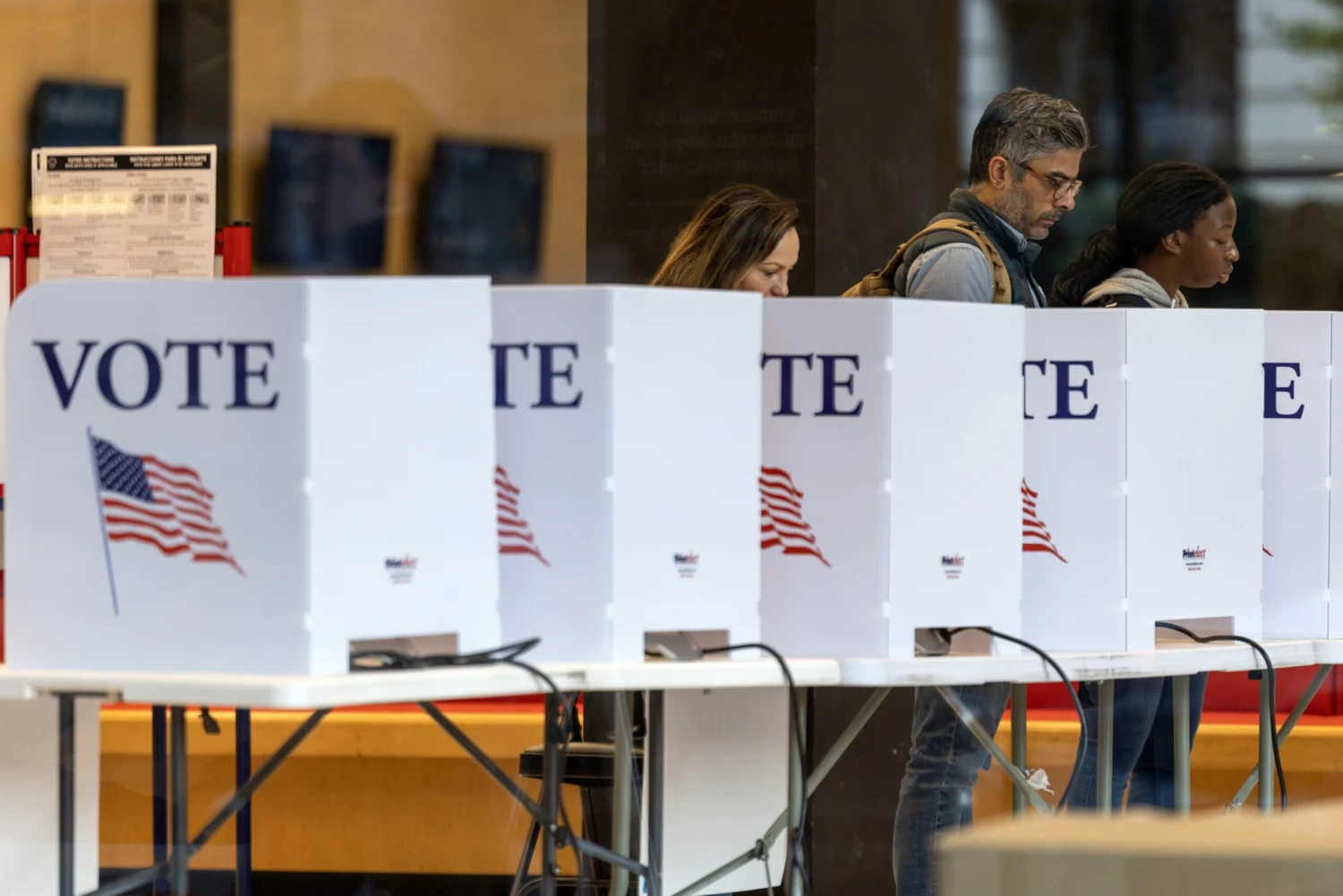
Voters cast their ballots at the Martin Luther King Jr. Memorial Library polling place in Washington, DC, USA, 03 November 2026. EPA/EMILY CURIEL
Since the Democratic Party’s electoral successes after November 3, incoming democratic lawmakers have been preparing investigations into Immigration and Customs Enforcement (ICE) and the Department of Homeland Security (DHS), and they’re expected to challenge the administration’s military spending, particularly funding for the ongoing war in Iran.
However, analysts caution that congressional pressure does not directly translate to constraints on presidential authority, particularly given Trump’s veto powers and executive control over foreign policy.
Prior to the elections, the Center for American Studies and Research (CASAR) at the American University in Cairo (AUC) hosted a panel titled “US Midterm Elections: Expectations, Facts and Reality,” where speakers examined how the midterm elections could reshape the balance of power in Congress, constrain President Donald Trump’s administration, and influence the United States’ role both in the MENA region and globally.
The discussion extended beyond electoral predictions to consider a broader question: how much can an election actually change about the state of America?
“These elections have the potential to slow down some of the more extremist actions of the current American president,” said Mark Deets, an associate professor of African and world history and director of CASAR, who was also moderating the panel.
Domestic Repercussions for the United States
Sean Lee, assistant professor of political science at The American University in Cairo (AUC), argued that the United States is experiencing “democratic backsliding”, in which state institutions are abused to disadvantage political opponents.
Several factors that would work against the Republicans were identified by Lee, including the likelihood of lower turnout among Trump’s supporters in the midterms, the economic repercussions of the war in Iran, and corruption within the American political system.
These concerns would later feature prominently after the Democrats’ victory, as voters expressed frustration over the rising cost of living, the war, and the Trump administration’s handling of government affairs.
Lee considered the possibility of the Democrats winning to be “kind of a check on the presidency to some extent” while claiming that the United States can no longer be considered a democratic system, but rather an oligarchic or a competitive authoritarian system.
“They say that it’s a system where parties compete in meaningful elections, but incumbents systematically abuse state institutions to tilt the political playing field against their opponents,” Lee explained.
Lee pointed to gerrymandering as an example of how electoral arrangements can be utilized to disadvantage political opponents. By manipulating district boundaries, mapmakers can weaken a party’s electoral influence, either by splitting its voters across multiple districts or concentrating them in a few, limiting their ability to secure seats.
Although congressional redistricting typically takes place every ten years, current efforts have taken place at the behest of Donald Trump, beginning in Texas before spreading to other parts of the country.
Partisan gerrymandering in Tennessee and racial gerrymandering in Memphis were also cited by Lee. Nevertheless, he cautioned that the strategy could backfire in some states, potentially costing Republicans seats rather than helping them secure an advantage.
Moving from these structural attempts, he presented another aspect of a competitive authoritarian system, which is the “more acute weaponization of the U.S. government against political opponents”, where he mentioned the example of agents from Homeland Security Investigations (HSI)––the investigative division of ICE—conducting a pre-dawn search at the home of U.S. Representative Ilhan Omar in Washington, D.C. Omar and democratic critics characterized the operation as political intimidation.
These instances, along with reported concerns that ICE agents could appear at polling stations, are part of efforts by the Republican incumbents to influence the election and “weaponize the government institutions against opponents”, Lee said. He said it fits the pattern of competitive authoritarianism, a concept developed by political scientists Steven Levitsky and Lucan Way. The data, he suggested, point the same way. Freedom House’s score had reached 93 percent in 2005 but declined to 81percent in 2025.
Concerns about ICE and DHS brought Lee’s discussion to a close, as he cited incidents involving “shooting citizens in the street and detaining people over their not only immigration status, but also in the case of Palestine protesters over their criticisms of, in this case, not even the United States, but of a foreign country, that is to say, Israel.”
Implications for Conflict in the Middle East
Beyond the question of American institutions, other panelists looked at what shifting power in Washington means for the world and especially the MENA region.
Amr Adly, an associate professor in the department of political science at AUC, argued that the relationship between the United States and the Middle East is not one-sided: just as American politics has shaped the region before, developments in the region have repeatedly reverberated through the global economy, including within the United States.
Using the examples of the 1973 and 1979 oil shocks, Adly illustrated how developments in the Middle East triggered major disruptions in global energy markets. Drawing a parallel between the Iranian Revolution, which contributed to the 1979 oil shock, and the current war involving Iran, he highlighted how geopolitical upheaval in the region can have consequences far beyond its borders. Although the United States is now one of the world’s largest oil producers, it is not immune to the economic consequences of a war involving Iran. The issue, however, extends beyond rising energy prices to who ultimately benefits from them.
“The distribution question, of course, is about who is getting the extra rent that is resulting from the higher energy prices. And here comes the issue that I think has compounded an already structural problem within the United States having to do with decades-long redistribution from the bottom to the top,” Adly noted.
The economic shift has a political counterpart, and in his view, the United States is increasingly acting in a “classical colonial role” in the Middle East, maintaining a direct military presence through fleets, troops, invasions, and bombing campaigns. The current war with Iran could expose the limits of American power if the United States fails to achieve its original objectives, particularly the removal of the Iranian regime, Adly argued, stating that the war is generating anxiety “within many imperialist circles within the United States elites”.
Another potential implication of the war is a shift in how U.S. partners view their security commitments with Washington. Adly argued that the war has exposed the vulnerabilities of existing security arrangements in the Gulf, potentially encouraging regional powers to reconsider their reliance on American security guarantees.
Pressure on those commitments is also building in Washington itself. He pointed to growing opposition to military intervention abroad among parts of both the political left and right, alongside deepening divisions over U.S.-Israel relations. Tracing this bipartisan resistance to the intervention in Iraq, he argued that the opposition to the U.S. dedicating resources “for such infrequent interventions” has been reflected in the votes and in public opinion.
“And that is yet another issue where the political class in general in the United States in both parties do not seem to be in line with what most of the Americans think,” Adly concluded.
Global Implications
Where Lee and Adly looked at the pressures on American power from within, Alaa El-Hadidy, a former ambassador to Turkey, Russia, and Romania, and now a professor of practice at AUC’s School of Global Affairs and Public Policy, looked at how other governments read it. He argued that foreign governments are following the midterms but don’t expect a shift in Congress to change Washington’s direction.
El-Hadidy argued that foreign governments—including Russia, China, and countries of the European Union—understand that a shift in Congress wouldn’t necessarily translate to a shift in the current administration’s direction. “So the address is not to go to Capitol Hill but to go to the White House,” he said.
El-Hadidy first pointed to the legislation targeting major purchasers of Russian oil and gas, which was signed into law on September 18, 2026. However, on October 16, Trump issued an executive order waiving the application of certain sanctions provisions under the law, an option that the legislation allowed, subject to reporting requirements.
Using this event as an example, El-Hadidy argued that it shows that Russia understands Trump’s transactional approach to politics and will continue to prioritize its relationship with the White House, rather than Congress, in pursuing its interests in Ukraine.
China, on the other hand, “is a little bit more sophisticated in their dealing with the Americans than Russians; the Chinese know how to play American internal politics more than Russia,” El-Hadidy argued. China was able to retaliate against Trump’s tariffs by imposing high tariffs on products produced by farmers—who are a constituency of Trump— thus pressuring Trump.
Because bilateral trade decisions can be highly affected by Congress, El-Hadidy noted that China would definitely be more interested in the midterm election results in comparison to Russia. He added that this might be because China does not have the same stakes as Russia—no war on its border—but only the question of Taiwan, which Trump had publicly said he’s using as a “good negotiating chip”.
However, El Hadidy believes that the EU has more at stake in the midterms than Russia or China, particularly because of security, NATO, and trade relations.
“The EU, like the Chinese and the Russians, understands quite well where the power of the Congress really is, where the role of the Congress [in] American foreign policy really is, and who has the real power, especially under this current administration,” El-Hadidy stated.
Has the Name of the Game Changed?
El-Hadidy’s remarks highlighted the concentration of executive power under Trump, raising a broader question in light of the Democrats’ electoral gains: was this concentration of power specific to the Trump administration, or does it reflect a more lasting transformation of the American political system?
“My personal hunch is that it’s never going to return back to as it was before Trump,” El-Hadidy said. “What Trump has done in the long run, is that he has given the presidency such new tools, which were in the Constitution, but were hidden or people or scholars did not pay enough attention to. This is going to be a very dangerous tool to use by whoever becomes president.”