Crisis Management, or Long-term Planning? New Handbook Maps Out Egypt’s Economic Future
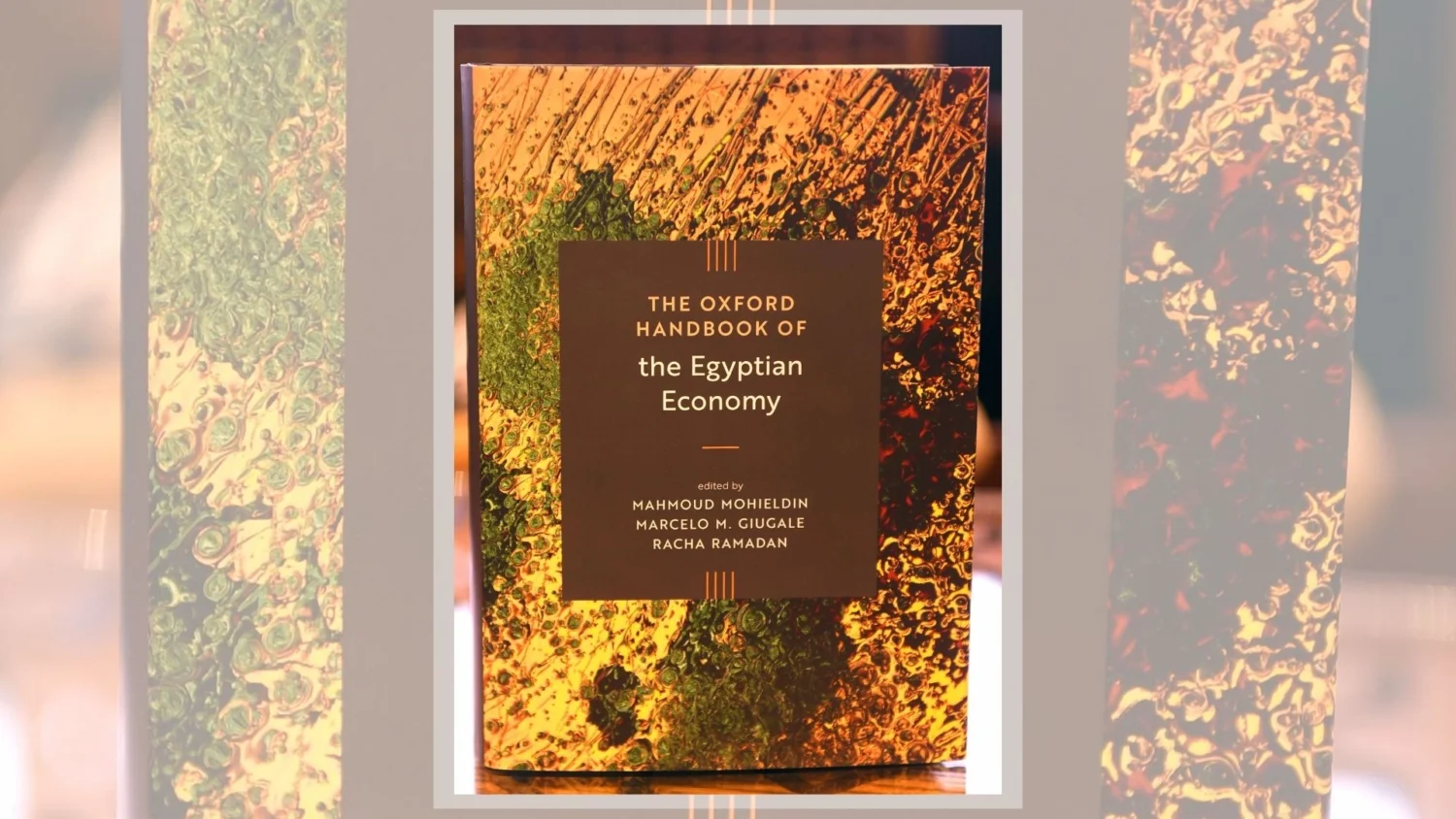
The newly published Oxford Handbook of the Egyptian Economy, an initiative of the Egypt Economic Development and Policies project, administered by the American University in Cairo, is the first comprehensive overview of the country’s economy
Egypt, nestled between Africa, Asia, and Europe, has earned the fond moniker “Mother of the World” (Um al Dunya). Its geographic position on the Red Sea makes it a promising location for trade and industry, and economic reforms in the past three decades have led to promising growth rates for GDP, an expanding tourism sector, and a boom in private investment.
Yet, despite its vast historic significance, modern economic realities have brought a litany of obstacles that challenge its growth, particularly in the realm of economics. Egypt’s economic growth has been mired in immense public debt, bureaucratic barriers to business, energy dependency, and significant poverty and inequality. There is no shortage of proposals to improve Egypt’s economic performance, but in this case, it seems the cart has been put before the horse. In other words, there is a significant lack of data and analysis on the status of the Egyptian economy and its current growth programs. This produces a significant gap between what may be promised on paper, and what is produced on the ground.
The Oxford Handbook of the Egyptian Economy, an initiative of the Egypt Economic Development and Policies project, administered by the American University in Cairo, marks an important first step in bridging that gap, bringing together over 69 experts across 43 chapters to provide a comprehensive overview of Egypt’s economic fundamentals, spanning reform, environmental challenges, and human development. The Handbook was launched at an event hosted by the American University in Cairo on September 10, 2026, and was attended by economists, policymakers, and experts, alongside representatives of the government, the National Bank of Egypt, Banque Misr, the Ford Foundation, and the United Nations Development Programme, amongst others. The book was introduced by its three co-editors and a panel of experts examined its strengths and weaknesses, pointing to a need for further focus on issues of governance, manufacturing, and social justice.
The Handbook: A Promising Beginning
A core theme of the book is how to balance the role of the state and the market; the Egyptian state has a large presence in the economy, yet removing it entirely would destabilize the system. Instead, as co-editor Mahmoud Mohieldin, professor of economics at Cairo University and president of the Egyptian Economic Association, explained, the goal is to create a more level playing field between private and public actors.
“In many cases, [the state] was unfairly competing with the private sector,” he said. “The obvious recommendation is not to tell it to go away, but to make the opportunity, based on the law of the land, fair for all players, be they private or public, big or small, foreign or domestic.”
How to achieve this balance, however, is a delicate task. The state holds many roles, operating as regulator, owner, employer, investor, entrepreneur, importer, exporter, borrower, and competitor. This economic footprint has important implications, said co-editor Marcelo Giugale, independent advisor to governments and multilateral institutions and adjunct professor at Georgetown University. Competitive neutrality, which places state-owned economic actors under the same rules as private businesses, may help level the playing field, he argued.
Beyond state engagement, the book also examines human capital as a key economic asset. Both Moheiddin and co-editor Racha Ramadan, professor of economics at Cairo University and general secretary of the Egyptian Economic Association, praised the Handbook for its coverage of a breadth of topics including population change, fertility, education, health, nutrition, and labor-market issues. Gender is also a key component here, Ramadan argued. She portrayed gender as more than a social or moral issue, but an economic one as well.
“We have two chapters tackling women’s gender inequality and violence against women,” she said. “[This focus] is not only from a moral perspective, there also is an economic cost of such inequality. Recent data indicates that violence in public spaces that prevents women from participating in the workplace could cost Egypt around $70 million per year.”
The Handbook also effectively discusses the middle class, which Moheiddin explained is often overlooked. While most analysis focuses on people of wealth or people in poverty, economic opportunities are present for the middle class that may help the economy as a whole become more resilient to future economic shocks. Poverty is, of course, also a key component of the Handbook. Ramadan explained that the Handbook distinguishes between monetary and multidimensional poverty (which expands beyond a lack of money into other forms of deprivation, like health, education, and living standards). One dimension may rise while another falls, making the goal of “reducing poverty” a more nuanced question than many assume.
The Handbook also extends beyond conventional macroeconomics by handling issues of water management (particularly on the Nile), climate change, agriculture, food security, urbanization, governance, social capital, and megatrends. Moheiddin emphasized the importance of understanding how these interact with demographic changes, digital transformation, debt, and natural disasters to not only shape Egypt’s current economic situation, but also influence its future.
With this wide breadth of topics, Ahmed Rostom, minister of planning and economic development, framed the Handbook as a key tool for policymakers, not just academics. He praised the Handbook for its timeliness and practical relevance, particularly with its discussion of macroeconomic resilience, fiscal discipline, financing, investment climate, and the role of the state and social development. Rostom commended the book for providing an exceptionally wide foundation for beginning analysis.
“Maybe in a year or two from now,” he said, “this excellent team of researchers could revisit some of the priorities and some of the assumptions of the Handbook, using the databases we are building now, to assess what progress has been done across several fronts.”
Looking Forward: Gaps and Opportunities
One suggestion is to add more practical recommendations for how to build a better state. Ugo Gentilini, global lead for social assistance with the social protection and jobs global practice at the World Bank, explained that the book did a good job of identifying the problem, but did not clearly outline what an effective state should look like. He called for greater attention to industrial policy, employment quality, social protection, and fiscal systems. He pointed out that the next question is not only how much the state should retreat from the economy, but also what capabilities it needs to develop.
Khaled Al-Wazani, professor of public policy in the Mohammed Bin Rashid School of Government, extended this concern over economic reform. “It is quite clear that reform measures do not automatically become economic transformation,” he argued. “The transformation requires a sustained institutional process based on technical diagnoses that show what exactly should be changed.”
In a similar line of thought, Khaled Sakr, former assistant director at the IMF, reminded the audience that while Egypt has made important strides in economic reforms, this progress is potentially reversible. He pointed out that Egypt’s reliance on external sources of income, like remittances, hydrocarbons, tourism, and the Suez Canal, is problematic, and that developing more sufficient domestic productive capacity is a key area for improvement. At the moment, Egypt is trapped in a cycle of crisis, addressing problems as they arise instead of building a more resilient long-term system.
As reform continues, human capital must be better integrated, many panelists argued. Hussein Abdelaziz, faculty member of economics and political science at Cairo University, pointed out that there are important shifts happening in Egypt’s demographics, including falling fertility and a growing working-age share of the population. If instrumentalized correctly, this demographic dividend could be productive, but he also pointed to the need for more data across demographics. Heba Nassar, professor of economics at the faculty of economics and political science and former vice-president of Cairo University, made a similar point, arguing that an overly macroeconomic understanding of reform may inhibit the translation of growth into improvements in education, health, skills, and social inclusion. Similar to other panelists, she emphasized the need for the state to step back from running businesses directly, but she also stated it needs to maintain a role in education and healthcare.
Another gap in coverage, argued former Minister of Solidarity and Social Justice Gouda Abdelkhalek, related to research on lower-classes, particularly the falaheen (Egypt’s traditional rural farmers). He noted that there was a lack of comprehensive data and analysis on the role of agriculture within the book, emphasizing that it remains key to employment, food security, and the country’s wider economic structure. In addition to calling for more attention on manufacturing, he also called for a clearer focus on the issue of social justice, arguing that the Handbook makes suggestions on how to protect lower classes, but not how to address wider systems of inequality, wealth distribution, and fairness in the wider economic system.
As it stands, the panelists leaned toward the observation that the Handbook provides an important first step to develop a more consistent, long-term, and structured analysis of Egypt’s economic standing. Its gaps, while important to address, are symptoms of the vastness and complexity of the topic, and addressing them will take the coordinated effort of researchers, practitioners, and policymakers.