Book Review: 2017 Novel Warns of Decay of American Democracy
Escalating state violence and waning strength of democratic norms paints a concerning picture for the future of the United States
A frigid morning on Nicollet Avenue in Minneapolis. Sirens wail as a crowd scatters through plumes of tear gas. Minutes earlier, Alex Pretti, a 37-year-old ICU nurse and father, lay dying—shot by a federal agent during what should have been a peaceful protest. His killing, the second of a civilian by agents in January 2026, ignites fury. Protesters hurl chants and snowballs; riot police answer with rubber bullets.
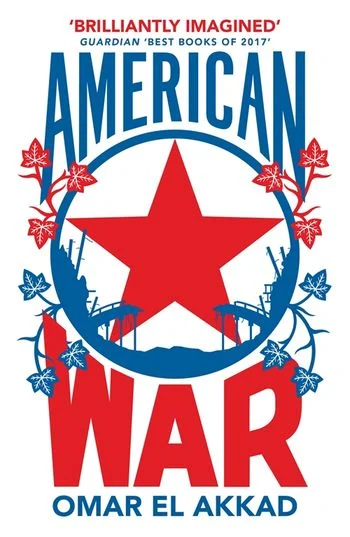
Watching the shaky livestream on my phone, I feel a chilling déjà vu. I’ve seen this before, I think, only last time it was fiction. Last time, it was in the pages of Egyptian-Canadian Omar El Akkad’s American War.
The Thin Line Between Novel and News
This haunting novel, published in 2017 and nominated for several awards, envisioned a future United States shattered by its own second civil war, a war that feels less unthinkable with each night like this. American War opens late in the 21st century, after rising seas have swallowed Florida and droughts have ravaged the heartland. In 2074, the Southern states defy a federal ban on fossil fuels and secede, igniting a brutal conflict between North and South.
El Akkad introduces us to Sarat Chestnut, a young girl from Louisiana, whose family is displaced by the war’s climate disasters and sent to Camp Patience, a sprawling refugee camp on the banks of the Mississippi. In one striking scene, Sarat’s family arrives at Camp Patience by boat, joining thousands of fellow Americans living under tents and tarps, a fate eerily reminiscent of real Red Cross shelters after the real world’s own recent hurricanes and wildfires.
The novel’s war burns for over 20 years, breeding atrocities on American soil that evoke the worst of Iraq, Syria, or Gaza. By the end, Sarat, once an innocent child, has been scarred by loss and radicalized into delivering a final act of vengeance: unleashing a deadly plague that forever poisons the North.
Reading American War today feels like peering into a funhouse mirror of our present. The book was meant as speculation, but in 2026 it reads more worryingly like prophecy and political parable. El Akkad himself has described the novel as “an account of a future US ravaged by war and climate disaster”, born of his years covering America’s wars abroad as a journalist.
Now those wars’ echoes are at all Americans’ doorstep. The scenes on American streets—armed troops in Los Angeles, protesters clashing with federal forces in Minneapolis—uncannily resemble the novel’s descriptions of a nation at war with itself.
In June 2025, Los Angeles was rocked by unrest after militarized ICE raids led President Trump to deploy 4,000 National Guard troops and 700 Marines into the city’s streets. Reuters reported it as the fiercest domestic crackdown of Trump’s term, “a focal point in a national debate over…the use of federal force in domestic affairs”.
Americans witnessed soldiers in full combat gear patrolling Sunset Boulevard and Blackhawk helicopters thundering over city blocks, images that could be outtakes from American War’s battle of Birmingham.
And just this month, Minneapolis’s grief and anger over two fatal shootings by immigration agents has prompted what former President Bill Clinton described as “horrible scenes” of conflict and a crisis of legitimacy. Clinton warned that “at every turn, the people in charge have lied to us…pushed increasingly aggressive and antagonistic tactics”—eroding 250 years of democratic norms. The American experiment, Clinton cautioned, is at a crossroads: “If we give our freedoms away after 250 years, we might never get them back”.
It’s not just politicians sounding the alarm. Scholars see the cracks in democracy turning into chasms. Barbara F. Walter, a political scientist at the University of California San Diego who has studied civil wars worldwide, notes that by every measurable risk factor “the U.S. has them all”.
According to Walter, we have become what experts call an “anocracy”, a weakened democracy teetering in the unstable zone where internal conflict erupts. Walter points to a deadly convergence of conditions: partisan hatred along identity lines, a flood of guns, and leaders who encourage violence.
Indeed, rather than tamping down violence, many American elites are fanning it. When a public official was assassinated in Minnesota last year, extremist media hailed her as a martyr of a “coming war”, and far-right commentators openly use “war” framing to mobilize supporters.
Walter’s conclusion is bleak: the United States is likely entering “a 10-20 year period of sustained instability and violence”, absent a dramatic change of course.
In American War, Sarat’s radicalization begins with her losing faith in the nation, watching her father die in a suicide bombing and her camp get massacred by Northern drones. How many real Americans are likewise losing faith now, seduced by extremist ideologies after seeing government violence or dysfunction?
The novel’s great warning is that when the social contract shatters, ordinary people can be driven to unthinkable revenge. Sarat was not born a killer; America’s war made her one. The current trajectory, many fear, could breed real Sarat Chestsnuts in the years ahead.
The Climate Siege
While political violence pulls America apart, American War also shines a light on another slow-burning catalyst of conflict: climate change and mass displacement. The novel’s civil war is triggered by a climate policy (fossil fuel prohibition) and intensified by ecological catastrophe.
Its refugees in Camp Patience recall today’s climate migrants, except today’s are no longer confined to distant islands or what they call the Global South. They are present in Great America, ominous in the real world.
In 2025, the U.S. was battered by record disasters: wildfires raged even in winter, and by July nearly half a million people worldwide had already been forced from their homes by wildfires, the highest mid-year total in decades. Astonishingly, Los Angeles County saw 260,000 wildfire displacements in January alone, almost as many internal evacuees as the entire country saw in all of 2024.
Over the summer, a historic flash flood in Central Texas killed at least 135 people when the Guadalupe River rose 31 feet in just 90 minutes. Thousands of Texans fled to emergency shelters on higher ground, a scene not unlike the drowned Gulf Coast that Sarat’s family escapes.
Koko Warner, a United Nations climate migration expert, has warned that such “climate shocks” are no longer sporadic anomalies but a trend now “influencing…security and stability” worldwide.
These are essentially the prequels to American War’s nightmare: resource depletion and displaced populations setting the stage for conflict. The novel’s haunting tableau of the Mississippi burning and camps overflowing feels like a foretaste of what a hotter, harsher world could bring if we don’t act.
Already, phrases like ‘America’s climate refugees’ have entered our lexicon as coastal towns relocate inland and wildfire survivors wonder if they can ever return home.
Perhaps the most jarring inversion in American War is its portrayal of the United States not as a global policeman, but as a ravaged land on the receiving end of foreign intervention. In the book, the rest of the world has moved on, a new superpower called the Bouazizi Empire (born from the Arab Spring’s embers) and a rising China broker peace and send aid to the shattered United States.
The novel pointedly imagines foreign drones bombing Georgia and international peacekeepers herding Americans in camps, a role reversal aimed at Western readers who are used to seeing such tragedies play out in other countries. It forces the question: What if we became the next Gaza, the next Syria?
The Imperial Boomerang
As Omar El Akkad said in a recent interview, he grew up in the Arab world watching Western wars and always thought “I’m sitting on the side that’s launching the bombs”, never imagining that side could be us. His faith in the “free world” was deeply shaken by the 2023–25 war in Gaza, when the United States unflinchingly backed Israel’s devastating bombardment.
American War flips that script: an America reduced to ruins, reliant on others’ mercy. It’s a provocation, and a reminder of how quickly empires fall.
Consider the United States’ current foreign policy choices. In Gaza, the United States is still underwriting Israel’s siege in the name of security, even as children freeze to death in winter rubble for lack of aid. In Davos in January, President Trump unveiled a glitzy “New Gaza” redevelopment plan, calling the war-torn enclave “great real estate”, all while Gaza’s actual residents shiver in tents waiting for food and medicine.
The disconnect is staggering. Amr Adly, a political scientist at the American University in Cairo, blasted Trump’s approach to Gaza as “shocking and extremely dangerous”. When Trump floated the idea last year of relocating Gaza’s entire population to Egypt or Jordan, Dr. Adly warned it would “destabilize the region as a whole”, effectively compromising Egypt’s security and echoing the Nakba, the mass displacement Palestinians suffered in 1948.
To many in the Middle East, America greenlighting what they see as ethnic cleansing in Gaza confirms the worst hypocrisies of an empire that preaches human rights but picks and chooses when they apply. El Akkad captures this global revulsion. Reflecting on Gaza, he wrote that the West’s moral authority has crumbled, and “the bombardment of Gaza…will be remembered as the moment millions of people looked at the west, the rules-based order, …and said: I want nothing to do with this.”
And then there’s Venezuela—another theater where American power is on display, for better or worse.Amid the 2025 holiday rush, the respectable U.S government carried out a stunning operation: the capture and removal of Venezuela’s strongman Nicolás Maduro, who is now sitting in a U.S. jail awaiting trial.
After years of economic sanctions strangling Venezuela, the Trump administration suddenly shifted tactics. By early 2026 it began “rolling back” oil sanctions on Venezuela, not out of mercy, but to exploit Venezuela’s oil as we squeeze Russia. Leaked plans show U.S. officials courting oil companies to invest in Venezuela’s oilfields now that Maduro is gone.
It is a classic oil-fueled regime change play, straight from the 20th-century imperial playbook. In fact, Washington insiders are openly discussing Venezuela in terms of “post-regime transition.” Yet even on U.S bases, the blowback is brewing: Congress, including members of Trump’s own party, is so uneasy with his adventurism that they’ve moved to limit his military authority in Venezuela. Five Republican senators joined Democrats to demand a future vote to limit the President’s powers regarding the conflict with Venezuela, wary of sliding into another open-ended conflict.
The irony is rich: as the United States projects force abroad, its own Union is fraying. The more the administration flexes the empire’s muscle in places like Gaza and Caracas, the more it resembles the hubris of ancient Rome, arrogant, overextended, and blind to the rot from within, an allegory well-illustrated in American War.
One of El Akkad’s most poignant subplots is the global aid shift: in the late stages of the Second American Civil War, a Chinese ship named Běijīng anchors in Chesapeake Bay, delivering relief supplies to destitute Americans while Washington lies in ruins.
“In the real world, one wonders: if our political violence and climate disasters continue on current trend, how long before we are appealing to the U.N. for humanitarian aid or peacekeepers on our soil?”, an American from Minneapolis told the Cairo Review.
The Next Chapter
When one reads Sarat’s journey, from a child who only wanted to live by a quiet river, to an extremist molded by pain, one can’t help but think of all the young lives today being shaped by violence and division: the child in Gaza who has lost her entire family, the teenager in Ohio falling down an online hate rabbit-hole, the migrant kid in Texas staring through barbed wire in a detention camp.
Our current trajectory is not destiny; it’s a call to action. Maya Wiley, a U.S. civil rights leader, said it best during last year’s turmoil: “Our democracy is under siege from coordinated attacks…We must act with urgency, clarity, and unity to resist these threats and uphold the Constitution.”
American War reminds us that radicalization is born from trauma and despair. It is a warning that only America can help itself. The alternative is concerning: if injustice, climate chaos, and democratic decay are allowed to fester, the great American ideal could decay creating a generation of Sarat Chestnuts, with nothing left to lose.