
Using Sex to Sell Racism: How AfD Policies Defy Logic
The sexual politics of the new far-right parties like the Alternative für Deutschland are full of deliberate contradictions and obvious echoes of Nazism
Ever since 2017, when the far-right Alternative für Deutschland populist party in Germany revived its own political fortunes by splashing a provocative new campaign of titillating and entertaining images across dozens of cityscapes and millions of personal computer screens, commentators have sought to explain the contradictory relationship between the party’s programmatic demands to return to ‘old-fashioned’ values and the imagery it uses to capture the popular imagination.
An extraordinary amount of ink continues to be spilled on the presumed puzzle: officially, the party wants to restore the ‘traditional’ heteronormative family model (a salary-earning father and a childrearing-prioritizing mother with multiple children), yet its leading figure, Alice Weidel, is an out lesbian, formerly worked as an investment banker for Goldman Sachs and Credit Suisse, has a PhD in economics, and lives in a civil partnership with a Swiss woman of Sri Lankan heritage, with whom she is raising two sons.
Is Weidel simply “the perfect fig leaf” for a party that is otherwise given to vicious homophobia in addition to its relentless völkisch racism against migrants and refugees, especially those hailing from predominantly Muslim countries? What all the speculations about this supposed great paradox miss is that strategic contradictoriness is not an aberration for the AfD; it’s a deliberate method.
Indeed, the contradictoriness is highly functional: it expands potential audiences, keeps opponents guessing, entertains with shrewd humor, and provides plausible deniability in case of critical rebuke. It is especially visible in the party’s sexual politics—whose main purpose is not so much to police the populace’s intimate choices, but rather to use sex to sell racism. Moreover, the sexy racism messaging, which does not shy away from borrowing Nazi iconography, has gone through a revealing evolution over time—from cute to cruel.
Sexy Racism
The first iteration of this strategy was best captured on a poster with attractive young (white) females in exceedingly skimpy bathing suits heading to the beach, supplemented by the taglines “Burkas? We prefer bikinis” and “Our land. Our rules”.
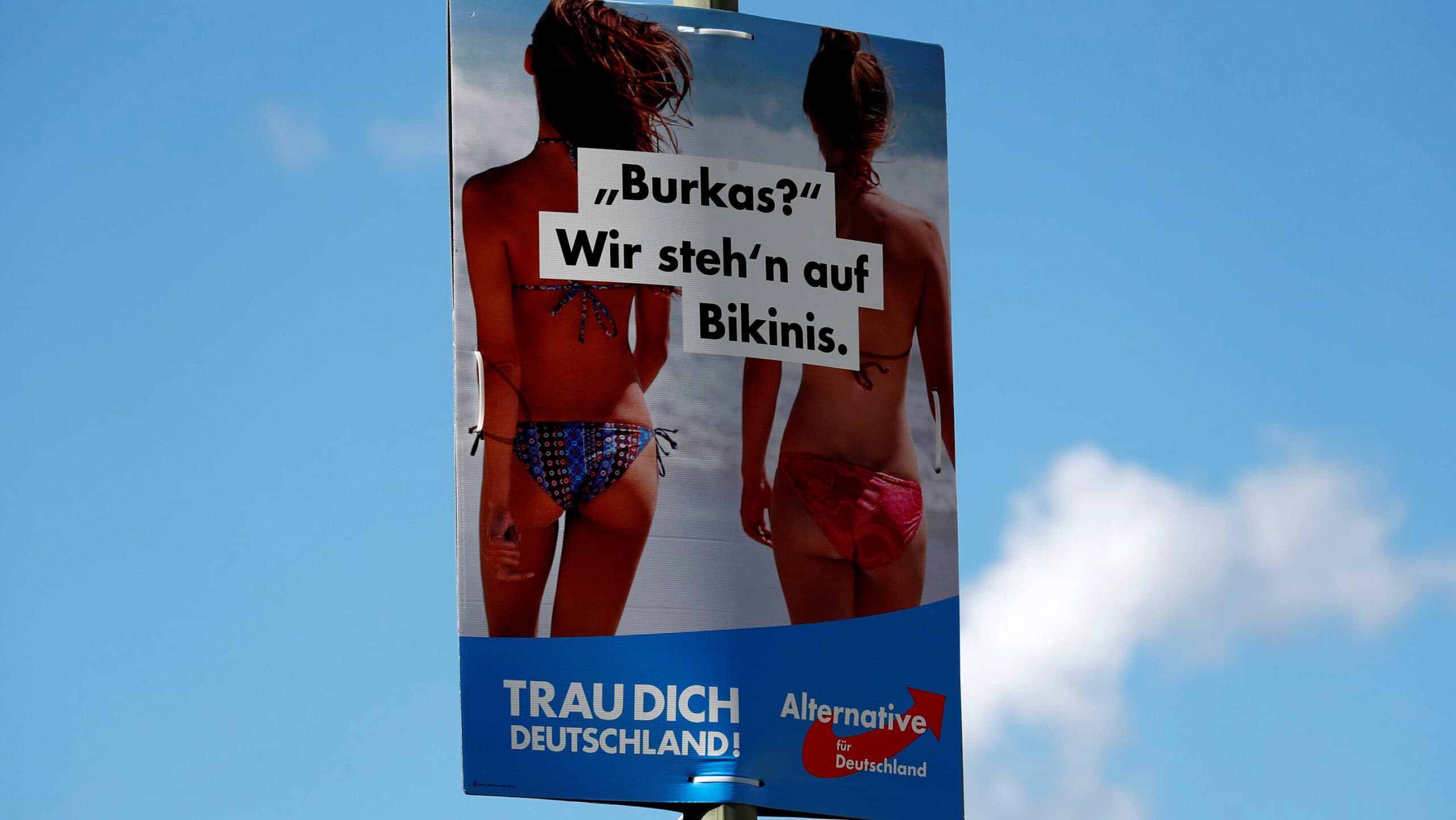
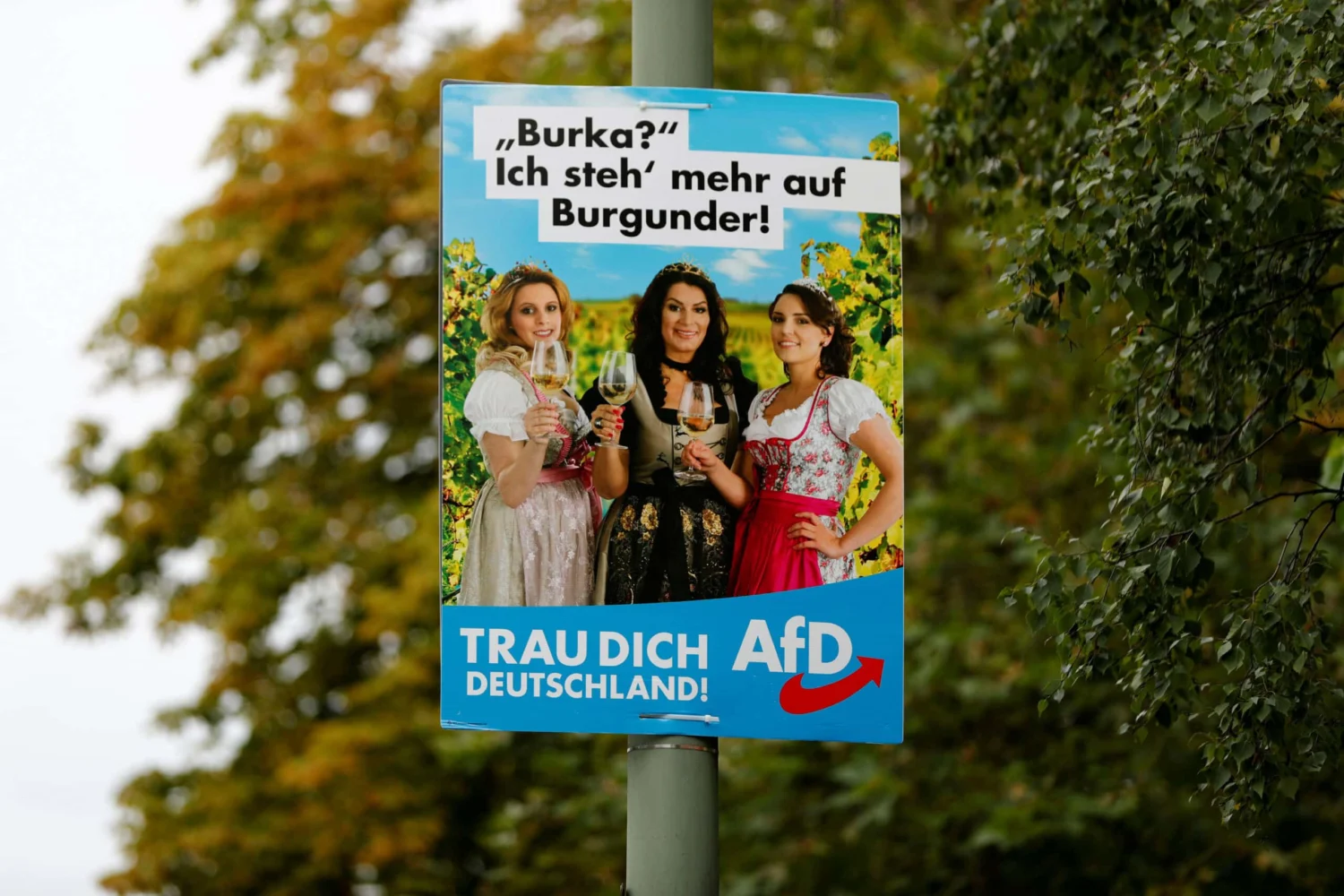
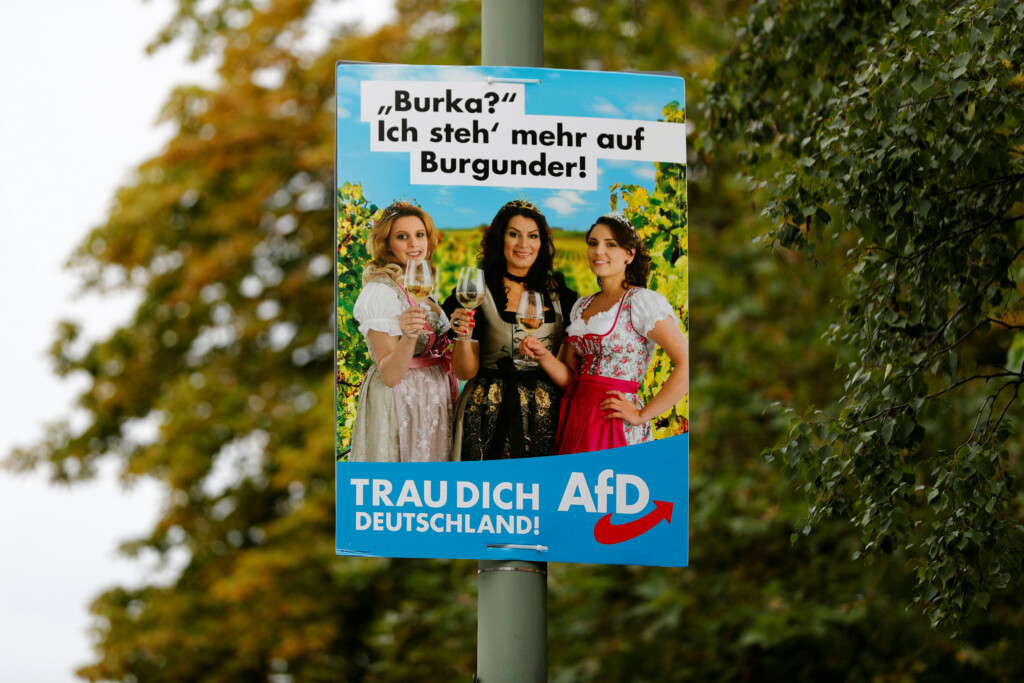
Here viewers could delight in the women’s behinds, while the racism remained implicit; the self-reflexive cleverness was evident in the vibe of seemingly light-hearted fun. A related image contrasted burkas with burgundy wine being offered by buxom barmaids.
And yet another showed the sensual pregnant belly of a young white woman with the tagline “New Germans? We make them ourselves”.
Two years later, the imagery shifted to something more overtly pornographic—even as it simultaneously centered the purported threat posed by migrant men to white womanhood. One poster from the 2019 state election campaign in Saxony showed a naked blonde handcuffed to a radiator while a dark silhouette of a man with a knife hovered ominously in the corner. The tagline read: “Pepper spray doesn’t always help. Good politics does. Therefore now vote AfD”. Similarly, for the European elections of 2019, the Berlin branch of the AfD filled public spaces with a repurposed copy of the nineteenth-century artwork, The Slave Market, by French painter Jean-Léon Gérôme. Here, a lovely and light-skinned naked woman is being aggressively manhandled by brown men in turbans and the headline read: “So that Europe does not become ‘Eurabia”.
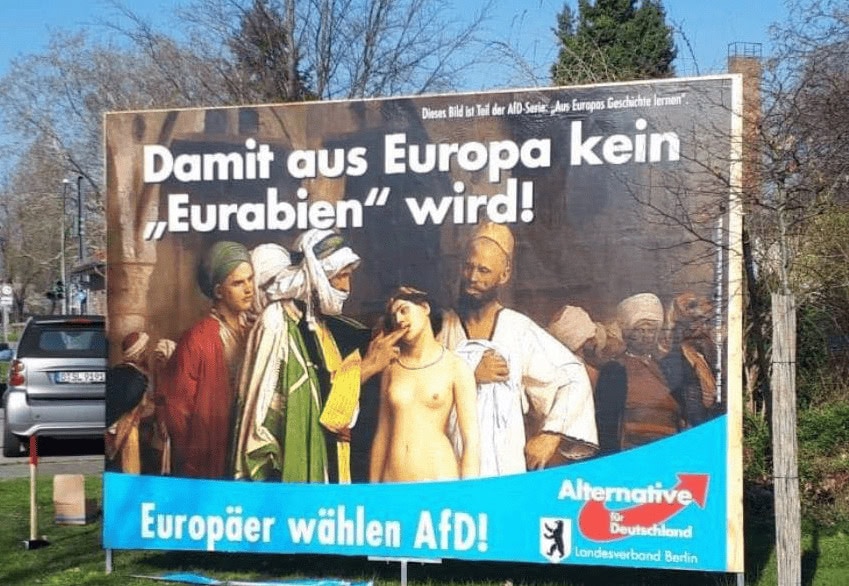
The visual echoes of these anti-Muslim representations with anti-Jewish pornography from the Third Reich are noteworthy. From the late 1920s into the early years of the regime, the Nazi newspaper Der Stürmer recurrently featured a naked blonde being violated by Jewish men or by snakes with Jewish names. The point, of course, was that these images conveyed a double effect: even as they stirred moral indignation at the menace supposedly emanating from men of color, they also invited all to gaze on nude female flesh.
More recently, in 2024, the images have become creepier and more brutal—as was the case in the music video and AfD party song “Remigration Hit”. Here, gyrating attractive female flight attendants dressed in AfD blue and “Aryan” pilots celebrate while herding droves of dejected and humiliated brown and black men into hundreds of airplanes and flying them off into the distance. The video then concludes with a huge rally signaling AfD rule and general revelry. The video contains boastful references to the infamous May 2024 dance party on the island of Sylt (during which elite young Germans were captured on film singing “Germany for the Germans, foreigners out”) as it includes unmistakably Nazi iconography.
Here we find a novel form of arousal. Rather than brown and black men being portrayed as menacing threats (as in the Saxony ad), this video portrays the men of color as abject and the white men as virile and superior. The video also mocks the purportedly “woke” white allies seeking to rescue the men of color. Instead of selling fear, sex is used to sell the elation of triumph.
While sexualized fear-mongering has by no means gone away in German political discourse—in fact the other parties, from the Christian Democrats to the Greens, have jumped on that bandwagon, too—what is manifest in the video is instead a mode of full-on braggadocio, where Schadenfreude reigns and—as the American journalist Adam Serwer put it about Trumpism—“the cruelty is the point”. This is dominance posturing and triumphalism. It is also sexy racism. When a liberal politician filed a criminal complaint noting that the song, when publicly performed, was an “incitement to hatred”, AfD politicians fired back that it was just a joke—young people testing limits and having innocent fun. Plausible deniability is found again in the blurred space between humor and sincerity.
Strategic Contradictoriness
The AfD, then, needs to be understood as a self-consciously postmodern political phenomenon: postmodern in the sense that the party’s messaging is not just self-reflexively clever but also unapologetically inconsistent. Indeed, the party plays, gleefully, with the inevitable contestedness and instability of truth, and is unabashed about advancing manifestly outrageous assertions. No claim is too absurd so long as it serves the purpose of either acquiring/maintaining power or muddling the audience’s grasp of facts. The classic example might be Weidel giggling with Elon Musk and declaring that Adolf Hitler was “this communist, socialist guy”.
This comfort with (and delight in) incoherence is also why, depending on context and target audience, the party can style itself as both anti-gay and pro-gay. On the one hand, AfD politicians have embraced a nationalistic “pride month” (Stolzmonat)—replete with the slogan “against rainbow shit and gender madness”—in their overt antagonism to what they consider left-wing queer pride advocacy. On the other hand, gay voters are appealed to via blunt racism with slogans such as: “My partner and I don’t value the acquaintance of Muslim immigrants, for whom our love is a deadly sin”.
In its published platforms, the party is officially opposed to further expansion of LGBT rights, sometimes calls for undoing the equality of marriage law passed in 2017, and expressly upholds reproductive, white, gender-polar heteronormativity. A Bavarian branch of the party has circulated a poster—self-consciously echoing Nazi anti-Bolshevism imagery, but also just campily silly—portraying a Conchita Wurst-resembling drag queen ‘threatening’ a child to represent the danger of tolerance-teaching sex education.
Sometimes the party rails against Christopher Street Day (Europe’s annual LGBTQ+ pride parades); other times, party advertisements imply the AfD is the only party that will protect the parade against homophobic migrants through posters emblazoned with photos of Weidel. The party also has an official organization of gay members (Alternative Homosexuelle), who cheerfully aver that the party is the furthest thing from homophobic.
The heterosexual messaging is similarly mixed. Yes, over and over, the party celebrates “traditional” families. Yet, it also jokingly recommends teen sex. And single parenting is by no means off-limits among its leadership. One clear priority for the party is to present the party’s official anti-abortion platform as an effort to create a “welcome culture” for all (white) children (a deliberate reappropriation of former Chancellor Angela Merkel’s “welcome culture” for Syrian refugees). This anti-abortion platform is intended to offset what AfD leaders allude to as the fearful prospect of a “Great Replacement” of white European populations by immigrants. This racism is no longer just implicit, it is made patently clear by a female AfD politician excitedly reporting the results of far-right Hungarian president Viktor Orbán’s latest success in incentivizing a rise in the birthrate expressly of “‘light-skinned’” (hellhäutige) children with baby bonus payments.
But the goal is not merely reproduction, nor is it traditional familialism per se. The goal is popularity and, again and above all, power. Most recently, the prominent—and avidly taboo-breaking—AfD politician Maximilian Krah (infamous for various remarks including that the Nazi SS were not all criminal, that “Europe should stay European and not become African”, and that “collective sexual abuse of European girls is the typical corollary effect of Oriental invasions”) turned to the right-wing manosphere for messages he could borrow and rework to reach young white men and boost their lagging self-esteem.
This meant providing ideological, nutritional, and dating advice. Krah warned that “every third young man has never had a girlfriend”, that “the testosterone level of young men is sinking and sinking”, that the vegan or vegetarian preference for soy-based foods kept muscles feeble and boys should instead eat meat, that young men should “not vote Green” and should “not let yourself be talked into the idea that you should be nice, soft, weak and leftist”. Krah went on TikTok to inform viewers that “Real men are right-wing”. According to Krah, if only these messages were taken to heart, then things would work out (sexually) with their girlfriends as well (dann klappt’s auch mit der Freundin). It was Krah’s most successful video ever.
Anti-Disability Hostility
There is one more distinctive feature in the AfD’s cacophonous political messaging which has been long underplayed by the party’s political opponents and not analyzed closely until recently: The AfD has an obsessive concern with amplifying and legitimating hostility to people with disabilities, especially intellectual disabilities. No other far-right party in the world compares to the AfD in its hostility toward people with impairments and its obsession with saying sly, nasty, and cruel things. As with its racism against refugees and immigrants, the party revels in a posture of taboo-breaking against what it perceives as goody-two-shoes kindness, borrowing time-honored strategies of stirring emotions (above all repugnance) and economic anxieties from the anti-disability playbook.
Already in its 2016 party platform, the AfD had railed against “ideologically motivated inclusion” of children with learning difficulties into mainstream classrooms (claiming not just that it cost “‘significant expenses’” but also would “hamper other children in their ‘learning successes’”). Once the AfD entered the Bundestag (Germany’s federal parliament), it got more crass: In March 2018, the party sought provocatively to stir revulsion against the disabled by presenting a formal “inquiry” to the government with regard to the (utterly fabricated) issue of migrant families producing disproportionately more children with cognitive impairments because of the (again, fantasized) prevalence of “incestuous” marriage between blood relatives among refugees.
As it turns out, and just as ugly stereotypes of Muslims have replaced the Nazis’ ugly stereotypes of Jews in the AfD’s political pornography, this anti-Muslim claim was actually grafted onto a century-old antisemitic trope, in which it was contended that Jews produced more cognitively disabled offspring than gentiles due to their—supposed—prevalence of marriages between blood relatives. This stunt was met with outraged response from social welfare organizations and churches. The federal government neutrally answered the inquiry with the information that 94 percent of significantly impaired individuals were in fact German citizens. But this had been no slip-up by the AfD; it was intentional, as the aim had been to arouse both disgust and voyeuristic curiosity.
The AfD continued unperturbed, claiming that posing such questions was merely ‘research’, going on in a further inquiry to rail against allegedly excessive social spending on people with mental illnesses, and lamenting the recently granted voting rights for people under guardianship—as if the latter did not deserve political representation. Notably, Krah joined in the anti-disability pile-on when he made a point of mocking the German television news program Tagesschau for offering “easy language” news for individuals with learning disabilities, calling it “news for idiots”. Although he insinuated that the program’s purpose was to spread “leftwing nonsense”, disability rights organizations understood immediately that his primary aim was to insult the disabled.
The AfD’s most vigorously consistent animus is directed against inclusion of children with disabilities into mainstream schools. Apparently, this has turned into the single most objectionable aspect of the recently won rights for people with disabilities, secured when Germany ratified the UN Convention on the Rights of Persons with Disabilities (UNCRPD) in 2009. Nearly every regional AfD party program contains a clear rejection of inclusion.
AfD politicians like Markus Frohnmaier and Karin Wilke in their campaign materials demand an end to a “cuddle-curriculum” (Kuschelunterricht) and call for the reinstatement of “the achievement-principle”—the implication being that the nondisabled children are slowed down by the mere presence of the disabled. AfD representative Josef Dörr went so far as to suggest that if children with Down syndrome spent time together in class with “normal, healthy” pupils, it was akin to placing people with “severe contagious diseases” on a hospital ward together with noninfected persons—as if Down Syndrome could be infectious.
Most notoriously, in a televised interview in summer 2023, extreme-right AfD front-runner Björn Höcke—who led the campaign in the German state Thuringia that won 32 percent of the popular vote—again attacked the mainstreaming of disabled children in schools on grounds that it harms the ability of the nondisabled to become the “skilled workers of the future”. “Healthy societies have healthy schools,” he declared, but presently German children were falling behind in the “most basic” German and math skills. The cause of this dismaying deterioration? The schools, he said, needed urgently to be “liberated” from “ideological projects such as inclusion”. These attacks on inclusion are all the more concerning as they need to be understood more as a ‘frontlash’ than a backlash—a kind of preemptive or anticipatory counterrevolution against the prospect of shared schooling, which has in Germany hardly yet been comprehensively established.
Racial Hatred vs. Racial Fear
The utterly peculiar conjunction in AfD campaigns of soft-core porn carrying racist anti-Muslim messaging with a tenacious concern to re-invisibilize children with learning challenges and keep them hidden away in a segregated special education system can seem simply bizarre to non-Germans. What could possibly be the relationship between the titillating celebration of “Aryan” dominance in the “Remigration Hit” video and the blatant, compulsively repetitive malice toward children with learning challenges? It is only intelligible against the background of the Nazi past.
As astute interpreters of the intricate relationships between the coercive sterilizations and the “euthanasia” murders of people with disabilities and the Holocaust of European Jewry have noted, Nazi racism had two complementary components: racial hatred (against those deemed to be outsiders to the Volk) and racial fear (the deep insecurity about imperfections within the would-be dominant group). After all, becoming the ‘master race’ was just a fantasy, not an already accomplished reality. The would-be dominant group was never naturally dominant, and the dream of disability-free perfection was meant to be implemented through brutality. People with disabilities were perceived as a shame and a burden on the Volk, both biologically and economically.
The fundamental themes of AfD messaging follow from this Nazi paradigm: vehement contempt for the ideals of human equality and solidarity and viciousness toward any and all groups identified as vulnerable; a profusion of racialized scapegoats for complicated economic and social dynamics; and a persistent concern with appealing to narcissistic longings for national and personal greatness. Everything is about the promise of feeling superior. Even the loopily ludicrous guidance for boosting young white males’ self-esteem fits this overall picture.
And it’s working. The AfD’s popularity is at an all-time high at 25 percent nationwide in recent opinion polls—neck and neck with the Christian Democrats—and ranging between 35 and 40 percent in states of the formerly Communist East of Germany. The party has its sights set not just on regional rule in the 2026 elections, but also on the nation’s chancellorship in 2029, as its “Project 2029” makes explicit.
A major debate currently roiling the media, legal experts, and political classes in Germany involves the question of whether the party could or should be formally banned. The discussion is based on the fact that the domestic intelligence service, the Bundesamt für Verfassungsschutz, has designated the AfD as “confirmed right-wing extremist” and has found hundreds of its leaders’ pronouncements and expressed goals to be in express violation of foundational points in Germany’s constitution. Some commentators fear that a ban would create a “martyr effect” and raise popular support for the party; they urge instead that new ways be found to engage the party’s adherents. Other commentators focus on whether and how a “firewall” can be maintained sufficiently so that the centrist and left-leaning parties remain steadfast in refusing collaboration and thereby keep the AfD out of power.
The most vigorous critics diligently promote the pertinent analysis that the AfD’s economic proposals will actually serve the rich and in no way be helpful to the disenfranchised and disgruntled working class it pretends to represent. Others, however, call attention to how frighteningly successful the AfD has already been: not only in shifting the entire national conversation about migration and asylum rightward as well as trivializing the Nazi past and the Holocaust, but literally in eroding from within multiple pillars of Germany’s once-strong democratic infrastructure.
Alarmingly, moreover, the Christian Democrats, in power again since May 2025, have recently doubled down once more on the racist sexual fear-mongering. And no less worrisome, in the newest taboo-rupture, a prominent Christian Democrat has also joined in stigmatizing people with disabilities and claiming that the German economy simply cannot sustain the cost of support for people with disabilities mandated by the United Nations Convention on the Rights of Persons with Disabilities. This novel turn of events makes it all the more essential that activists, self-advocates, service providers, disability moms, journalists, and politicians from the other parties challenge the false math behind such claims and consistently provide robust and eloquent counterarguments. Thankfully, they are doing so.