Editor’s Note
As we were preparing to publish articles on the carnage in Gaza and the prospect of Palestinian statehood, Israel launched an unprecedented attack on the Qatari capital Doha.
The target is reported to be Palestinian negotiators and what remains of the Hamas leadership who were in Doha to discuss Egyptian and Qatari ceasefire initiatives.
The attack comes a day after two Palestinians from the West Bank opened fire at a bus stop in Jerusalem, killing six Israelis and wounding several others. The Palestinians were killed by an off-duty officer and armed Israeli civilian.
Earlier in the week, members of the flotilla of activists, lawyers, journalists, and parliamentarians from 44 countries hoping to break the siege on Gaza reported that one of their vessels was allegedly attacked by a drone off the shores of Tunisia.
In the meantime, there is an escalation in Houthi missile attacks from Yemen against Israeli targets, with Tel Aviv responding in deadly air raids.
If it was an already grim summer, the coming weeks promise to be more deadly, plunging the Middle East into further uncertainty.
As we were going to press, 86 percent of the 500-member International Association of Genocide Scholars have backed a resolution describing Israeli action in Gaza to fall within the legal definition of genocide in 1948’s Article II of the UN’s Convention for the Prevention and Punishments of the Crime of Genocide. This convention, and rightly so, came in response to the unimaginable horror and suffering unleashed by the Nazis against the Jewish people before and during World War II.
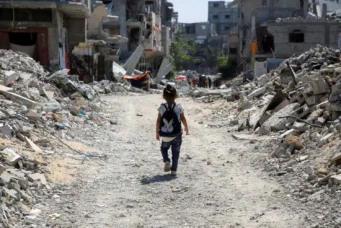
From the images of Palestinian children withered away into living skeletons as they face systemic starvation—a medieval weapon of war—to the Israeli hostages emaciated and pleading with a government that has tuned them out, it is forgivable to feel anguish and despair.
In the meantime, and facing homegrown public revulsion at their incapacity to act, European capitals say they will recognize Palestinian statehood at the United Nations 80th General Assembly. But the UK, among others, has said that the Palestinians must fulfill certain conditions—such as disarming Hamas, prohibiting it from playing a rule in any future Palestinian governance, committing to non-violence, recognizing Israel, and other such obligations—before statehood can be recognized.
Yes, Palestinian statehood, which is an inalienable right for the Palestinian people, is conditional. Even when having to stomach the images of bodies torn to bits and Israeli and Palestinian mothers begging for the conflict to end, there is still hesitation.
In response to more than 145 countries already recognizing Palestine as an independent, sovereign state—with a handful more following pursuit in the coming months—Netanyahu’s government has adopted a two-prong approach, first by launching diplomatic spats with the likes of France and Norway, and second by swearing to bury any hope of a Palestinian state by annexing the West Bank.
The genocide might be happening in Gaza, but the war threatens all of Palestine.
But will the recognition of Palestinian statehood halt the tanks from bulldozing through Gaza and destroying the lives of the two million people who live there? Will this iteration of a two-state solution halt Israeli settler attacks against Palestinians, their homes, and olive orchards?
Former Cairo Review editor Omar Auf tackles these questions and more in his essay “What Palestinian Statehood Must Mean to Mean Anything”.
“A two-state solution is currently impossible to achieve given the Israeli control over Palestinian lands, even before October 2023 let alone now, combined with the Israeli government and people’s hard slide to the right,” Auf argues.
“And to pursue it while a genocide is taking place with plans to annex the entirety of the West Bank is to stop a tsunami by spraying water at it.”
Israeli negotiator Gershon Baskin believes ending the war is the most important priority and, like Auf, sees that more needs to be done by the international community.
“There is growing global criticism against Israel, but it will take significantly more pressure to produce any real impact. Recognizing the State of Palestine (which should have been done decades ago) and cancelling the visa of a right-wing fanatic Israeli minister to Australia is not enough,” he writes in “Ending the War In Gaza: What Must Be Done Now”.
The ongoing war in Gaza has revealed uncomfortable truths to many within and outside Israel society. Israel may be impervious to defeat from an external enemy, but it risks destroying itself from within.
Founder of Tikkun Olam, a liberal Jewish blog, Richard Silverstein uses history as a guide in his piece “Beyond Its Wildest Dreams: Israel’s Campaign for Geo-Strategic Dominance in the Middle East”, arguing that Israel has made fateful errors in declaring its enemies defeated.
“You cannot eliminate an enemy solely by brute force. The urge to resist and rebel has historically always been an animating force in human affairs. Eventually, either Israel declines through its own internal dysfunction; or its enemies regain their power and renew their challenge. The tide will inevitably turn. Its colonial power and dominance will dissipate. At that point, its hubris will be its ultimate downfall,” he warns.
Hubris may very well have fueled a lot of the current crisis. One wonders what Hamas was hoping to achieve in its bloody attacks on Israelis on October 7, 2023. Did they really overlook 78 years of history suffered by the Palestinians and underestimate how Israel would respond? Like the Israeli government which continues to defy global outrage and the rising call of Israelis to end the war, Hamas, too, must answer to their own people.
A grim summer? Indeed. But there may yet be a spring of hope. As academic and author Raphael Cohen-Almagor observes in his essay Resolving the Israeli-Palestinian Conflict, both Israelis and Palestinians are battered and traumatised, but shifting attitudes suggest that opportunities may eventually emerge.
“We should not fall into the fallacy of thinking that the future is bound to be similar to the present situation, and whatever situation we are in is here to stay,” he cautions.
“Peace will not come quickly, but its potential rewards—security, prosperity, and justice for both peoples—justify the immense effort required.”
Indeed.
Cairo Review Managing Editor,
Firas Al-Atraqchi