The Promise and Perils of the “Policy Dial” in Syria
Calibrated sanctions relief is replacing “maximum pressure” in post-Assad Syria. Can incremental engagement survive strongmen, regional war, and distracted donors?
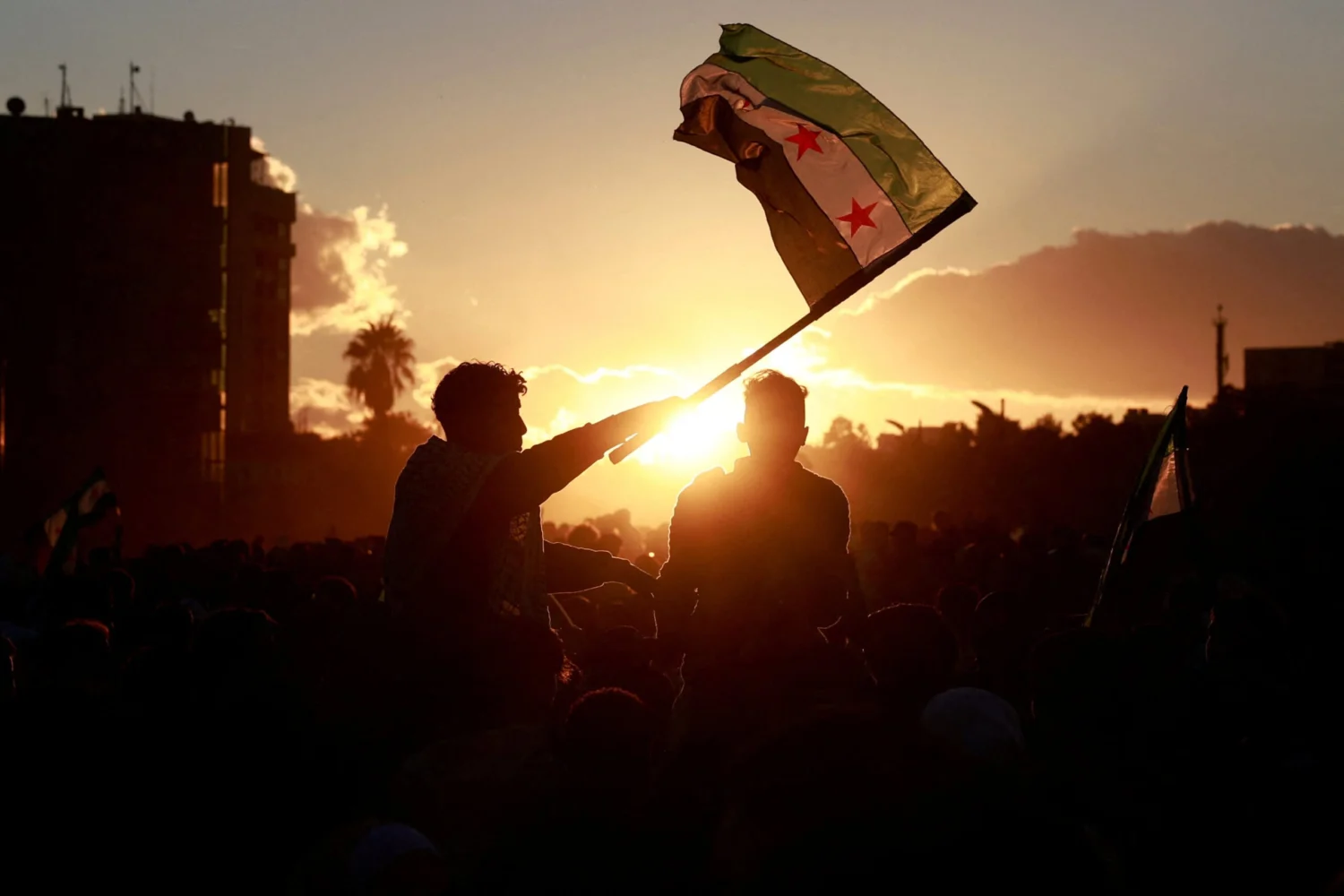
For more than a decade, outside powers have treated Syria as a switch with two positions. Under “maximum pressure,” sweeping sanctions were meant to force former President Bashar al-Assad from power or to the negotiating table; instead, they impoverished ordinary Syrians, fed a shadow economy, and enriched the regime insiders and warlords best placed to profit from it. The alternative—wholesale normalization that culminated in Syria’s readmission to the Arab League in May 2023—asked little of the regime and got nothing in return.
Since the regime’s collapse on December 8, 2024, Western governments and donors have reached for something more flexible—what practitioners now call the “policy dial”. Rather than flicking sanctions and aid on or off, the dial turns them up or down by degrees, tying each adjustment not to arbitrary deadlines or checklist deliverables but to measured progress on governance, justice, and inclusion on the ground. The challenge here, however, is that a system that rewards visible progress can be gamed by those who learn to stage reform without sharing power. And power in Damascus is concentrating fast in the presidency.
Syria is not the first place the binary has failed. In Iraq, Afghanistan, and Sudan, the rigid alternatives of total sanctions or unconditional relief produced similar outcomes: shadow economies, entrenched warlords, or new oligarchies thrived until external support ebbed. Post-Assad Syria is now the sharpest test yet of whether a calibrated alternative can do better. Nearly two years after Assad’s fall, the dial is a framework in operation, tested daily by diplomats, donors, NGOs, and Syrian communities themselves. Its promise is considerable, but so are its limits.
From Rigid Conditionality to Calibrated Engagement
The intellectual roots of the dial lie in critiques of the “big bang” liberalization that dominated Western post–Cold War interventions: the belief that war-torn states should hold elections and open their markets as fast as possible, with outside money and recognition arriving all at once. Political scientist Roland Paris, in At War’s End, his study of peacebuilding after civil wars, and Richard Caplan, who studies how international administrations govern war-torn territories, both stressed the perils of such externally dictated transitions. They argued that democratization and market reform, pushed through before the institutions needed to manage them had been built, produced fresh instability, the capture of public resources by elites, and cycles of violence in Bosnia, Kosovo, Iraq, and Afghanistan.
In Iraq, sweeping de-Baathification—the purge of Saddam Hussein’s ruling party from the civil service and the army—gutted administrative capacity, while the wholesale lifting of sanctions and the loosely monitored reconstruction money that followed fed patronage networks and sectarian fragmentation. Afghanistan showed how volatile, headline-driven international support left a hollow, aid-dependent bureaucracy and deepened the war economy.
Where adaptive, iteratively benchmarked models were tried—most notably in Kosovo, where the UN’s “standards before status” policy tied progress toward a decision on the territory’s future to regularly reviewed benchmarks on institution-building, minority inclusion, and rule of law—results were better, if uneven.
The tool common to all these efforts was conditionality: making aid, recognition, or sanctions relief dependent on what the recipient government does. Rather than being an alternative to “big bang” liberalization, conditionality was the lever outsiders used to push it through, usually in all-or-nothing form: meet every demand by a fixed date, or get nothing. The lesson was not that conditionality failed, but that rigid conditionality invited either manipulation or collapse, while iterative, empirically grounded adjustments offer a better—though far from foolproof—pathway for fragile transitions.
That insight is precisely what distinguishes the dial from the sanctions regimes that preceded it. Syria has lived through the rigid version at its most punitive. The Caesar Syria Civilian Protection Act, a U.S. law passed in 2019 (named for the military photographer, code-named Caesar, who smuggled out images of torture in Assad’s prisons), threatened sanctions on anyone, of any nationality, who did business with the Syrian state, and offered relief only if certain demands—that the Assad government never came close to meeting—were fulfilled. This was conditionality in its all-or-nothing form. The Caesar Act era of 2019–2024 devastated ordinary Syrians, fueling shadow economies and humanitarian shortfalls while entrenching the very regime and warlord networks best able to exploit illicit trade.
The opposite error is relief with no strings at all. Aid surges untethered from real benchmarks—as seen in early post-conflict Iraq and Sudan—tended to empower new oligarchies or provoke backlash when donor attention moved on. As a result, the policy dial is an attempt to steer between the two: conditionality that is graduated, continuously measured, and reversible.
In practice, the dial is meant to rest on multi-stakeholder monitoring panels that bring together local civil society, including minority groups, women’s advocates, youth councils, and faith leaders, alongside municipal authorities, field representatives of major donors, and independent observers drawn from regional think tanks and international media. Such panels would assess “policy settings” against a common set of indicators: municipal inclusion and representation, documented incidents of protest or violence, judicial reform, transparency in procurement and employment, and the delivery of education, health, and public infrastructure.
Responses are then meant to be scaled to progress: partial sanctions relief or sectoral grants for verified improvements (such as the restoration of women’s participation in local councils, successful corruption prosecutions, or demonstrable minority protection in returns) and targeted withholding where setbacks are substantiated. The aim is maximum leverage with minimum collateral damage: to suspend or re-target specific flows without pulling the plug on everything.
The Dial, Written into Law
The clearest evidence that this logic has moved from theory to practice lies in the sanctions architecture itself. The dismantling of “maximum pressure” is being deliberately phased: The European Union lifted its economic sanctions in May 2025; the United Kingdom removed broad sectoral measures the same month. In the United States, President Donald Trump announced the cessation of sanctions in a landmark Riyadh speech in May 2025; the core sanctions program was terminated by Executive Order 14312 on June 30, 2025, and the Caesar Act—the punitive instrument of the previous era—was permanently repealed when Trump signed the FY2026 National Defense Authorization Act on December 18, 2025.
Crucially, that repeal was not unconditional. It required the president to certify to Congress every 180 days, for four years, that Syria’s government is taking action on counterterrorism, minority protection, and regional security. In effect, a version of the dial has been written into American statute: relief is granted, but if Damascus misses its benchmarks for two consecutive reporting periods, the law invites the president to consider targeted sanctions on individuals. The same selective logic governs what remains in place.
Washington revoked Hay’at Tahrir al-Sham’s terrorist designation in July 2025 and removed Syrian President Ahmed al-Sharaa and his interior minister from the Specially Designated Global Terrorist list in November 2025—the UN Security Council having delisted both men the day before. Syria’s designation as a State Sponsor of Terrorism, kept under review for more than a year, was rescinded only on August 24, 2026. Asset freezes tied to alleged chemical-weapons perpetrators, Captagon traffickers (an illicit stimulant), and those implicated in mass atrocities remain in place, however. This is calibration by design: aid and commerce expand incrementally while leverage is retained against specific actors and specific crimes. With the last country-wide designation now lifted, what remains of the dial in American law is chiefly the certification requirement and the sanctions on named individuals.
The humanitarian and economic machinery has tracked the same conditional logic. The 2025 Brussels Donor Conference committed roughly €5.8 billion (c. $6.5 billion) to Syria and its neighbors, with disbursements tightly tied to continuing reform and credible monitoring, and the EU has since committed a further €620 million (c. $7 million) for 2026–2027 for socio-economic recovery and reconstruction. The International Organization for Migration has cautioned, however, that sanctions relief must be matched with concrete support for livelihoods, housing, and legal documentation if returns are to prove sustainable, a reminder that the dial counts what goes in (sanctions lifted, money pledged) more easily than it secures what comes out: homes, jobs, and returns that last.
The Limits Arrive as Quickly as the Promise
The dial’s central vulnerability is what might be called opportunistic adaptation. Powerbrokers (such as former regime affiliates, emerging militias, and newly “connected” business groups) have proven adept at constructing the appearance of reform to unlock funds, contracts, or legitimacy, while perpetuating exclusion and clientelism beneath the surface. Partial compliance becomes a strategy: deliver just enough to move the dial, change little underneath. The risk is a system that rewards reform theater and leaves much of society politically and economically on the margins, eroding the real-world value of what the dial promises.
The monitoring on which the dial depends is also fragile. Donor performance dashboards are a genuine advance over the era of vague communiqués, but they require granular, ethically collected field data and honest brokers. UN, OCHA, and ICRC teams remain the backbone of monitoring, yet they face intimidation, restricted access, and incomplete reporting in contested zones. Local civil society leaders, often young and politically exposed, bear real personal risk for reporting “dial failures” in real time—a reality too often absent from policy design. Syrian civil society organizations have themselves warned of stagnation in the political process and of monitoring mechanisms that lack transparency and independence.
When Force Replaces Negotiation: The January Offensive
No episode tested the dial’s integrity more directly than the confrontation in Syria’s northeast. A March 2025 framework agreement between Damascus and the Syrian Democratic Forces (SDF), the Kurdish-led, U.S.-backed force that then held much of the northeast, had envisaged a negotiated integration that respected Kurdish political and cultural autonomy. It made no meaningful progress over ten months, and its end-of-2025 deadline expired with none of its provisions implemented. What followed was not dialogue but coercion: in January 2026, Damascus launched a rapid offensive, seizing Raqqa, Deir ez-Zor, and swathes of Hasakah before a U.S.-brokered ceasefire halted the government’s advance. The terms imposed were markedly harsher than those of March 2025—the SDF’s immediate handover to Damascus of territory, oil fields, border crossings, and detention camps, and the dissolution of the SDF as a distinct formation in favor of individual integration into the national army. The earlier framework was, in effect, shelved in favor of terms imposed by force.
A presidential decree and a subsequent comprehensive agreement in January 2026 added cultural concessions (including citizenship for stateless Kurds, recognition of Kurdish as a national language, and Nowruz, the Kurdish and Persian New Year, as a national holiday) but stopped short of the constitutional guarantees Kurdish leaders had demanded. Implementation has, however, proceeded more smoothly so far than many expected.
Government forces entered Hasakah and Qamishli, two of the northeast’s main cities, while Kurdish police kept order during the handover. On May 24, 2026, the formerly Kurdish-held districts voted in legislative by-elections for the seats that had been left empty when the People’s Assembly was first selected in October 2025. Each step, however, came with a caveat. Only nine Kurdish candidates won seats. The Druze-majority province of Suwayda held no vote at all. The SDF formally dissolved itself and merged into the national army on August 25, 2026, but how its fighters will be commanded and vetted inside national units has yet to be tested. UN human rights experts, meanwhile, condemned reports of summary executions, attacks on civilians, and torture during the offensive and the ceasefire that followed, and called for violations by all parties to be investigated.
The episode crystallizes a structural tension: when a central government extends its authority by force rather than negotiated inclusion, external actors face a dilemma between endorsing coercive stabilization and insisting on benchmarks that were bypassed in practice. A dial calibrated to “demonstrated political progress” struggles to register the difference between consolidation and conquest. Understandably, Kurdish leaders have warned that ceasefire terms not embedded in a permanent constitution remain reversible.
A Transition Still Answering for Its Violence
That tension between stabilization by force and inclusion by negotiation is sharpened by the wider record of communal violence the transition has yet to reckon with. Sectarian massacres of Alawites, followers of an offshoot of Shia Islam to which the Assad family belongs, on the coast in March 2025 and of Druze in Suwayda in July 2025 (the latter left close to 2,000 people dead), together with a church bombing in Damascus in June 2025, have repeatedly tested the government’s credibility and slowed returns. Suwayda itself remains largely outside government control, run by forces loyal to the Druze spiritual leader Hikmat al-Hijri, and intermittent clashes with government forces, along with tensions among Druze factions, have continued through 2026, most recently in early September.
In the meantime, the National Transitional Justice Commission, established in May 2025, has begun building a national victims’ registry with an emphasis on survivor participation through workshops and advisory roles—a meaningful step toward the kind of inclusive accountability the dial is supposed to reward. But Human Rights Watch has noted that the commission’s mandate covers only abuses by the former regime, leaving victims of other actors without recourse; this is precisely the selective accountability that corrodes legitimacy.
Nor have international mechanisms filled the gap. They have gained access to the country, but not the full access they need to work there, and the UN Commission of Inquiry’s mandate is renewed only a year at a time, most recently in March 2026. The documented toll is staggering: the Syrian Network for Human Rights records at least 234,805 civilians killed since March 2011, around 202,000 of them by regime forces, alongside more than 180,000 cases of arbitrary detention and enforced disappearance.
The Constitution That Has Not Been Written
If the dial is meant to reward institution-building, the most consequential institution remains unbuilt. The March 2025 constitutional declaration was always a placeholder; al-Sharaa himself acknowledged that creating a permanent constitution could take up to three years. Yet, as of September 2026, no drafting committee has been named, and the constitutional court the declaration created was seated only in July 2026, its members appointed by presidential decree.
The declaration concentrates power in ways that sit uneasily with the dial’s inclusivity benchmarks because they grant the presidency authority to appoint the constitutional court, to appoint and dismiss ministers without checks, and to control a large share of the People’s Assembly through a committee it names. It also enshrines Islamic jurisprudence as the primary source of legislation, a formulation that has generated persistent anxiety among non-Sunni communities. A May 2026 cabinet reshuffle, prompted partly by criticism of nepotism, underscored how personalized authority remains intact; among those removed was the president’s own brother, who had served as secretary-general for the presidency.
This concentration of power is precisely the condition in which opportunistic adaptation flourishes. It also has a concrete legal consequence. Syrian law still does not codify war crimes or crimes against humanity, so when a Damascus court sentenced Bashar al-Assad to death in absentia for both in August 2026, jurists were left asking on what legal basis it had acted. A permanent constitution, and the legislation that must follow it, is thus a prerequisite not only for inclusive governance but for a transitional justice process that can withstand scrutiny. Both the European Union and the U.S. Congressional Research Service have flagged that donor confidence in longer-term reconstruction will hinge on whether the constitutional process proves genuinely inclusive, making it—in the dial’s own terms—a setting of the first order that has not yet been adjusted.
A Transactional Patron
The dial’s design assumes patient, benchmarked engagement but Washington’s posture has often supplied the opposite. After moving cautiously in the wake of Assad’s fall—wary of al-Sharaa’s origins as a former al-Qaeda operative—the Trump administration pivoted sharply, first at a Saudi–U.S. investment forum in Riyadh in May 2025 and then at a November 2025 White House summit that embraced al-Sharaa as a security partner. Engagement has coalesced around five core demands: joining the Abraham Accords, expelling foreign terrorist fighters, deporting Palestinian militants, supporting operations against the Islamic State (IS), and assuming control of IS detention facilities. Al-Sharaa has made credible progress on several, though the Abraham Accords and the detention handover remain unresolved.
The structural risk is that headline diplomacy substitutes for sustained institutional engagement. Sweeping cuts to USAID and the termination of stabilization programming by mid-2025 removed the United States as a meaningful funder of local governance reform—the very work the dial depends on—leaving that burden to regional powers whose agendas do not center on accountability or minority inclusion. The United States Congress, notably, has proved a more demanding partner than the executive. House Foreign Affairs Committee chair Brian Mast told a February 2026 hearing that Washington expected actions, not words; he had made his support for repealing the Caesar Act conditional on mechanisms to reimpose sanctions—the conditionality that is the dial’s institutional safeguard.
The Dial Against a Regional Fire
The dial’s deepest weakness is that calibrated engagement must always compete for attention with larger geopolitical emergencies, and in 2026 that vulnerability became acute. What began on February 28, 2026, as US and Israeli strikes on Iran, including the killing of Supreme Leader Ali Khamenei, escalated into a regional war that has yet to end. Iran’s closure of the Strait of Hormuz triggered a global fuel crisis. A U.S.–Iran ceasefire reached in early April, and a Pakistani-mediated memorandum of understanding signed in June were both meant to reopen the strait and end the war, but both unraveled amid disputes over Israel’s parallel war with Hezbollah in Lebanon and over Iran’s claim to control shipping through the strait. Fighting resumed in July and, as of mid-September, the Strait remains closed to most commercial shipping; Houthi attacks have carried the disruption into the Red Sea, and Washington and Tehran are still trading conditions for reopening it.
For Syria, the war is both an opportunity and a hazard. Assad’s fall had already been a strategic defeat for Iran because it dismantled the Iraq–Syria–Lebanon logistics network that sustained Hezbollah. In the meantime, the new Syrian government has adopted a deliberate policy of non-confrontation while barring the reconstitution of Iranian military infrastructure on its soil. Yet, residual risks persist—Tehran retains influence across the eastern border and longstanding ties to coastal Alawite communities. Damascus has kept out of the war (al-Sharaa has reiterated that Syria will remain outside it unless directly attacked), and that restraint is itself a benchmark the dial can credit. But the indirect costs are heavy: donor attention and EU bandwidth consumed by the wider crisis—as the CSIS analysts warned they would be—economic risk perceptions rising, and more than 390,000 people pushed across the border into Syria by the fighting in Lebanon since early March, straining services already near collapse.
The economic picture is correspondingly mixed. The rate of returning refugees has accelerated dramatically—Syrian officials cited more than 3.5 million returnees by late May 2026, up from 1.4 million in February—yet nearly nine in ten Syrians still live below the poverty line. According to the World Bank, reconstruction needs at $216 billion remain largely unmet, and signed foreign contracts have concentrated in extractive sectors, infrastructure, and real estate—the so-called “islands of investment”—rather than broad-based recovery. Even the donor architecture has shifted: the nine Brussels donor conferences of 2017–2025 have given way to a Syria Partnership Coordination Forum that the EU co-chairs with the Syrian government, and the civil-society “Day of Dialogue” that once ran alongside them was held in Damascus for the first time in November 2025. The shift is symbolically significant, but symbolism does not move money: pledged funds still too often stall in intermediary banks that remain wary of residual sanctions-compliance risk.
What the 2026 Cycle Requires
The lessons of the nearly two years since Assad’s fall point to four priorities, each drawn from where the dial has worked and where it has failed.
First, local and survivor voices must be co-designers of benchmarks and monitoring, not afterthoughts. Experience from Kosovo to South Sudan suggests that inclusive ownership both improves data and increases legitimacy. The victims’ registry is a start, but inclusion must extend to those reporting failures in real time.
Second, independent verification must be insulated. Third-party monitors, open dashboards, and whistleblower protections are what separate a credible dial from donor theater; donors should withhold funds where minimum transparency is not met.
Third, flexibility cannot become arbitrariness: locally specific calibration is the dial’s strength, but it must not slide into substituting donor whim for consistent standards.
Fourth, and perhaps most difficult, engagement must survive setbacks: transitions are non-linear, and threshold-based withdrawal can undo hard-won gains in institution-building and communal trust. “Dial down” rather than “turn off” should be the default—unless grave breaches are proven.
For Syrian actors, governmental and non-governmental alike, the challenge is twofold—to treat the dial as leverage for building inclusive institutions and devolved governance rather than a mechanism for extracting resources and recognition, and to demonstrate to wary populations and a skeptical diaspora that the transition can deliver real change in rule of law, livelihoods, and security without reproducing the exclusions and violence of previous decades.
The dial remains the best available framework for external actors to keep leverage while calibrating engagement to reality rather than to deadlines. But its success is contingent, not guaranteed. If its mechanisms prove durable—flexible under pressure, rigorous in monitoring, genuinely participatory in design—2026 may mark a turning point for Syria and for the wider practice of supporting fragile states. If policy instead becomes donor-driven theater, if elite and militia capture return unchecked, or if the constitutional process marginalizes minorities and entrenches executive dominance, the country risks sliding from civil war into a protracted crisis of legitimacy from which recovery would be immeasurably harder. The dial’s promise was always that progress could be measured and rewarded incrementally. The question 2026 will answer is whether anyone is still watching the gauge.