AI’s Dark Secrets: Inside the Global Exploitation of Data Workers
As the Global North continues to benefit from the AI boom, it is increasingly critical that multinational corporations provide protections of and be accountable for the wellbeing of data workers around the world

The global race to invest in AI infrastructure and its adoption into everyday life has put an ultra-responsive helper in everyone’s pocket, whether they’re searching for medical advice, a digital beau, or how to cook a brisket.
And the growth isn’t stopping. The UN Trade and Development organization estimates that the global AI market is projected to grow from $189 billion in 2023 to $4.8 trillion by 2033. But this technology doesn’t run itself. The AI supply chain relies on data workers, the humans responsible for labeling images, moderating content, and evaluating the prompts that make AI possible.
These are often online gig-workers paid on a task-by-task basis. LinkedIn reports data annotation as one of the 25 fastest-growing roles in the U.S. in 2026.
Since 2020, investigations from TIME magazine, the Pulitzer Center, and more have revealed tech multinational corporations (MNCs) in the Global North often outsource the training of AI models to data workers in cheaper labor markets, largely in the Global South. Many feature stories of economic exploitation, underpayment, repeated exposure to traumatic content in content moderation, and sudden job cuts.
In February 2026, Swedish newspaper Svenska Dagbladet revealed that Meta’s popular RayBan AI glasses send video from its wearers to data workers in Kenya, who use the video to train the company’s AI.
As one worker told Svenska Dagbladet, “In some videos you can see someone going to the toilet, or getting undressed. I don’t think they know, because if they knew they wouldn’t be recording.”
Even though their work is critical to the success of AI products, global data workers are vulnerable. The UN’s International Labor Organization (ILO) reports that data workers in developing nations are paid as little as $2 an hour.
Without recognition and labor protections for these data workers, tech MNCs, which are largely based in the Global North, control the economic fates of disenfranchised foreign workers who power their technologies.
Exploitation through Data Work
While there are no reliable data sources to estimate the size of the gig work economy, the World Bank’s 2023 report “Working Without Borders: The Promise and Peril of Online Gig Work” used various methods including country surveys, web scraping, and website traffic data to estimate that gig workers account for 4.4 to 12.5% of the global labour force.
The report found nearly 40 percent of traffic to gig platforms came from lower to middle income countries. Much of the gig work covered includes content writing, freelance design, and micro tasks, like the task-by-task data labeling and annotation used in AI development.
MNCs often subcontract data work to the Global South via two paths: digital platforms or business-process outsourcing firms (BPOs).
Digital platforms such as Remotasks, Appen, and Microworkers connect clients to remote workers anywhere in the world, who receive payment by the task completed. BPOs offer data work services at physical centers where workers enter to complete the tasks at hand.
Outsourcing work to countries with lower pay and less restrictive labor regulations is not new, the garment industry is famous for it. Multinational corporations (MNCs) look to maximize profit by training massive amounts of data at the cheapest cost possible.
Companies themselves may outsource not only to cut costs, but to reach workers with regional language skills to train new AI models. For workers, data work is attractive because it can be a new income stream, it’s often remote and flexible, and offers the chance to earn in a strong currency.
“Doing data work and platforms is attractive because it’s an opportunity to earn in dollars which is generally considered a stronger and more stable currency,” said Camilla Salim Wagner, a researcher at the Data Workers’ Inquiry and the Distributed AI Research Institute.
“This is the case for a lot of data workers from Venezuela who, during the hyper-inflation crisis, would turn to platform data work to earn in dollars.”
However, this dynamic grants tech MNCs an enormous lever of economic influence over data workers in the developing world.
In 2022, The MIT Technology Review broke the news that digital platform work companies like Remotasks were profiting from Venezuela’s economic crisis, outsourcing data labeling tasks to Venezuelan workers for cheap labor. Some reported undercounted hours, lower pay than counterparts in North America and the Philippines, in addition to facing suspension if these workers were not quick or accurate in their tasks.
Human rights organization Equidem explains that tech MNCs can set the terms of business relationships with BPOs because there are few buyers but many suppliers of data work, resulting in “AI work for low wages at a high pace — conditions that are incompatible with decent work standards.”
These contracts with BPO firms can be ended at any time, increasing competition between suppliers of data work and creating market conditions that create a race to the bottom in employment standards. As a result, data workers suffer, facing minimal job protections and sub-minimum wages, in addition to psychological and physiological consequences.
Equidem interviewed 113 workers for its 2025 report “Scroll, Click, Suffer,” documenting the harm faced by outsourced data workers in Colombia, Ghana, and Kenya who moderate content and train AI models for tech MNCs.
Adam, a migrant worker in Colombia working for a BPO firm subcontracted by Meta and Byte Dance, told Equidem researchers, “The content was 99% child pornography and abuse material. I was dealing with inappropriate content day in and day out, 8 hours a day. I lost around 15 kilos in 6 to 8 months.”
The increasing interconnectivity between tech MNCS and data work suppliers is charted in Tech Equity’s Data Work Landscape 2.0, mapping 1,924 relationships between 116 data work companies, subcontractors, investors, and partners.
The Amsterdam-based Centre for Research on Multinational Corporations argues these companies have a responsibility for the well-being of global data workers because the companies are increasingly not only the buyers, but also the sellers and suppliers of data work.
For example, consider Meta, who bought a 49% stake in the data-labeling giant Scale AI in June 2025. Scale AI owns Remotasks and was sued six months earlier, alleging the company subjected contract workers to view distressing content while training AI tools for Meta and Google.
The Washington Post and the Independent reported in 2023 how Filipino data workers working for Remotasks were paid below the Philippines minimum wage. As one worker told The Equal Times in 2025, “I work between 8 and 10 hours per day for an average of €6. It’s less than the legal minimum, and I have no social protection, but I don’t have a choice. In this part of the Philippines, there are very few jobs.”
In the emerging economies, remote data work might outpace local salaries. This can lead workers to stay in poor working conditions to maintain a certain level of income, setting up a situation rife for exploitation. Yet non-disclosure agreements (NDAs), rife throughout the data work industry, prevent workers from publicly speaking out and unionizing.
The Intercept Brasil reported in 2024 that OneForma, a crowdworking platform used by Google for data preparation, made workers sign agreements waiving rights to collective legal action.
“NDAs are extremely pervasive in the industry. They prevent workers from talking to each other, from finding each other,” says Salim Wagner. “If you make workers communicating more difficult, you make organizing more difficult by default.”
This high level of institutional secrecy prevents even workers from knowing necessarily what they are working on, even if it may implicate their own country.
In February, the London-based Bureau of Investigative Journalism revealed data workers in countries targeted by U.S. military forces may have unknowingly worked on AI projects for the U.S. military through Australian AI-training company Appen.
To understand this, the theories of techno-neocolonialism and data colonialism provide a framework to explain how the AI boom’s benefits flow toward companies in the Global North.
Explaining Techno-neocolonialism
Techno-neocolonialism is a contemporary phenomenon where global powers and multinational corporations can exert influence over the economic and technological realms of developing countries previously under colonial rule.
As Jerry John Kponyo at the Kwame Nkrumah University of Science and Technology explains, an elite set of companies and shareholders in the Global North continue “to benefit disproportionately from the Global South’s contributions,” mimicking colonial era relations of extraction and exploitative labor.
The Digital Platform Labor (DiP) Lab compares data work in Venezuela, Brazil, Madagascar, and France in its 2025 report “Global Inequalities in the Production of Artificial Intelligence: A Four-Country Study on Data Work,” arguing that the companies in the Global North search for exploitative conditions in global communities to outsource data work.
The Venezuelan data workers surveyed were largely men educated in science, technology, engineering and mathematics (STEM), pursuing it as a full time job in lieu of reliable employment opportunities amid an economic crisis. In Brazil, nearly two thirds of data workers surveyed were women with children, serving as both an opportunity for unemployed new graduates and people reliant on the informal job market.
Madagascar, once colonized by France, is the second largest exporter of computing services in Francophone Africa. French clients can outsource data work to Madagascar at low cost through contractual labor, allowing for what the DiP lab calls “a quasi-employee relationship without the obligations associated with formal employment under French law”.
Of the Malagasy (as people of Madagascar are known) data workers surveyed, nearly 75% held higher education degrees and many saw data work as a step towards entering jobs in the formal economy relevant to their degree.
However, the DiP Lab explains there is limited career progression due to company structure, with French clients holding “tight control over their production processes” and leaving “very few intermediate management positions available to locals”.
This occurs as national economies worldwide are increasingly staking their future on AI’s growth. Forty-one AI-related stocks account for nearly half of the S&P 500’s market value; global corporate investment in AI doubled in 2025; and half of new AI strategies came from emerging economies in 2024.
But as countries look to increase AI infrastructure capacity and re-skill workforces for labor changes, what opportunities does outsourced data work offer to talent in emerging markets looking to capitalize on artificial intelligence?
Not much, as the ILO explains. Many data workers are highly educated and the mismatch of skilled workers to these jobs reduces opportunities for career progression. Oftentimes, these jobs require skilled specialized knowledge acquired from a bachelor’s degree.
The Middle East and North Africa (MENA) Observatory on Responsible AI reports 7 countries in the MENA region have published national AI strategies. Wealthier GCC nations like the UAE and Saudi Arabia are staking future economic growth on heavy investments in AI. However, many lower-income MENA countries are constrained in AI growth due to lower resources to reskill a labor force, debt, and socioeconomic crises.
Nur Arafeh, senior fellow at the Arab Center Washington DC, explains that AI can create jobs in data work jobs like data-cleaning, labeling, and content moderation in lower-income MENA countries, but can trap workers in “activities that do not contribute to long-term economic transformation or technological capacity-building.”
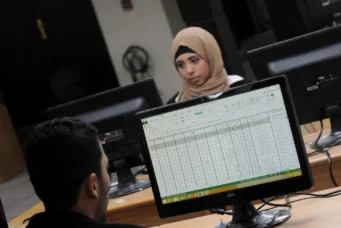
Another recent report on digital platform labor by the DiPLab surveyed over 600 Egyptian platform workers and over 60% of the Egyptian workers surveyed held bachelor’s degrees in science or technical fields. The majority of respondents were young, 76% were male and 59% were single. Many reported spending their earnings immediately on rent, food or clothes.
The majority reported working on platforms out of financial necessity, with average monthly earnings reaching $58.76 USD, and nearly 48.75% reported earning less than $30 USD in the previous month. As one participant said, “Since I am Egyptian, I get tasks that have a very low pay rate,” noting that tasks that pay $20 in Egypt are paid $450 overseas.
Participants reported working for the following platforms: Microworkers, Contra, Telus, OneForma, Toloka, Fiverr, Clickworker, Upwork, Appen, Universal Human Relevance System and Remotasks—all of which are based in either the United States, Australia, Canada, Israel, or Europe.
Similar to the practice of Non-Disclosure Agreements (NDAs), these workers also mentioned how platforms banned worker interactions limiting solidarity. Some even downplayed their degrees believing it would increase their chance of gaining work, as one respondent said, “should I let go of my engineering degree and not mention it?”
As in techno-neocolonialism, the current system for data work lets the benefits of artificial intelligence flow to world powers and tech MNCs unbound by historical colonial lines. The structure also limits opportunities for well-educated local talent, who may seek out exploitative data work out of financial necessity. The benefits flow up, with the DiP Lab tracking that data work flows from the Global South, to production hubs for AI, including North America, Europe, India and China.
For its part, “Data colonialism” is a closely related concept first coined by professors Nick Couldry and Ulises A. Mejias. This framework views data as a raw material for capture and explores how data workers can be exploited by multinational corporations, regardless of whether they work in the Global North or Global South.
The AI revolution requires extensive human labor to constantly update artificial intelligence systems. Without established legal rights for data workers and accountability for MNCs, this workforce is left to the whim of boardrooms an ocean away, as seen in the case of Meta in Kenya.
Avoiding Accountability: The Case of Meta in Kenya
Kenya’s three-year long entanglement with Meta and U.S-based Business Process Outsourcing (BPO) Sama highlights the urgent need for protections for data workers.
A TIME investigation in 2022 already revealed poor working conditions in Sama’s Nairobi center, where Kenyan employees were underpaid at $1.50 an hour to moderate brutal and traumatizing content uploaded to Facebook.
A former content moderator sued both companies in May 2022 and Meta initially argued it could not be tried in Kenya because the company is not based in the country. This argument was rejected by Kenya’s Court of Appeal in February 2023.
But Meta tried the same argument again when faced with a March 2023 lawsuit for unfair dismissal, filed after the company closed its Nairobi content moderation center and fired 184 content moderators.
The lawsuit, also filed against Sama, alleges the content moderators were fired for unionizing and then prevented from applying for the same roles at a new firm Facebook hired.
Meta argued it was “not subject to the Constitution and the laws of Kenya,” but the Court of Appeal found in September 2024 the company could be sued in Kenyan courts.
Soon after, the government proposed Business Laws (Amendment) Bill 2024, preventing the clients of outsourcing companies from being sued by Kenyan contractors.
Dubbed a silicon savannah, Kenya’s government has courted tech giants like Uber and Meta for years. In May 2024, Microsoft and the UAE-based G42 firm announced a $1 billion investment in building a digital ecosystem initiative for Kenya, including data center infrastructure, internet access, and local AI model development and research.
At a December 2024 public town hall, Kenyan President William Ruto referenced the bill and Sama, saying, “Now I can report to you that we have changed the law. So, nobody will take you to court again on any matter.”
The law was passed but has been challenged by tech workers in a lawsuit and petition, who claim it was passed unconstitutionally and as a result of lobbying by tech companies.
A 2025 joint investigation by The Guardian and the London-based nonprofit Bureau of Investigative Journalism revealed that while facing lawsuits in Kenya, Meta moved its regional content moderation to Ghana, recruiting workers through French tech MNC Teleperformance.
Some of those workers developed depression, suicidal thoughts and various mental illnesses after repeated exposure to traumatizing content. They were also instructed to conceal that they moderate content for Meta. This prompted a new set of lawsuits, alleging Teleperformance punished workers for unionizing and advocating for better working conditions.
Kenya’s story with Sama and Meta are symptoms of techno-neocolonialism. Data is immaterial, so when a MNC outsources digital data work, there’s no shipment, factories, or machinery attached. This allows corporations to arrive then pack up and leave as they like, avoiding the ramifications of their actions and leaving workers with no route to redress grievances.
Researcher Salim Wagner identifies this geographic mobility as a key differentiator between outsourcing in data work versus other industries. “They’re basically geographically unbound, and they can accelerate those ‘race to the bottom’ competition dynamics between workers and between countries,” she said.
Their influence allows them to export trauma, as TIME journalist Billy Perrigo puts it, “along old colonial axes of power, away from the U.S. and Europe and toward the developing world”.
Data Colonialism in the Global North
As the theory of data colonialism suggests, workers in the Global North are also impacted.
Data annotation is one of the fastest growing jobs in the United States through data work startup companies like Mercor, Surge AI, Scale AI, and Handshake, who are each earning around $1 billion.
Many people turn to AI-training as an extra source of income in a precarious labor market. In the past year, articles from WIRED and New York Magazine talk about the screen writers, lawyers, and doctors who turn to training the AI systems which then displace their own jobs.
While data workers in the Global North may share some similar experiences with those in the Global South, they are often paid more. In 2026, the Guardian reported U.S.-based AI raters at GlobalLogic were paid more than data-labeling counterparts in Africa and South Africa.
Even still, the financial precarity of contract labor, for essential work, remains exploitative.
The report “Ghost Workers in the AI Machine: U.S. Data Workers Speak Out About Big Tech’s Exploitation,” by the Alphabet Workers Union, surveyed 160 data workers in America. Eighty-six percent were worried about financial responsibility and a quarter relied on public assistance. Workers had few health benefits, with only 23% covered by health insurance. Over half of all workers surveyed believed they are training AI to replace other workers’ jobs.
These problems have political grounds. Support for the growth of artificial intelligence technologies has been a mainstay of the U.S. President Donald Trump administration since inauguration day. The AI Action Plan is dedicated to improving American AI dominance through executive orders making American AI companies “free to innovate without cumbersome regulation.”
Even internationally, some have called for an AI Monroe Doctrine, to consolidate American control of AI development in the Western hemisphere and limit the influence of China.
According to nonprofit watchdog Public Citizen, one in four federal lobbyists work in AI. The New York Times reports OpenAI opened its first Washington lobbying office this May and its rival Anthropic has increased spending on Washington lobbying to $3 million.
At a local level, some American states embrace data center construction, while others are pushing back through regulation.
In May 2025, the U.S. Department of Labor dropped its investigation into San Francisco-based Scale AI in compliance with the Fair Labor Standards Act (FLSA), just two months after the investigation was announced. The FLSA is responsible for tracking whether companies are misclassifying employees as independent contractors and/or not paying wages. The then-$13.8 billion company had been sued in both December 2024 and January 2025 by former workers alleging they were misclassified as contractors instead of employees.
Some analysts suggest the investigation may have been dropped because Scale AI has been seeking favor from the Trump Administration, in addition to the Department of Labor relaxing its stance on the classification of workers as contractors.
The failure of one of the most developed countries in the world to protect its workers does not bode well for improving the conditions of workers across the globe.
What Can Be Done?
Ultimately, data work is here to stay. The demand for data work will reach $10.2 billion in revenue by 2034 according to market intelligence firm Global Insight Services.
Digital sovereignty is frequently floated as a possible solution to closing the global digital divide and stopping techno-neocolonialism. In short, it is the ability for countries to own the infrastructure and technologies related to technological development.
But digital sovereignty might not help workers. Sana Ahmad, senior researcher at the Weizenbaum Institute in Berlin, asks “What does sovereignty mean? Does it mean protecting the big corporations in the country? How does that sort of involve not just the workers, which it doesn’t, but also not the small and medium enterprises? So I think it’s a bleak situation.”
Raising awareness about the unjust exploitation can spark change and the exploitation of data workers has been covered widely over the past five years.
Global data workers are taking collective action and unionizing in groups such as the Data Workers Union and Data Labelers Association. April 2025 saw the creation of the Global Trade Union Alliance of Content Moderators, the first of its kind.
Meta is currently facing a class action lawsuit, filed in its home state of California, for breaching user privacy by sending recorded video from smart glasses to Kenya to train AI.
Platform work was discussed in last year’s session of the International Labour Conference, and this year’s conference resulted in the adoption of the first convention on decent work in the platform economy.
On a global scale, the United States and China are pulling ahead in the international AI race and setting the stage for a global AI framework which is controlled by wealthier nations.
AI adoption in the Global North grew almost twice as fast as in the Global South, with 27.5% of the population in the Global North using AI in the first quarter of 2026, compared to 15.4% in the Global South. American startups received over half of all venture capital funding in 2025; meanwhile, China is leading the development of globally adopted open source AI agents.
Corporations from both countries are expanding into emerging markets, like those in the African continent, whose digital economy is expected to grow to $712 billion by 2050.
Behind that growth will be millions of workers, but it is only through accountability and work protections for the human labor behind artificial intelligence that data work can be equitable worldwide. The continual demand for decent work, working conditions, workers rights and accountability is the way that people worldwide can benefit from new opportunities created by artificial intelligence, and prevent exploitation on an international and individual scale.