
No Magic Wand: What Really Gives Women Power in Arab Parliaments
Gender quotas have put more women in Arab legislatures, but Marwa Shalaby argues that strong political parties, not reserved seats, determine whether they gain real influence
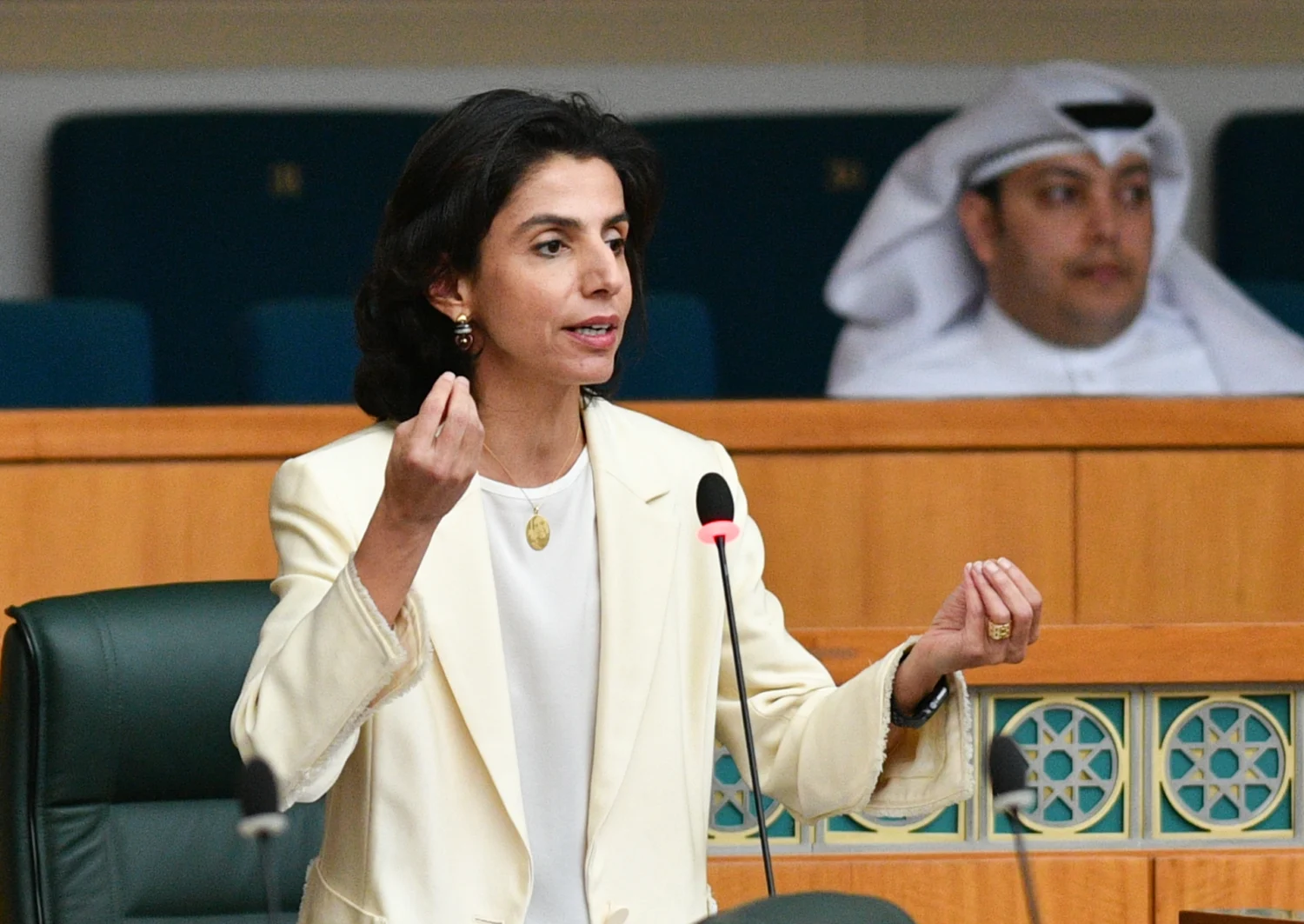
Kuwait MP Alia Al-Khaled attends the Kuwait parliament special session at the National Assembly Hall in Kuwait City, Kuwait, 25 October 2022. EPA/NOUFAL IBRAHIM
Gender quotas have greatly increased the number of women in autocratic legislatures across the Middle East and North Africa, but whether those seats bring real power is a different question. Marwa Shalaby, professor of political science and gender and women’s studies at the University of Wisconsin-Madison, has spent more than a decade trying to answer it using fieldwork and legislative data from three countries. Her research shows that quotas alone are not enough; instead, she points to how well-established a country’s political parties are as an indication of whether women will be able to secure actual influence.
Her book Varieties of Power: Women’s Political Representation in Arab Parliaments compares Morocco, Jordan, and Kuwait — three monarchies whose quota systems and party strength vary. In Morocco, political parties are well established, and most women run for office with their support. But in Jordan (where parties are weak) and Kuwait (where parties are illegal), women run as individuals, which Shalaby argues limits their ability to push for the issues their constituents care most about. Cairo Review contributor Audrey Thibert spoke with Shalaby about why quotas are not a “magic wand” and what really counts for women in office.
Your book is centered around Morocco, Jordan, and Kuwait. Why did you choose these countries in particular?
I chose these three cases because the three countries vary in terms of quota implementation. Morocco has a somewhat strong gender quota implemented by the parties. Jordan has a weak gender quota. And Kuwait has no gender quota. This is the first important variation that I wanted to capture. The second is party strength. Morocco has strong political parties, or relatively strong compared to other MENA countries. Jordan has a very weak party system. In Kuwait, parties are banned.
Also, there is interesting variation when it comes to women’s numerical presence. Morocco has the highest level of female representation, followed by Jordan, and then Kuwait.
So I picked the three countries based on the question that I care about — how does the strength of the party that women are affiliated with affect their ability to substantively represent women? I wanted to better understand the intersection of the quota and the party institutionalization across these different countries. It was very important for me to control for the regime type. Otherwise, I would have a lot of moving parts going on.
In the book, I argue that the political features of monarchical regimes are important for understanding the relationship between parties and women’s substantive representation, because in monarchies, the monarchy is distant from the party system itself. It’s a cleaner way of testing these questions.
For instance, in Algeria or Egypt, the ruling party is affiliated with the head of the state. Therefore, it’s going to be hard to tell whether the variation we’re observing is about the variation in the parties or the variation driven by the relationship with the regime and the state. So focusing on monarchies, where there is a distance between the head of the state and the parties’ actions, gives us a cleaner way of understanding the effect of party institutionalization on performing substantive representation, versus when we introduce another layer of complexity where we also have the autocrat in the picture, and the parties are potentially catering to the desires of the autocrat. So the question becomes more complicated.
Can you explain how institutionalized parties have an impact on women’s role in the legislature?
Think about places like Jordan and Kuwait, where women are running on their own. In Jordan, they mostly run as independents. In Kuwait, they always run as independents because parties are banned. Early on, women lack the support to get in.
Why do parties matter? Because they increase women’s ability to access politics. Parties enable them to connect with grassroots organizations, women’s organizations, and voters. They allow them to mobilize, to have access to resources, and to know more about the demands and priorities of the voters.
So what does that look like in Morocco, with high party institutionalization?
Morocco was where I found the highest level of party institutionalization, and there are women’s branches and local branches.
Parties play a kind of dual function. First, they connect women to voters, and so they know what women actually want—what their priorities and policy demands are so they’re better able to represent them. Second, parties help women focus on the priorities of their communities and their own gender groups so that the women don’t have to worry about catering to the entire electorate for them to get reelected.
When they get in the legislature, they express their own priorities and the things that they actually care about. The starkest pattern in my data is that women in Morocco are way more likely to push for gender-related issues compared with places like Jordan and Kuwait, where you don’t find a pattern. Women are all over the place. They’re basically picking what the constituents want to guarantee reelection and to stay in their positions.
Let’s talk about Jordan, first.
In Jordan, where there is a quota system and weak party systems, women are basically running on their own. They’re not pushing for women’s rights. They’re not pushing for gender reform. They are so concerned about catering to the entire electorate.
This was very clear in my interviews. They were saying, “If I only focus on women’s issues or mostly focus on women’s issues, voters in my district will not vote for me anymore because they’re going to just label me as just for women.”
What about Kuwait?
The story is similar for Kuwait, where women were able to win only one or two seats over the past decade. Women face major challenges to accessing political power with the absence of political parties. The combination of tribal politics and weak popular support has diminished their chances to win seats. Furthermore, the most organized political group in Kuwait’s electoral arena, the Islamists, have never fielded a single female candidate.
And this is detrimental for women when they’re not part of these male-dominated networks. They really have to work so hard and cater to everyone in the electorate to guarantee their vote.
What do you think is often misunderstood about the politics of authoritarianism?
There is this very widely shared idea among scholars, and even among ordinary people in the West, that MENA’s legislatures are useless. That they are not arenas for policymaking. That they are not arenas for real decision-making. That they are just window-dressing institutions that only serve the interests of the autocrat, and are inconsequential.
The more I studied these legislatures, I realized that this is a very simplistic way of thinking about them because there’s so much policymaking and there’s so much agenda-setting happening within these institutions. Yes, they don’t draft the number of bills that you would see in a democracy. They don’t play a strong legislative role, but these institutions play a major monitoring role. They have checks and balances on the executive, on the ministers, and on the government.
One thing that people don’t talk much about, and my upcoming book is on this, is opposition in these legislatures. There are so many oppositional actors in these legislatures that are constantly challenging the regime and pushing for their policy agendas.
These are the main misunderstood areas that I found about the politics of authoritarianism, especially authoritarian legislatures. My book is trying to open this black box of autocratic legislatures and play a small role in unpacking some of these inner dynamics.
[Shalaby’s forthcoming book, under contract with Cambridge University Press, examines opposition in Arab parliaments.]
If quotas alone aren’t enough, are they worth keeping at all?
The message that I was trying to deliver in the book is that I am not against gender quotas. I’m a big supporter of gender quotas.
But when do we say gender quotas are successful? I would say a gender quota is successful if it’s introduced for five to 10 years, and then after this, women are able to get the same seats on their own or get drastically more seats than the reserved seats. But this is not the case in the Middle East right now. Women are not getting seats beyond the gender quota seats.
In Morocco, there has been a gender quota for more than two decades now, and women are still struggling. They get a handful of seats beyond the gender quota each election. The same is true for Jordan, where women won maybe two or three seats beyond quotas. For me, these are not successful quotas.
A successful quota is a quota where women start in the first 10 years with this 10% quota, and then the next 10 years they’re getting like 20% or 30% of the seats on their own because they already built a reputation. Voters are used to seeing them in the electoral arena.
That doesn’t mean that I’m saying we should take away the quotas, because if you take away the quotas, women are not going to get in at all. Quotas on their own are not a magic wand. International organizations and policy practitioners come in and say, “Just throw the quota in, and everything will be fine.” And it’s not a magic solution.
So then what do you hope policymakers, advocates, or journalists covering the region take away from the book?
The important part that is overlooked in autocracies, and in the MENA region in particular, is the link between empowering parties and empowering women.
I’m thinking about sustainable parties structured with strong organizations that are able to support women with a broad support base, local branches, and local outreach. Parties have to be organizationally strong for them to be able to help women.
We really need to think through the link between party institutionalization or party strength and women’s substantive representation and power and influence. And most work on gender ignores this part, even in democracies. They take party strength in democracies for granted, and they don’t really understand variations. What happens when parties are less or more strong?
I think this is the link that I was trying to tease out in the book and say to policymakers, advocates, and journalists—look beyond the surface, look beyond the quotas. How can we increase their influence and power within these legislative bodies? And I wanted to direct their eyes to the parties, and what we can actually do for these parties to help them and promote them so they can actually help women and promote women.
Since the book was published, have any developments in the region surprised you positively or negatively?
I would point to the example of the Moroccan prime minister. Morocco’s king appointed a female prime minister [Fatima Ezzahra El Mansouri], who is a very competent and skilled politician. That was a development that surprised me in a very positive way and made me very hopeful.
It does not mean that it will change these layers of misogyny in society from the top down. Skeptics say the Moroccan government just wants to look good in an international context, to look progressive, and it does not care about women’s rights.
Others say that even if this is the case, it is a good gesture to have women in positions of power, where it can actually help change perceptions and send signals that women are capable and competent and that they can succeed in positions of power. However, we know from previous research that women are actually punished more harshly when they do a poor job compared with men.