Chokepoints: Iran War Threatens Free Flow of Gulf Energy Supplies
With global trade in disarray following disruptions at two vital chokepoints, the Gulf’s energy strategy is under new forms of duress
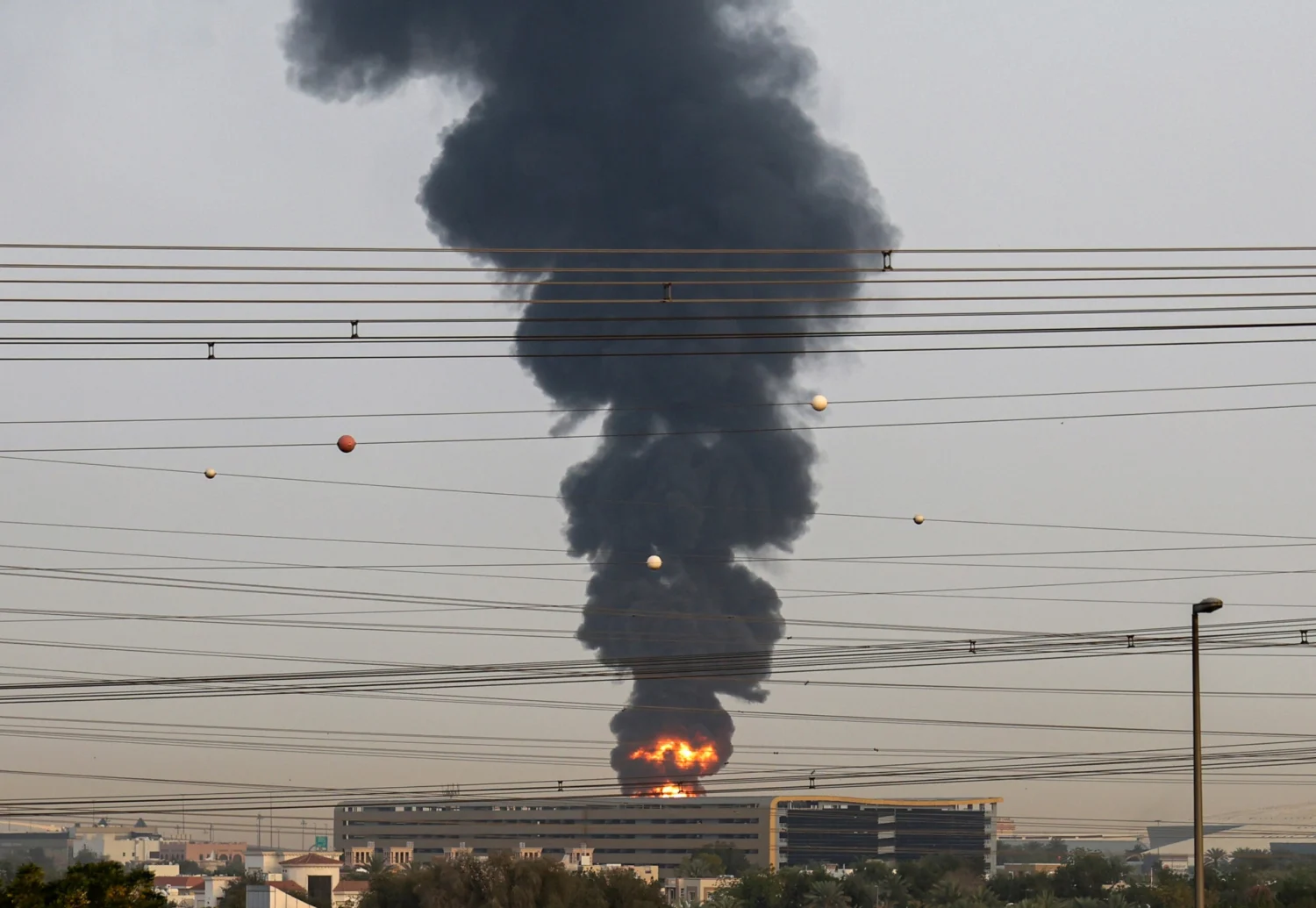
Smoke rises from an area near Dubai International Airport (DXB) in Dubai, United Arab Emirates amid the U.S.-Israel conflict with Iran. March 16, 2026 EPA/STRINGER
The ongoing U.S.-Israeli war on Iran, which broke out in late February 2026, has triggered what the International Energy Agency (IEA) calls the “largest supply chain disruption in the history of the global oil market”. Disruptions at the Strait of Hormuz (which connects the Persian Gulf to the Gulf of Oman) and Bab el-Mandeb (which connects the Red Sea with the Gulf of Aden) have exposed the fragility of global energy networks.
“The coming of the war and the blocking of the two straits reminded us of the importance of geography and also of the importance of Gulf and Gulf energy to global energy markets,” Faris Al-Sulayman, a political economist and co-founder of Haala Energy, said during a webinar on October 20, 2026.
The online discussion, titled From Hormuz to Suez: Energy and Security Reordering, is part of an ongoing series hosted jointly by the Pathways Beyond Neoliberalism at the American University in Cairo (AUC) and the Arab Political Science Network (APSN). AUC instructor and Pathways research manager Ingy Higazi moderated this session, which is part of a webinar series on Political Economy from the Global South.
Al-Sulayman noted that the conflict’s economic fallout was uneven across the Gulf at first. Because Saudi Arabia, the UAE, and Oman had access to Red Sea ports and pipeline infrastructure, they were initially in a net-positive fiscal position. Even though their overall export volumes dropped, soaring global prices more than made up for the difference, successfully cushioning state revenues. However, the subsequent closure of the Bab el-Mandeb, a vital southern narrow passage connecting the Red Sea to the Gulf of Aden, disrupted trade, making the northern exit of the Red Sea the only reliable way for Saudi oil to exit, which, combined with ongoing Houthi strikes on Saudi infrastructure, severely complicated exports.
The link between security and economic survival also shaped how Gulf states approach the green transition amidst ongoing disruptions. In peacetime, under strict Organization of the Petroleum Exporting Countries (OPEC) production quotas, the primary incentive for Gulf states to deploy domestic renewables like solar and wind was to burn less crude oil domestically so they could export those extra barrels abroad instead.
While that direct export incentive is temporarily muted because oil cannot move reliably through blocked routes, the broader developmental logic behind clean energy remains unchanged. Al-Sulayman noted that Gulf leaders increasingly view renewables not merely as an insurance policy, but as a fundamental industrial input required to power future domestic sectors such as green hydrogen, data centers, and advanced manufacturing. Crucially, even though the war has created supply chain disruptions, such as slowing down the ability to import solar panels and wind turbines, largely sourced through international markets like China, construction on major utility-scale projects continues. This resilience proves that the shift toward green energy is a vital factor of their long-term economic diversification strategy rather than a short-term project that a regional conflict can easily derail.
Domestically, these security pressures have led states to crack down on media coverage, Sultan Alamer, a senior resident fellow at the Middle East Policy Council and a postdoctoral fellow at Harvard University, explained, both to eliminate the accuracy of drone attacks and to project normalcy.
To cope with the evolving situation, Gulf states have accelerated regional defense coordination. While Riyadh has already looked to diversify its security ties toward Turkey and Pakistan, Al-Sulayman suggested the crisis will fast-track that shift. At the same time, governments are leaning into regional defense arrangements like the Mecca Joint Defence Agreement and closer military coordination with Egypt, with the Egyptian president recently requesting parliamentary authorization to provide defense assistance to Saudi Arabia. Yet Alamer warned that these regional partnerships fall short of addressing the core structural problem: a technological disparity where traditional strategies are entirely unequipped to handle the cheap, low-cost drone warfare wielded by non-state actors.
This inadequacy has triggered a stark reality check regarding traditional security guarantees. Shifting from economics to international security, Alamer argued that the crisis has forced a stark reality check for the Gulf regarding the reliability of the United States. Because the United States launched the strike on Iran without consulting regional governments and in the face of their explicit reservations and opposition, leaders are scrambling to rethink their security approach. Alamer noted that this unilateral action put previous assumptions under a “huge reality check with regard to the reliability of the United States”, leaving governments caught in a dilemma between seeking formal defense with the United States and strengthening regional alliances.
On the international front, Al-Sulayman addressed expectations surrounding China, arguing that the conflict dispelled any aspiration that China might step into a U.S.-style security role in the region. He noted that China has no interest in assuming any kind of military responsibility, as its involvement remains strictly economic and trade-based rather than as a security guarantor.
However, Al-Sulayman warned that the crisis has dealt the Gulf a heavy reputational blow. Ongoing disruptions have made the region a less attractive place for international investors to base operations and re-export into Europe, and confidence has taken a hit. This economic unease is solidified by the security reality on the ground; as Alamer pointed out, the widespread increase in drone warfare by non-state actors means that major construction projects and investments remain constantly vulnerable to sudden destruction, leaving stakeholders on edge.
Alamer emphasized that economic stability in the Gulf can no longer be unlinked from regional politics or military security. Because drone strikes and non-state actors directly threaten large-scale investments and daily economic life, financial safeguards alone are no longer enough. “Absent of finding a political solution or a security solution to what’s going on, it would make it for a purely economic or investment solution difficult,” Alamer cautioned, noting that leaders must fundamentally rethink how they address both the security dimension and the economic dimension simultaneously.
“The region is filled with non-state actors who now have the means and capacity to launch attacks,” Alamer said.
“That will be a continuous concern for anyone who wants to invest in the Gulf, who wants to build projects.”