
Lines Under the Sea: The Politics of the Middle East’s Data Corridors
The Middle East is using fiber to rebuild the transit economy it once framed around oil and the Suez Canal. Which routes get laid will depend as much on security and sovereignty as on engineering, with the question of Palestine central to the choice
In the space of four months in 2026, competing announcements offered three ways to redraw the Middle East’s digital map. On February 7, Saudi Arabia’s state-controlled STC Group won the concession for SilkLink, an $800-million program to lay 4,500 kilometers of fiber announced an $800 million SilkLink award (1) to build more than 4,500 kilometers of fiber across Syria, alongside data centers and international cable landing facilities at the western coast of Tartus. Nine days later, Emirati and Iraqi investors unveiled plans for WorldLink (2), a $700 million system linking the UAE to Iraq’s Faw Peninsula and then overland to the Turkish border. In June, Türkiye and Saudi Arabia signed a railway cooperation memorandum to revive the Hejaz corridor (3) through Syria and Jordan, a route also envisaged for fiber networks. These are projects at different stages of commitment, not three completed networks. Meanwhile, Lebanese leaders explored including Beirut and Tripoli in the India-Middle East-Europe Economic Corridor (IMEC).
IMEC was announced on September 9, 2023, at a special infrastructure event on the sidelines of the G20 summit in New Delhi (4). Its founding memorandum (5) brought together India, the United States, the European Union, France, Germany, Italy, Saudi Arabia, and the UAE around transport, energy, and digital links. Israel and Jordan were named along the route but were not signatories. This political framework now competes and overlaps with China’s longer-established Belt and Road networks and the new Gulf-backed corridors through Syria and Iraq. The distinction matters: a diplomatic memorandum is not yet a financed cable system.
The engineering problem these projects claim to solve is not new. Cables have crossed Egypt since the nineteenth century, and the Suez crossing has carried most Europe–Asia telecommunications traffic for the whole of the fiber-optic era. What has changed is not the technology but the risk attached to relying on a single route, and the value of what that route now carries.
A Suez for Data
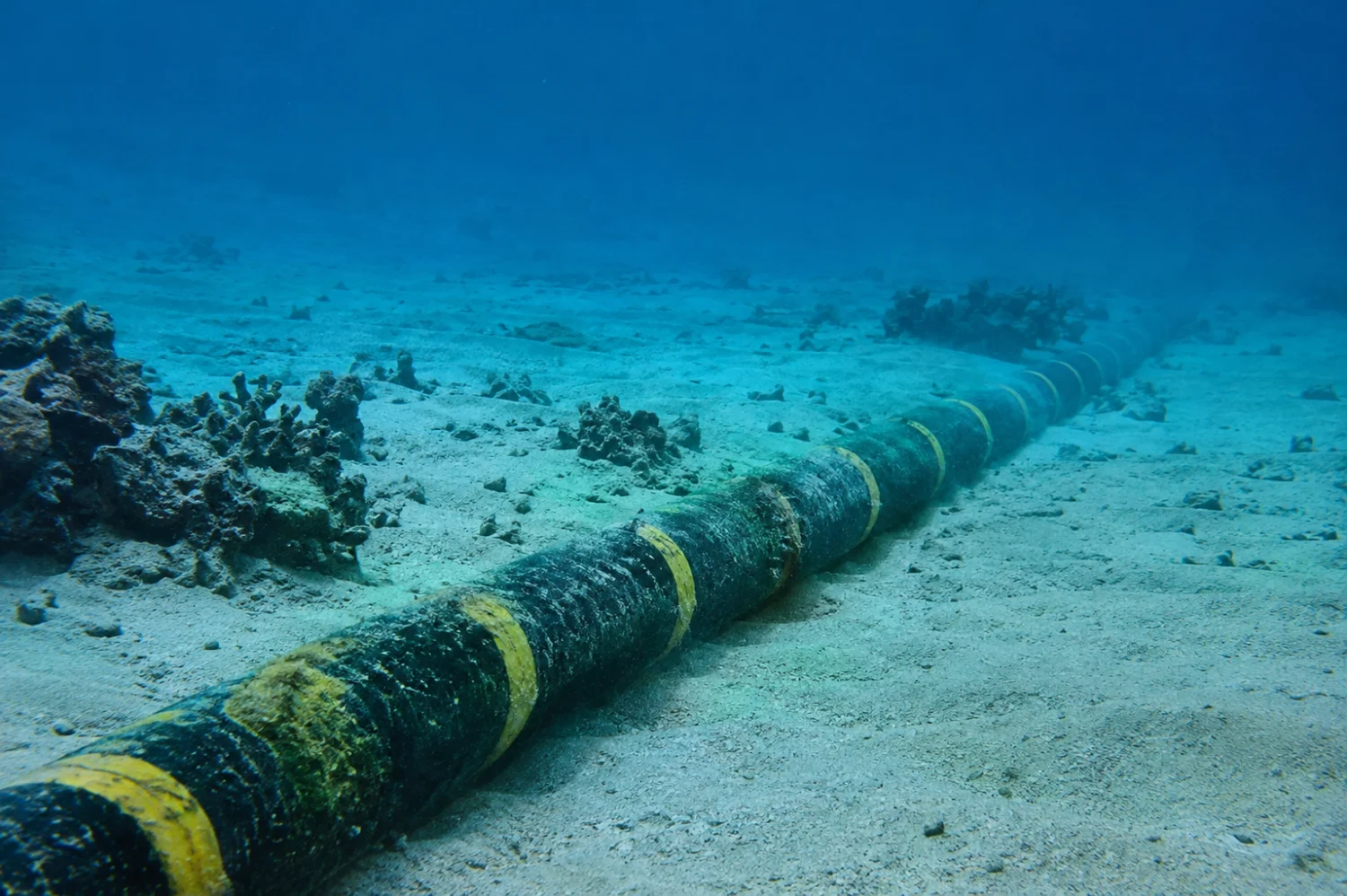
Submarine cables carry almost all intercontinental internet traffic. The concentration is especially striking between Europe and Asia: TeleGeography estimated in 2024 that more than 90 percent of capacity between the two regions used cables in the Red Sea (6). Egypt’s terrestrial crossings connect these systems to the Mediterranean, giving state-controlled Telecom Egypt a powerful position in the network. This is a concentration of routes and capacity, not proof that an identical share of all actual data traffic follows them. The cable inventory shows how extensively both Chinese-backed and Western-backed systems depend on the Egyptian crossing, even as projects such as Blue-Raman seek an alternative (7).
This is a textbook chokepoint, and recent years have shown how fragile it is. In early 2024, damage to several Red Sea cable systems disrupted an estimated 25 percent of traffic through the waterway, according to operator HGC (8). Subsequent analysis linked the damage to the dragging anchor of the Rubymar, a merchant ship abandoned after a Houthi missile attack (9). That is an indirect consequence of attacks on shipping, rather than established evidence of deliberate cable sabotage. Further cuts near Jeddah in September 2025 again disrupted connections, but their cause and responsibility were not established in the initial reporting (10). The Houthi campaign nevertheless compounds the exposure by making the sea less safe for shipping and repair operations. Repairs require specialist vessels and can take weeks; Egypt cannot secure the whole maritime route that feeds its crossings.
At the same time, the Gulf’s gigawatt-scale artificial intelligence campuses have created something new: the prospect that the Middle East will produce and consume intercontinental data, not merely pass it along.
The result is a familiar pattern. The region is rebuilding, in data, the transit economy it once built around hydrocarbons and goods, and with the same three features. There is a dominant node that collects rent—formerly the Suez Canal and the pipeline terminals, now the Egyptian terrestrial crossing. There are challengers trying to build around it—formerly the trans-Arabian and Iraqi pipelines, now SilkLink, WorldLink, and IMEC’s land route. Moreso to the point, the great-power rivalry of the last century between the Atlantic powers and the Soviet Union, has now become between the United States and China; their tug-of-war decides which routes get capital, technology, and political cover.
What is different this time, however, is how openly the choice of route has become a political statement.
Routes as Statements
In a sector where cost per bit and latency — the delay in transmitting data — matter greatly, the current competition makes political constraints unusually visible. A direct Gulf–Mediterranean route through Jordan and Israel was central to the vision behind IMEC, with Haifa as a maritime gateway and telecommunications links alongside the transport corridor. But the war in Gaza and the impasse over Saudi–Israeli prospective normalization have undermined the political bargain needed for that route. The obstacle is not simply the engineering of a cable; it is whether the states along its path would cooperate for decades.
Instead, Saudi Arabia and the UAE are backing longer and costlier routes through Syria and Iraq that can reduce dependence on Israel as well as Egypt. In February 2026, Middle East Eye reported that Riyadh wanted the separate East-to-Med Corridor to reach Greece through Syria rather than Israel (11); this was a reported routing preference, not confirmation of a completed redesign. SilkLink could provide the Syrian infrastructure needed to make such a preference credible. Held 75 percent by STC and 25 percent by the Syrian Sovereign Fund (12), it is therefore both a reconstruction project and a potential component of an alternative regional route. The two projects are distinct, but their strategic logic converges: neither needs to make connectivity conditional on Israel.
The logic here is that of asset specificity. A submarine or terrestrial cable has a design life of about twenty-five years. It cannot be moved, its salvage value is negligible, and its worth depends entirely on the continued goodwill of every jurisdiction it crosses. A consortium choosing a route is therefore not making a reversible commercial decision; it is placing a quarter-century bet on a political configuration. A state that expected normalization would not sink $800 million into an asset premised on its absence. When Crown Prince Mohammed bin Salman publicly called Israel’s conduct in Gaza a genocide, that was not rhetorical decoration on a commercial decision. It was the political premise that made the Syrian investment rational.
If SilkLink succeeds, Saudi Arabia will have achieved the regional infrastructural centrality that normalization was supposed to deliver, without normalizing. Israel’s transit role within IMEC, and with it the corridor’s promise of integrating Israel into the regional economy, would evaporate. A corridor through Haifa is a statement that normalization is expected; a corridor through Tartus is a statement that it is not. Because these assets last decades and cannot be redeployed, such statements are unusually credible, which is precisely why they are being made in fiber rather than in communiqués.
The same logic explains why IMEC’s dedicated cable does not exist. Three years after New Delhi, it has no consortium, no supplier, no financing structure, and no service date. Its digital pillar consists of capacity bought on SEA-ME-WE 6 and Blue Raman, cables built by others for other purposes. Where the political ground is uncertain, private capital does not pick the wrong route. It declines to pick at all.
Israel’s case carries a further irony. Its most promising contribution to the region is not as a freight corridor (Haifa and Ashdod together could handle perhaps three to five million containers a year, nowhere near a Suez substitute) but as a technology partner. Israel has talent, chip design, and a Mediterranean climate where free-air and seawater cooling are viable much of the year; the Gulf has capital, land, and energy. On purely economic grounds, the combination is the strongest available in the region. It remains unavailable, and its unavailability is a direct function of Israeli policy in Palestine, Lebanon, and Syria. No commercial arrangement substitutes for the political condition.
The Compute Shock
If traffic were growing slowly, all this would be a contest over shares of a fixed pie. It is not. Today, roughly 330 terabits per second (Tbps) transit Egypt, against installed corridor capacity of 500 to 600 Tbps. The corridor is not short of capacity. But that comfort is unlikely to last.
The Gulf has announced three to four gigawatts of AI compute by 2028. Stargate UAE (13) is a planned AI computing cluster in Abu Dhabi developed by OpenAI with G42, Oracle, NVIDIA, Cisco, and SoftBank. Its announcement specified one gigawatt of capacity, with an initial 200-megawatt phase expected in 2026. Separately, Microsoft has announced $15.2 billion in UAE spending and investment over 2023–2029 (14).
Meanwhile, Saudi Arabia’s national strategy targets 1.5 gigawatts of data centers by 2030 (15). These investments aim to turn the Gulf into a producer of digital services for customers beyond its borders. Serving those customers requires dependable international links: AI inference – the use of a trained model to answer a request – can be sensitive to delays, particularly for interactive voice and video. A campus in Abu Dhabi can serve half the world’s population within a 2,000-mile radius, but only if the paths to those users are short and reliable. A gigawatt of compute in Riyadh that can reach Europe only through a congested and periodically severed Red Sea is a stranded asset.
The scale of new demand depends on whom Gulf compute ends up serving. If it remains a regional service, incremental Asia–Europe demand by 2030 may be a modest 80 to 120 Tbps. If the Gulf becomes the AI hub for the population within that 2,000-mile radius, the most plausible case, it adds 300 to 500 Tbps, roughly doubling corridor requirements. If it becomes the default inference zone for Asia-Pacific, the figure could reach 700 to 1,000 Tbps, exhausting everything now planned. In the central case, SilkLink, WorldLink, and IMEC stop being rivals for the same traffic and become complementary parts of a system that needs all of them.
Physics may yet slow this down. Gulf summers of 46 to 50 degrees Celsius make liquid cooling mandatory from the first rack, though; counterintuitively, this narrows the region’s disadvantage, since AI hardware needs liquid cooling everywhere. The tighter constraints are electricity and water. The UAE has the region’s only firm clean baseload in the Barakah nuclear plant but a renewable mix of about 5 percent. Saudi Arabia has ample generation but faces two- to four-year lead times on transformers and switchgear, and a grid that is 70 percent gas-fired. The International Energy Agency identifies grid and equipment bottlenecks as material limits on data-center growth (16). Also, projected data center water demand in 2030 is 61 billion liters a year in the UAE and over 75 billion in Saudi Arabia, in countries that desalinate most of their water. Any delay in the compute buildout delays the traffic that justifies the corridors.
Egypt’s Dilemma
The demand question matters most for Egypt. Telecom Egypt’s dominant crossing position has allowed it to charge fees that operators have criticized as high, as documented by Data Center Dynamics (17). Such charges strengthen the commercial case for bypasses, alongside resilience and geopolitical concerns. Egypt’s rent can thus help finance its own competitors. This is the logic of a scarcity rent: prices reflect not only the cost of providing a crossing but also the cost of avoiding it.
Cairo cannot easily change course. Telecom Egypt is state-controlled, and international connectivity brings valuable foreign currency. Digital-corridor revenues are at $0.7–1.3 billion annually, but this is an analytical range, not a separately audited transit-fee total. The Suez Canal offers a clearer warning: official figures (18) show receipts falling from $10.25 billion in 2023 to $3.991 billion in 2024, a decline of 61 percent amid Red Sea disruption. Transit rents can vanish quickly when the transit state does not control the security of the route.
Egypt’s behavior is contradictory. Its pricing is that of a monopolist defending against entry, which accelerates entry. Yet, its investments are those of a node in an expanding network: four new landing stations in Sinai create a second crossing independent of Suez, and the Coral Bridge link to Jordan’s Aqaba, operational since August 2025 (19), quietly makes Egypt the fallback Mediterranean gateway for an IMEC routed through Jordan rather than Israel. Under strong demand growth, bypass corridors add to the system rather than replace Egypt; Egypt would lose share but not volume. A pricing policy designed to deter entry would waste that opportunity. Reconciling the two requires decoupling Telecom Egypt’s transit receipts from immediate treasury needs, which is essentially a public finance reform more than a telecommunications one.
Two Doctrines, One Chokepoint
The strategic competition is often presented as an alternative to China’s infrastructure expansion. The Indian Council of World Affairs, for example, places IMEC in the context of India’s response to the Belt and Road Initiative (20). It is more precisely a contest between two doctrines of infrastructure provision, and they differ less in engineering than in contracting form: how projects are financed, contracted, and governed. That distinction helps explain why a politically attractive corridor may still struggle to become a bankable investment.
China’s Digital Silk Road, with more than $17 billion deployed since 2013, proceeds through bilateral deals: a Chinese policy bank lends, a state carrier anchors the consortium, HMN Technologies (formerly Huawei Marine) supplies the system, and a host government signs. One lender, one supplier, one host, and the transaction closes. The flagship Peace Cable runs from Pakistan’s Gwadar through Djibouti to Egypt and Marseille (21), conspicuously bypassing India. Chinese entities own, built, or upgraded thirteen cables in the Middle East and North Africa. The infrastructure also carries a governance model, as Beijing promotes “cyber sovereignty” and data localization at the International Telecommunication Union (22).
IMEC, by contrast, rests on a single memorandum signed at the 2023 G20 by India, the United States, the European Union, France, Germany, Italy, Saudi Arabia, and the UAE, with Israel as a terminus but not a signatory. It has no secretariat, no treaty basis, and no body empowered to allocate costs among its members. It spreads political legitimacy across eight signatories but offers no mechanism to turn that legitimacy into a financing decision. The two models fail differently: the bilateral one through host-state debt distress and Western sanctions, the multilateral one through non-decision.
Washington has answered Beijing mainly through exclusion. U.S. interagency review blocked HMN from the SEA-ME-WE 6 consortium despite its lowest bid (23), and the practice has since become systematic. Since HMN is one of only four firms in the world that build submarine systems at scale – alongside the American SubCom, France’s Alcatel Submarine Networks, and Japan’s NEC – this is no minor intervention. Yet, the split is far from clean. The India-Europe Xpress, an Indian flagship, is co-owned by China Mobile and built by SubCom. China Unicom remains a member of SEA-ME-WE 6. A Chinese state firm operates Haifa’s newer Bay Port terminal under a twenty-five-year lease, placing Beijing at the Mediterranean end of a corridor designed to exclude it. The network is divided at the level of suppliers and standards while remaining entangled in ownership.
Neither approach eliminates the shared vulnerability. Many Asia–Europe systems still converge on the Red Sea, while connections serving ports and landing stations inside the Gulf face the additional constraint of the Strait of Hormuz. Oman’s Arabian Sea coast and the UAE’s Fujairah offer access outside that strait, although onward routes still require their own security and commercial arrangements.
The Winners of Geography
The clearest lesson from the region is that a well-connected geographic position can be worth more than membership in the diplomatic framework organizing a particular project.
Türkiye was deliberately left out of IMEC over its Belt and Road leanings, its ties to Hamas, and its frictions within NATO. The exclusion backfired. SilkLink, WorldLink, the revived Hejaz corridor, and China’s Middle Corridor through Central Asia all end in or pass through Anatolia. Istanbul’s DE-CIX exchange grew 42 percent in a year, and a planned Turkcell–Sparkle cable from Izmir to Milan would give all eastbound traffic a clean exit to Europe. IMEC is the only proposed corridor that does not cross Türkiye, which is why Ankara stands to gain most from its failure.
Oman demonstrates a different asset: credible neutrality. It maintains relations with Iran, has hosted U.S.–Iranian back-channel talks, stays out of the Emirati–Saudi rivalry, and belongs to neither IMEC nor the Belt and Road, while signing in 2018 a memorandum of understanding on its development (24). As a result, it is the one Gulf jurisdiction that China, the United States, India, Saudi Arabia, and Iran can all accept. Its ports at Duqm, Salalah, and Sohar sit outside Hormuz. It hosts eighteen submarine cables, the most in the Gulf Cooperation Council, a count far out of proportion to its economy. Neutrality, in this market, is a productive asset with a measurable return.
Between these two poles lie the riskiest bets. Iraq’s WorldLink would ride the same right-of-way as the $17 billion Development Road from Faw to the Turkish border, letting goods and data share the cost of security, but it has no named contractor and runs through territory contested between Baghdad and Erbil in Iraq’s northern Kurdish regions. Syria commands the shortest land route from the Gulf to Europe and has made SilkLink its first major post-war investment, yet sanctions remain partly in force, the transitional government is untested, and an eighteen- to twenty-four-month build schedule looks optimistic. The routes sponsored by Riyadh and Abu Dhabi, announced ten days apart and both finally ending in Türkiye, reflect a Gulf rivalry more than a great-power one. Under strong demand, they will both be needed; under weak demand, they are duplicate sunk assets in fragile territories.
This shift carries a bigger change in risk. A new class of land corridors is turning Saudi Arabia, Iraq, Jordan, and Syria into the region’s next chokepoints. Maritime chokepoints can be addressed with naval escorts and insurance; territorial ones depend only on the political stability of the host. The financial instruments to price that risk do not yet exist.
Three Futures
Looking to 2030, three configurations seem internally consistent. In the first, a Gulf duopoly, SilkLink and WorldLink are both completed, Israel is bypassed, Türkiye becomes the main European exit for Gulf data, and IMEC survives only through maritime and digital links between India and the UAE. In the second there is fragmentation, every corridor is partially built and none fully operational: SilkLink is slowed by Syrian fragility, WorldLink by Iraqi insecurity, IMEC by Israeli–Iranian escalation. The Red Sea and Egyptian route stays dominant for longer than expected, and Türkiye profits from every failure. I judge these two equally likely, at roughly 40 percent each.
The striking point is that they differ only in execution, and that execution depends on governance and security in Syria and Iraq, the two weakest states in the picture, rather than on any decision in Riyadh, Abu Dhabi, Washington, or Beijing.
The third future, which I put at around 20 percent probability, is an IMEC revival through Lebanon. On February 25, 2026, President Joseph Aoun formally requested the inclusion of Beirut and Tripoli in the corridor (25), with French mediation. If a ceasefire in Gaza holds and Israel withdraws from southern Lebanon, a Lebanese variant would give IMEC a Mediterranean exit that does not depend on Saudi–Israeli normalization, with Haifa becoming one node among several rather than the hinge. Its low probability reflects the fragility of that precondition, not a flaw in the design.
What Should Be Done
For Egypt, the main error to avoid is treating the competition as zero-sum. Sinai diversification and the Jordan connection should be accompanied by competitive transit terms and efforts to attract data processing, so that Egypt earns income from digital production as well as passage.
For Iraq and Syria, the constraint is not capital but the credibility of the security guarantee behind a sunk asset. Sovereign guarantees, political risk insurance, and milestone-based financing are the obvious tools. Their absence from the announced structures is the most telling sign of how seriously to take both projects.
For Oman, and any state that can credibly claim neutrality, the task is to invest in that credibility through carrier-neutral facilities, sovereign cloud accreditation, and non-exclusive landing regimes, rather than trading it away for alignment. Its value will rise with great-power rivalry, until the point at which the great powers demand exclusivity. The systematic exclusion of Chinese suppliers suggests that point is approaching.
For IMEC’s sponsors, the problem is one of design, not money. A corridor with eight signatories and no secretariat cannot contract with a consortium because it has no counterparty. The minimum remedy is a permanent coordinating body with budgetary authority. Beyond that, the Lebanese variant and an Omani auxiliary node at Duqm or Salalah are cheap improvements that reduce IMEC’s dependence on conditions no signatory can deliver. A corridor whose critical path runs through the most intractable question in the region, the Israeli–Palestinian conflict, should be redesigned so that it does not.
For investors, interconnection assets at unavoidable points, in Istanbul and at the Egyptian crossing, are the only positions that pay under every scenario. And power, water, and cooling are more likely than any political variable to determine whether the compute buildout that justifies the corridors arrives on time.
Fiber and Sovereignty
The data corridors between Asia, the Middle East, and Europe are becoming the physical foundation of the AI economy, and the existing cable base will not carry what that economy is likely to demand. But the decisive variables are not technical. Security and sovereignty, rather than capacity, cost, or latency, will determine which corridors get built and when. That is unusual in an infrastructure sector where unit economics normally rule.
For the Arab world, this cuts both ways. Geography is once again a source of income and leverage, as it was in the age of canals and pipelines. It is also, once again, a source of exposure that host states cannot hedge alone. The states that fare best will be those that combine an unavoidable position with credible neutrality and institutions that can guarantee a twenty-five-year commitment. Those that treat their position as a monopoly to be defended, or as a token of alignment to be traded, risk discovering, as the Suez Canal did in 2024, how quickly a transit rent can disappear.
Above all, the fiber map has become a map of political positions. Each kilometer laid through Tartus rather than Haifa records a judgment about the future of Palestine. Until that question is addressed, the region’s most efficient routes and most promising partnerships will remain on paper, and capital will keep flowing to the longer way around.
Note: This article draws on Aita’s working paper Contested Corridors: Submarine Cables, Terrestrial Fiber and the Political Economy of Asia to Europe Data Flows through the Middle East (July 2026), produced in collaboration with the Arab Forum for Alternatives under the EU-funded TRACHMED research mobility project (26).


