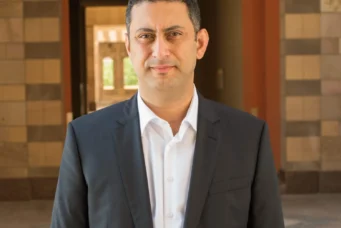
The Case for Soft Power and the Enterprise Fund Model—with James Harmon & Cornelius Queen: CR Amplified ep. 10
What’s a better geopolitical strategy—force, or finance? James Harmon and Cornelius Queen join CR Amplified to discuss how business can be an alternative to hard power for Washington.

Abigail Flynn: Hello and welcome to CR Amplified, The Cairo Review’s podcast where we talk to experts and policymakers about relevant issues on the world stage.
I’m Abigail Flynn.
Our Summer 2026 issue, titled Power Plays, explores how major powers are making major moves across the international geopolitical landscape and how small and middle powers are reacting.
The role of hard power has come to the forefront with the recent US-Israel war on Iran. But the US has faced significant challenges in achieving its strategic goals through military force. That raises the question: is pursuing soft power the wiser choice for US foreign policy?
Today, we’ll be speaking with the authors of A Daring Enterprise: A US-Egyptian Partnership and the Case for Soft Power, authors James Harmon and Cornelius Queen.
The book details the story of the Egyptian-American Enterprise Fund, a private investment fund that Mr. Harmon was tasked with starting in Egypt by then-Secretary of State Hillary Clinton back in 2011.
The fund aims to bolster Egypt’s economy and improve quality of life for Egyptians by supporting the private sector. Since 2015, the fund has made 148 investments in Egypt, attracted $1.7 billion in foreign capital, and supported 58,000 jobs through its investment portfolio.
The program has seen great success within Egypt, but can it be replicated elsewhere? And does China — Egypt’s other major investment partner — present a threat to US soft power in the country today?
Today, I’m happy to be joined by Mr. James Harmon and Mr. Cornelius Queen to discuss more.
Hello and thank you for joining me. Before we begin, could you please take a moment to introduce yourselves?
Cornelius Queen: For introductions, I’m Cornelius Queen. I’m the Senior Vice President at the Egyptian-American Enterprise Fund. And Jim…
James Harmon: I’m the Chairman and Chief Executive Officer of the Enterprise Fund.
A.F: Thank you, and thank you again for joining us.
For our first question, I would like to note that our listeners are generally in politics, not finance.
So could you explain to us, in simple terms, what the Egyptian-American Enterprise Fund actually is?
C.Q: The Enterprise Fund is a private investment fund authorized by the United States Congress to help support private sector development in Egypt. It’s essentially a private equity-type vehicle that takes equity stakes in Egyptian businesses to help them grow, create jobs, and attract foreign capital to Egypt.
The mission of the Enterprise Fund is to stimulate private sector development in Egypt so that the private sector can become the leading engine of growth for Egypt’s economy.
The Enterprise Fund concept goes back to the early 1990s. It was born out of the first George H.W. Bush administration as an initiative to support private sector development during the transition to democracy in former Soviet Union countries.
A.F: Thank you for that very clear answer.
Now, could you tell me a little bit more about why you chose to write a book about the fund, starting with experiences of Mr. Harmon when he entered the country in 2011, and then looking further at how you developed the fund over the next 15 years?
J.H: This book that we’ve written, one of the reasons we wrote this book was to explain to other governments the success we’ve had with the Egyptian-American Enterprise Fund — why we do it and what was it that caused us to achieve such success with the enterprise fund.
But we also wrote it for the American public because our key conclusion is that we wanted the enterprise fund model could be a very important part of our foreign policy. We could help a lot of other countries, not just Egypt.
What’s interesting is that the President, in his new budget proposals, has asked Congress for additional funding to create a number of new enterprise funds.
A.F: It will be interesting to see how those potential new funds play out.
Stepping back in time a little bit, can you share how you received the mandate to start this fund during the revolution from then-Secretary of State Hillary Clinton?
J.H: I had served in the Clinton administration as Chairman of the Export-Import Bank. So when she first spoke to me in 2011, I had to think about it before deciding to take the assignment.
The early challenges, I must say neither I nor the young assistants I took with me — a woman from the State Department and fortunately one of my assistants from my private sector fund who was Egyptian and knew the language and country well — were aware of how unhappy the population was. The violence in the square when we arrived was a surprise, but it wasn’t directed against the United States or against us; it was really against life in Egypt and the difficulties they were having.
On our very first trip, I chose to meet with the Muslim Brotherhood. That was controversial, and the American government didn’t understand why I chose to do that. I wanted to hear their point of view, just as I wanted to hear every point of view.
On the way there, we were trapped in the violence and our car got stuck. People were burning cars, and there was a degree of violence that I had not fully anticipated.
A.F: It’s clear that you entered Egypt in 2011 facing a monumental task.
But now can you tell me more about the obstacles you faced from the US side, particularly regarding the debates between Democrats and Republicans about how to approach Egypt?
J.H: Well, I came back from that first trip and told Hillary that I would accept the role. But Hillary and Bill Clinton, whom I was close to through the administration, were clearly Democrats.
On the other side, we had Republicans who felt differently but also believed they understood Egypt.
[Senator] Lindsey Graham was one of them; he had been to Egypt and felt he understood the situation.
So we had two sides of the American political spectrum interested in Egypt, but with very different points of view.
A.F: In the book, you discuss a meeting you had with Senator Lindsey Graham after he put a hold on congressional funding for the project as a signal to President Obama that he was unhappy with the administration’s approach to the Middle East.
Can you tell us more about how that conversation went?
J.H: Lindsey Graham felt that I hadn’t gone through his party or spoken to him about what we were going to do in Egypt, why we were doing it, and how we planned to go about it. He had strong points of view because he had just returned from Egypt.
I met with him in his office, and he was yelling and screaming at me for not giving him an opportunity to advise us on the trip or on what I planned to do. I tried to explain to him quietly that I had every indication of coming back and reporting to Congress.
I wasn’t a political person; even though I had served under President Clinton, I wasn’t politically motivated in this role. I was simply trying to keep the US Congress informed about what we saw in Egypt and how we could help.
He raised his voice in a very dramatic way, yelling and screaming. I remember, on a humorous note, leaving his office and his assistant walked me to the elevator bank and said, “I think that was a good meeting.”
I said, “Were you in the same meeting I was?” and told her how I felt about what he had said.
I didn’t think that as being very effective communication, but that is not unusual in Washington politics. People feel very strongly. Lindsey Graham was one of them, and he expressed himself in no uncertain terms—not so much against me, but against Obama.
He was angry at the President and took his anger out on me because I was meeting with him.
C.Q: I would just add, Jim, that after 2011, Egypt was in a very fluid political operating environment as it went through its transition after the fall of Mubarak.
That translated into challenges in our own US foreign policy regarding how to respond to Egypt’s transition.
There were disagreements between Republicans and Democrats, with the Obama administration in power and members of Congress like Senators Lindsey Graham and John McCain having their own disagreements with US-Egypt policy.
Unfortunately, we were a casualty of those when certain members of Congress, like Senator Lindsey Graham, put a hold on our funding. When a hold is placed on funding in the US Congress, no money comes from the government to a program like the Egyptian-American Enterprise Fund.
So we had been tasked with helping rebuild the private sector, but our own government was holding the money hostage to make a point against President Obama’s policy in opposition to his policy in Egypt. You can imagine how difficult it is to build a business when you don’t have funding.
Those were some of the early challenges from 2011 to 2013, when there was inconsistency in how much funding we received and when we would receive it.
In 2013, Lindsey Graham lifted his hold, and we received our first tranche of funding. Those early years were difficult because we were operating in a fluid environment in Egypt, and members of Congress and their staff had concerns about deploying US capital in that context, that was very fluid, and they wanted to see results and a proof of concept before releasing all the money at once.
So we ran into funding challenges early on, but eventually we received the full $300 million. I think we were able to responsibly deploy that into several good investments that generated significant returns for the taxpayer. And now, we have bipartisan support across Congress based on our strong track record in Egypt, where we’ve helped double the US government’s money.
A.F: It’s clear that the fund faced many challenges in its early years.
But since then, however, it seems to have made incredible progress in Egypt, which the book attributes to your decision to support local Egyptian managers rather than importing American managers.
Can you tell me more about how you made that decision?
J.H: The most important decision I made during my first and second trips to Egypt was that I could not put Americans on the ground in Egypt in that environment.
That decision was critical to everything we did. I realized quickly that there was a lot of talent in Egypt, capable of people fully investing.
Early on, I had a meeting with my two assistants. We had a list of candidates to lead the fund, and I turned to my Egyptian assistant, Ola, and asked her who the most successful investor in Egypt was at the time.
That was my natural instinct as an investor: to find the Warren Buffett, the brilliant investor in Egypt.
She named Nassif Sawiris and suggested we see him. She called him right while we were sitting there and asked, “Would you see us?”
We got on a plane the next morning, flew to London, and met with him. He looked at the list and said, “Good people, but none of them can run what you want to run. I know who can do it: my banker, Ashraf Zaki.”
I was very grateful, and I called Ashraf from London and asked him to come to New York. He came the following week, and I met with him over a series of meetings across a couple of days. At the beginning, he said to me, “I don’t want to work for the United States.”
I remember feeling somewhat discouraged, thinking that after finding the person who could help us identify investments to deploy the $300 million, he was telling me he wouldn’t work for the United States.
That’s when I made a fortunate decision. I said, “Ashraf, how about we work for you?” He looked at me and asked, “What does that mean?” I said, “We’ll finance what you want to do. You create your own fund, we’ll provide you with up to $300 million, and we will follow your recommendations.”
When he accepted, we agreed to talk regularly. Initially, I spoke with him every Sunday—which, of course, was Monday in Egypt. Every Sunday, we had a five- or six-hour call and went through everything he was looking at and how he planned to do it. This was around 2015 or 2016, or earlier.
He came up with some very good ideas, and he was the one who introduced me to Fawry.
The decision to invest in Fawry resulted in probably our most successful investment…
C.Q: …which I’m sure your listeners are familiar with. It’s the largest electronic payments platform in Egypt, extending digital payment services to 55 million Egyptians — half the population — in a country where many do not have access to a bank account.
It was an important decision we made early on to invest in growing companies with platforms that could reach millions as part of our strategy to expand financial inclusion and access to financial services in Egypt.
Given Fawry’s popularity, the uptick in Egyptians using digital payments, government support for financial inclusion in the fintech space, and Fawry’s excellent leadership, the company has grown exponentially.
We invested a little over $20 million in the company in 2015 and have generated almost $100 million in proceeds — five times our investment — while still holding a relatively significant stake in the company.
So, it has been enormously profitable on a financial basis, but also impactful on a developmental basis by extending digital financial services to Egyptians.
A.F: Stepping back to a wider view, can you describe some of the general impacts that the fund has had on Egypt?
C.Q: Just to put things into perspective, we’ve been investing in Egypt for a little over a decade. We’ve supported seven first-time fund managers who have helped us invest in a little over 150 companies.
Today, our investment portfolio supports close to 70,000 Egyptian jobs.
On a financial basis, we’ve taken the $300 million from Congress and almost doubled it — the current estimated market value of our assets exceeds $500 million compared to $300 million in congressional funding.
I would add that these returns have come despite severe political instability and economic crises. The Egyptian currency has lost 80% of its value against the dollar over the last year, yet we’ve been able to generate dollar returns despite that significant devaluation.
Our message in the book is that if you can do this in Egypt, you can replicate the model in other countries to advance US foreign policy interests while supporting locally led private sector development — which, as we’ve shown in Egypt, helps create jobs and improve quality of life for the population.
At a moment when we are seeing the limits of US military power across the Middle East, the US really needs a new playbook. And we think enterprise funds meet the moment: they support private sector development by creating partnerships between the United States and local citizens around shared economic interests, while also generating returns for taxpayers when managed well as seen in our case.
A.F: This idea of exporting the fund model and relying on soft power instead of hard power seems to be a key message the book is sharing with the public.
J.H: The reason for writing the book to tell this story is not simply because of my fondness and friendship with Ashraf Zaki — which continues to this day — or any particular story, including Fawry.
It is because we believe the enterprise fund model can be used in a number of other countries, whether we do it or other countries do it. Bringing people in to be investors in an enterprise fund and helping create new businesses may be the most important part of our legacy.
The success of the Egyptian-American Enterprise Fund is greater than almost any other initiative of this kind by the United States.
We think that it will change our own foreign policy. So that we will be more focused on investing not in the military sense — no threatening countries, not putting military into a country — but in fact by economic development helping to create jobs helping to create better lives.
It’s not just Egypt, it could be done in a lot of frontier and developing countries throughout the world.
A.F: Thank you.
Now, The Cairo Review is a regional political journal, so I’m going to ask a bit more of a political question.
One aspect that really intrigued me was in the final chapter, which framed the discussion around China and how enterprise funds can be used to counter Chinese influence.
If you don’t mind, I’ll read a passage from Chapter 9, and then I have a question:
“The opportunities for the United States to project American values and the American way of doing business to counter the challenge of China via the now-proven enterprise fund concept are numerous. The US emphasis on sustainable development and building relationships — as opposed to China’s extractive lending practices and transactional approach to foreign aid — could not present a greater contrast.”
My question here is: many in Egypt view China as a lucrative investment partner.
China is consistent in its funding, willing to engage in mega infrastructure projects, and does not attach many of the structural requirements that Western programs like the IMF impose regarding governance and transparency.
At the moment, Egypt appears to be pursuing investment opportunities from both the United States and China simultaneously.
Given that, how do you think the Enterprise Fund and other US investments are challenging — or perhaps being challenged by — China?
C.Q: From my perspective, we are modeling a different way of doing business — the American way of doing business.
We project American values through our efforts to support the private sector in Egypt through a private equity and venture capital lens. We don’t see many investors in that specific space in Egypt.
As you rightly noted, China is a growing investor in Egypt, primarily in the Suez Canal Economic Zone, investing heavily in infrastructure projects as part of its foreign policy and Belt and Road Initiative to expand influence across the developing world.
And so with that there have been concerns and news reports over the years regarding China’s predatory lending practices and coercive economic development models, not necessarily debt-trap diplomacy concerns where assets could be seized if loans aren’t repaid.
But I do think it presents a stark contrast to what we are doing with the Egyptian-American Enterprise Fund. We are empowering locally led private sector development rather than placing Americans on the ground to run companies.
Everything is Egyptian-led. I think we’ve read that in some cases where China builds infrastructure it brings its own workforce rather than rely on local talent, we rely on and empower local actors.
Those actors will continue investing in Egypt long after we leave, and the relationships we help build with local investment partners will strengthen long-term the relationship ultimately between the United States and Egypt.
So It’s a different model of economic development that we think is an interesting alternative to a more state-led Chinese model that can sometimes feel a little more transactional.
A.F: I’d like to end by asking why you think it’s so important to have a well-developed soft power approach like enterprise funds, rather than relying on hard power.
J.H: Looking back at history, my early years were during World War II when the world was engaged in a violent conflict, followed later by the Korean and Vietnam Wars.
Gradually since then, we have seen economic conflicts and strategic challenges—with Russia, for example.
Now, I think we are a little bit more cautious with not getting in a disagreement with China if we can.
If together we can lead this world — we have developed a model that can be successful in most countries we go into.
Although the book focuses on what the US has done in Egypt and how this model could be used in much of Africa and much in the frontier developing world, it also does mention the difference between this approach and the Chinese approach.
In an era of hydrogen bombs and other frightening war weapons, no one wants to have war.
We look for ways that help meet the challenges of the United States and other countries, and to do it in a civilized and structured way. We think the model that the enterprise fund model we implemented in Egypt is a framework that can be used.
A.F: I think that is an excellent point to end on.
Thank you both so much for taking time out of your busy schedules to speak with The Cairo Review.
The book was a pleasure to read, extremely well written, and I highly recommend it to our audience. I hope we see positive movement from the US side in terms of funding future programs as readers in the US get their hands on it.
J.H: Thank you, Abigail.
C.Q: Yes, thank you, Abigail.
A.F: And thanks to you, the listener. We hope you enjoyed this episode of CR Amplified.